



 Chat with AI
Exam 22: Protein Synthesis, Posttranslational Modification, and Transport

Exam 1: Principles of Biochemistry100 Questions
Exam 2: Physical Biochemistry: Energy Conversion, Water, and Membranes100 Questions
Exam 3: Nucleic Acid Structure and Function100 Questions
Exam 4: Protein Structure100 Questions
Exam 5: Methods in Protein Biochemistry100 Questions
Exam 6: Protein Function114 Questions
Exam 7: Enzyme Mechanisms106 Questions
Exam 8: Cell Signaling Systems102 Questions
Exam 9: Glycolysis: a Paradigm of Metabolic Regulation100 Questions
Exam 10: The Citrate Cycle100 Questions
Exam 11: Oxidative Phosphorylation99 Questions
Exam 12: Photosynthesis100 Questions
Exam 13: Carbohydrate Structure and Function100 Questions
Exam 14: Carbohydrate Metabolism100 Questions
Exam 15: Lipid Structure and Function100 Questions
Exam 16: Lipid Metabolism100 Questions
Exam 17: Amino Acid Metabolism100 Questions
Exam 18: Nucleotide Metabolism99 Questions
Exam 19: Metabolic Integration101 Questions
Exam 20: DNA Replication, Repair, and Recombination99 Questions
Exam 21: RNA Synthesis, Processing, and Gene Silencing100 Questions
Exam 22: Protein Synthesis, Posttranslational Modification, and Transport100 Questions
Exam 23: Gene Regulation100 Questions
Select questions type


Does the figure below represent a prokaryotic or eukaryotic translation system? Describe the clues used to form a decision.
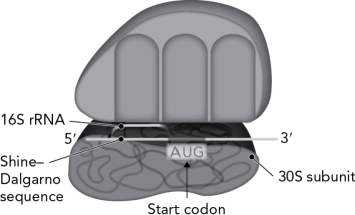
(Essay)
4.9/5  (70)
(70) Prokaryotic mRNA will directly interact with __________ during translation.
(Multiple Choice)
4.8/5 (86)
(86) After the initiation complex is complete, what occurs next in the process of translation?
(Multiple Choice)
4.8/5 (74)
(74) Noncanonical base pairings are observed between the third position of the codons and the first position of the anticodons. This concept is known as the
(Multiple Choice)
4.8/5 (73)
(73) The antibiotics streptomycin, tetracycline, and chloramphenicol all interfere with
(Multiple Choice)
4.8/5 (73)
(73) Which of the following sequences is most likely a nuclear localization signal?
(Multiple Choice)
4.7/5 (82)
(82) A protein is targeted to the plasma membrane. Its final functional location is as a subunit of a transmembrane protein that interacts with the central subdomain of the membrane. Analysis of this protein would most likely show modification with a
(Multiple Choice)
4.8/5 (69)
(69) All glycoproteins have __________ covalently added posttranslationally.
(Multiple Choice)
4.9/5 (75)
(75) Different tRNAs for the same amino acid that bind alternate codons are known as tRNAs.
(Multiple Choice)
4.8/5 (73)
(73) Both prokaryotes and eukaryotes recognize __________ as a start codon.
(Multiple Choice)
4.8/5 (79)
(79) An experiment with bacteria that has been exposed to an antibiotic reveals that the translocation step has been inhibited. Which antibiotic was likely used?
(Multiple Choice)
4.8/5 (86)
(86) In yeast, the number of tRNA genes is __________ the number of _.
(Multiple Choice)
4.8/5 (93)
(93) Contrast both the structure and function of a prokaryotic initiator tRNA with a prokaryotic Met-tRNAMet.
(Essay)
4.8/5 (68)
(68) A newly discovered protein is found to be modified by a lipid. Where is this protein most likely located?
(Multiple Choice)
4.9/5 (85)
(85) The tRNA 3 ' 5 ' anticodon loop that recognizes the 5 ' 3 ' codon UCC could have the sequence
(Multiple Choice)
4.9/5 (82)
(82) Relate the importance of the binding of Ran to importin to its role in nuclear import.
(Essay)
4.8/5 (88)
(88) Which sequence is MOST likely to be prenylated in the ER? (The … represents additional amino acids N-terminal to those shown.)
(Multiple Choice)
4.9/5 (78)
(78) Which molecule contains both an amino acid acceptor stem and an anticodon?
(Multiple Choice)
4.7/5 (88)
(88) 
Filters
- Essay(0)
- Multiple Choice(0)
- Short Answer(0)
- True False(0)
- Matching(0)