



 Chat with AI
Exam 1: Economics: the Core Issues

Exam 1: Economics: the Core Issues152 Questions
Exam 2: The Useconomy: a Global View146 Questions
Exam 3: Supply and Demand164 Questions
Exam 4: The Role of Government153 Questions
Exam 5: National Income Accounting152 Questions
Exam 6: Unemployment147 Questions
Exam 7: Inflation152 Questions
Exam 8: The Business Cycle153 Questions
Exam 9: Aggregate Demand149 Questions
Exam 10: Self-Adjustment or Instability140 Questions
Exam 11: Fiscal Policy151 Questions
Exam 12: Deficits and Debt151 Questions
Exam 13: Money and Banks146 Questions
Exam 14: The Federal Reserve System146 Questions
Exam 15: Monetary Policy149 Questions
Exam 16: Supply-Side Policy: Short-Run Options147 Questions
Exam 17: Growth and Productivity: Long-Run Possibilities143 Questions
Exam 18: Theory Versus Reality146 Questions
Exam 19: Consumer Choice136 Questions
Exam 20: Elasticity141 Questions
Exam 21: The Costs of Production151 Questions
Exam 22: The Competitive Firm148 Questions
Exam 23: Competitive Markets150 Questions
Exam 24: Monopoly147 Questions
Exam 25: Oligopoly145 Questions
Exam 26: Monopolistic Competition144 Questions
Exam 27: Natural Monopolies: Deregulation144 Questions
Exam 28: Environmental Protection144 Questions
Exam 29: The Farm Problem132 Questions
Exam 30: The Labor Market137 Questions
Exam 31: Labor Unions144 Questions
Exam 32: Financial Markets146 Questions
Exam 33: Taxes: Equity Versus Efficiency146 Questions
Exam 34: Transfer Payments: Welfare and Social Security146 Questions
Exam 35: International Trade149 Questions
Exam 36: International Finance142 Questions
Exam 37: Global Poverty141 Questions
Select questions type


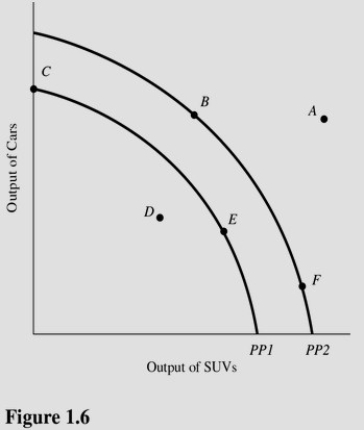 In Figure 1.6,if the opportunity cost of producing cars was zero at all levels of production,the production possibilities curve would be best be represented by a
 (Multiple Choice)
4.9/5  (72)
(72) Producing at a point inside the production possibilities curve
(Multiple Choice)
4.8/5 (71)
(71) Table 1.3 shows the hypothetical trade-off between different combinations of brushes and combs that might be produced in a year with the limited capacity for Country X,ceteris paribus. Table 1.3
Production Possibilities for Brushes and Combs
Combination Number of combs Opportunity Cost(Foregone brushes) Number of brushes Opportunity Cost (Foregone combs) 4 0 NA 3 10 2 17 1 21 0 NA 23 On the basis of Table 1.3,the lowest opportunity cost for combs in terms of brushes is
(Multiple Choice)
4.8/5 (87)
(87) How does the market mechanism answer the WHAT,HOW,and FOR WHOM questions?
(Essay)
5.0/5 (87)
(87) Explain why an economist would say,"There is no such thing as a free lunch."
(Essay)
4.7/5 (80)
(80) 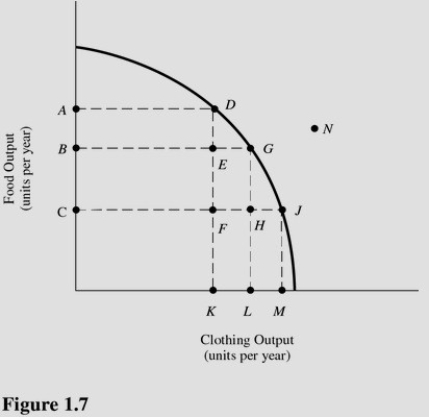 Refer to Figure 1.7.The cost of producing at point D rather than point J is
 (Multiple Choice)
4.8/5 (92)
(92) According to the text,there is no such thing as a free lunch because
(Multiple Choice)
4.8/5 (89)
(89) If market signals result in pollution beyond the optimal level,then
(Multiple Choice)
4.9/5 (86)
(86) Table 1.3 shows the hypothetical trade-off between different combinations of brushes and combs that might be produced in a year with the limited capacity for Country X,ceteris paribus. Table 1.3
Production Possibilities for Brushes and Combs
Combination Number of combs Opportunity Cost(Foregone brushes) Number of brushes Opportunity Cost (Foregone combs) 4 0 NA 3 10 2 17 1 21 0 NA 23 On the basis of Table 1.3,in the production range of 2 to 3 combs the opportunity cost of producing 1 more comb in terms of brushes is
(Multiple Choice)
4.8/5 (69)
(69) Which of the following is an example of government failure?
(Multiple Choice)
4.9/5 (79)
(79) Table 1.2 shows the hypothetical trade-off between different combinations of Stealth bombers and B-1 bombers that might be produced in a year with the limited U.S.capacity,ceteris paribus. Table 1.2
Production Possibilities for Bombers
Combination Number of B- 1 Bombers Opportunity cost(Foregone Stealth) Number of Stealth Bombers Opportunity cost (Foregone B-1) A 20 NA 195 B 35 180 C 45 150 D 50 100 NA Refer to Table 1.2.In the production range of 20 to 35 B-1 bombers,the opportunity cost of producing 1 more B-1 bomber is
(Multiple Choice)
4.8/5 (86)
(86) Which of the following has occurred when government directives do not produce better economic outcomes?
(Multiple Choice)
4.9/5 (77)
(77) With respect to factors of production,which of the following statements is not true?
(Multiple Choice)
4.8/5 (62)
(62) 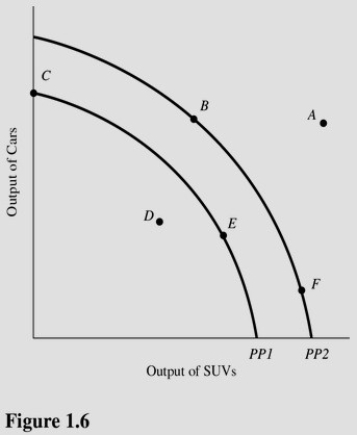 In Figure 1.6,at which of the following points would the opportunity cost of producing one more SUV be highest?
 (Multiple Choice)
4.7/5 (93)
(93) 
Filters
- Essay(0)
- Multiple Choice(0)
- Short Answer(0)
- True False(0)
- Matching(0)