



 Chat with AI
Exam 1: Economics: the Core Issues

Exam 1: Economics: the Core Issues152 Questions
Exam 2: The Useconomy: a Global View146 Questions
Exam 3: Supply and Demand164 Questions
Exam 4: The Role of Government153 Questions
Exam 5: National Income Accounting152 Questions
Exam 6: Unemployment147 Questions
Exam 7: Inflation152 Questions
Exam 8: The Business Cycle153 Questions
Exam 9: Aggregate Demand149 Questions
Exam 10: Self-Adjustment or Instability140 Questions
Exam 11: Fiscal Policy151 Questions
Exam 12: Deficits and Debt151 Questions
Exam 13: Money and Banks146 Questions
Exam 14: The Federal Reserve System146 Questions
Exam 15: Monetary Policy149 Questions
Exam 16: Supply-Side Policy: Short-Run Options147 Questions
Exam 17: Growth and Productivity: Long-Run Possibilities143 Questions
Exam 18: Theory Versus Reality146 Questions
Exam 19: Consumer Choice136 Questions
Exam 20: Elasticity141 Questions
Exam 21: The Costs of Production151 Questions
Exam 22: The Competitive Firm148 Questions
Exam 23: Competitive Markets150 Questions
Exam 24: Monopoly147 Questions
Exam 25: Oligopoly145 Questions
Exam 26: Monopolistic Competition144 Questions
Exam 27: Natural Monopolies: Deregulation144 Questions
Exam 28: Environmental Protection144 Questions
Exam 29: The Farm Problem132 Questions
Exam 30: The Labor Market137 Questions
Exam 31: Labor Unions144 Questions
Exam 32: Financial Markets146 Questions
Exam 33: Taxes: Equity Versus Efficiency146 Questions
Exam 34: Transfer Payments: Welfare and Social Security146 Questions
Exam 35: International Trade149 Questions
Exam 36: International Finance142 Questions
Exam 37: Global Poverty141 Questions
Select questions type


When the invisible hand does not produce optimal outcomes for the economy,there is evidence of
(Multiple Choice)
4.8/5  (66)
(66) 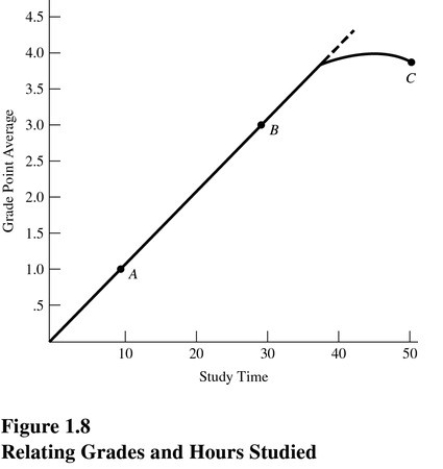 Figure 1.8 suggests that
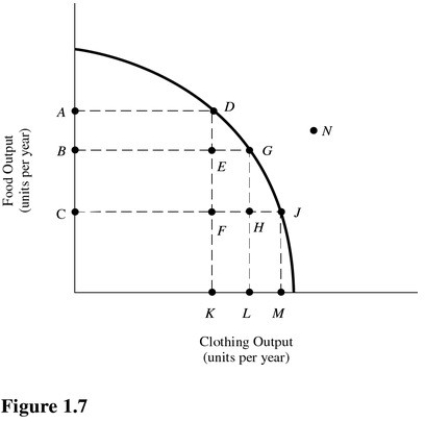 Refer to Figure 1.7.Which of the following points are unattainable,ceteris paribus?
 (Multiple Choice)
4.8/5 (95)
(95) Government failure occurs when government intervention fails to improve economic outcomes or makes them worse.
(True/False)
4.8/5 (94)
(94) Table 1.3 shows the hypothetical trade-off between different combinations of brushes and combs that might be produced in a year with the limited capacity for Country X,ceteris paribus. Table 1.3
Production Possibilities for Brushes and Combs
Combination Number of combs Opportunity Cost(Foregone brushes) Number of brushes Opportunity Cost (Foregone combs) 4 0 NA 3 10 2 17 1 21 0 NA 23 On the basis of Table 1.3,in the production range of 1 to 2 combs the opportunity cost of producing 1 more comb in terms of brushes is
(Multiple Choice)
4.9/5 (90)
(90) Table 1.1 shows the hypothetical trade-off between different combinations of Stealth bombers and B-1 bombers that might be produced in a year with the limited U.S.capacity,ceteris paribus. Table 1.1
Production Possibilities for Bombers
Combination Number of B- 1 Bombers Opportunity cost(Foregone Stealth) Number of Stealth Bombers Opportunity cost (Foregone B-1) 0 NA 10 1 9 2 7 3 4 NA The highest opportunity cost anywhere in Table 1.1 for Stealth bombers in terms of B-1 bombers is
(Multiple Choice)
4.9/5 (78)
(78) Describe the shape of the typical production possibilities curve and explain why it has this shape.
(Essay)
4.8/5 (80)
(80) 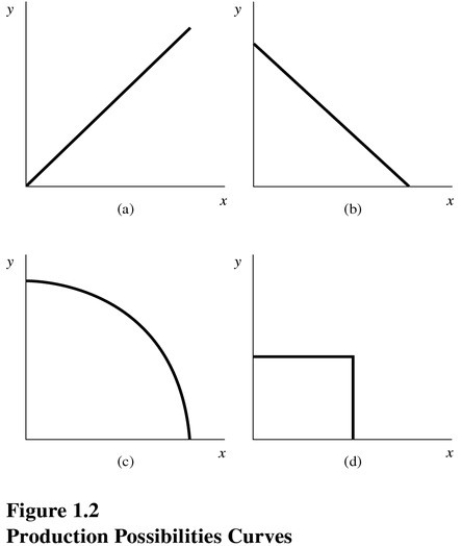 Choose the letter of the curve in Figure 1.2 that best represents a production possibilities curve for two goods for which there are constant opportunity costs:
 (Multiple Choice)
4.7/5 (88)
(88) All economies must make decisions concerning what to produce,how to produce it,and for whom to produce.
(True/False)
4.8/5 (68)
(68) 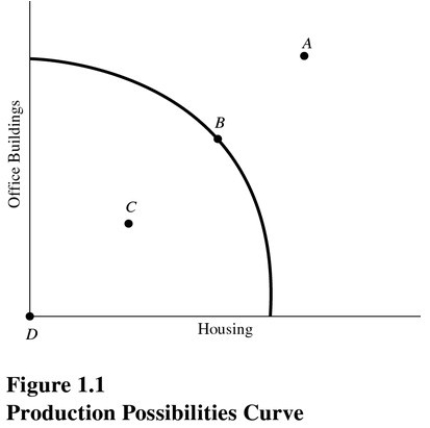 At which point is society producing the most output possible with the available resources and technology? (See Figure 1.1. )
 (Multiple Choice)
4.9/5 (87)
(87) To calculate the slope of a line,find the vertical distance between two points and divide it by the horizontal distance between the same two points.
(True/False)
4.9/5 (75)
(75) In a market economy,the people who receive the goods and services that are produced are those who
(Multiple Choice)
4.9/5 (84)
(84) 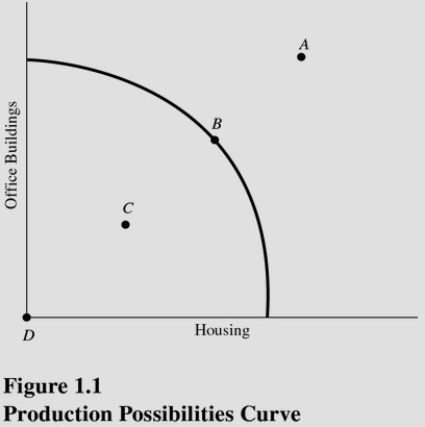 At which point is society producing some of each type of structure but still producing inefficiently? (See Figure 1.1. )
 (Multiple Choice)
4.8/5 (69)
(69) 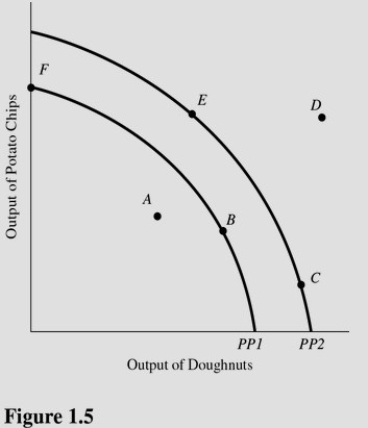 Using Figure 1.5,if an economy has the capacity to produce represented by PP2,then point E represents
 (Multiple Choice)
4.7/5 (88)
(88) Government intervention may achieve a more optimal outcome than the market mechanism when addressing
(Multiple Choice)
4.8/5 (71)
(71) 
Filters
- Essay(0)
- Multiple Choice(0)
- Short Answer(0)
- True False(0)
- Matching(0)