



 Chat with AI
Exam 31: Labor Unions

Exam 1: Economics: the Core Issues152 Questions
Exam 2: The Useconomy: a Global View146 Questions
Exam 3: Supply and Demand164 Questions
Exam 4: The Role of Government153 Questions
Exam 5: National Income Accounting152 Questions
Exam 6: Unemployment147 Questions
Exam 7: Inflation152 Questions
Exam 8: The Business Cycle153 Questions
Exam 9: Aggregate Demand149 Questions
Exam 10: Self-Adjustment or Instability140 Questions
Exam 11: Fiscal Policy151 Questions
Exam 12: Deficits and Debt151 Questions
Exam 13: Money and Banks146 Questions
Exam 14: The Federal Reserve System146 Questions
Exam 15: Monetary Policy149 Questions
Exam 16: Supply-Side Policy: Short-Run Options147 Questions
Exam 17: Growth and Productivity: Long-Run Possibilities143 Questions
Exam 18: Theory Versus Reality146 Questions
Exam 19: Consumer Choice136 Questions
Exam 20: Elasticity141 Questions
Exam 21: The Costs of Production151 Questions
Exam 22: The Competitive Firm148 Questions
Exam 23: Competitive Markets150 Questions
Exam 24: Monopoly147 Questions
Exam 25: Oligopoly145 Questions
Exam 26: Monopolistic Competition144 Questions
Exam 27: Natural Monopolies: Deregulation144 Questions
Exam 28: Environmental Protection144 Questions
Exam 29: The Farm Problem132 Questions
Exam 30: The Labor Market137 Questions
Exam 31: Labor Unions144 Questions
Exam 32: Financial Markets146 Questions
Exam 33: Taxes: Equity Versus Efficiency146 Questions
Exam 34: Transfer Payments: Welfare and Social Security146 Questions
Exam 35: International Trade149 Questions
Exam 36: International Finance142 Questions
Exam 37: Global Poverty141 Questions
Select questions type


The demand for labor determines the

Free
(Multiple Choice)
4.8/5  (79)
(79) Correct Answer: Verified
B
The willingness of firms to hire labor is represented by the market labor demand curve.
Free
(True/False)
4.8/5 (74)
(74) Correct Answer:Verified
VerifiedTrue
Discuss the impact of unions on relative wages (that is,compare the wages of union workers with those of nonunion workers).
Free
(Essay)
4.9/5 (85)
(85) Correct Answer:Verified
VerifiedAs a result of union efforts to limit the supply of labor in certain industries,excluded workers have had to move to nonunion industries.The effect of these movements has been to raise wages in unionized industries and lower wages in nonunionized industries.There is a general consensus that unions have increased the relative wages of unionized workers by 15 to 20 percent.
The decline in unionization can be explained by all of the following except
(Multiple Choice)
4.9/5 (81)
(81) The labor share of total income is the proportion of total income earned by
(Multiple Choice)
4.9/5 (81)
(81) A profit-maximizing monopsonist will hire workers at the point where the marginal factor cost curve intersects the
(Multiple Choice)
4.8/5 (85)
(85) From a union's perspective,the optimal level of employment is determined by the intersection of the
(Multiple Choice)
4.9/5 (74)
(74) In determining how much labor union workers will offer,the union concerns itself mainly with the
(Multiple Choice)
4.9/5 (70)
(70) Which of the following is not true about the wage level in a bilateral monopoly?
(Multiple Choice)
4.9/5 (89)
(89) 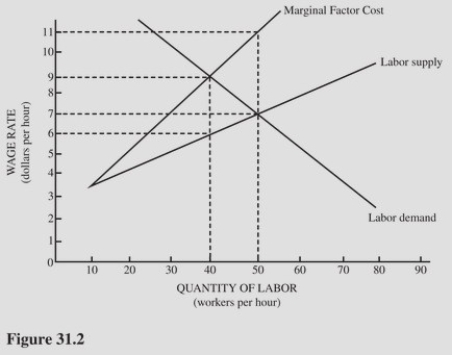 In Figure 31.2,what is the difference between the marginal revenue product of the last worker hired by the monopsonist and the wages the monopsonist pays the last worker?
 (Multiple Choice)
4.9/5 (88)
(88) The United Farm Workers have been unsuccessful for decades in their attempts to organize California's strawberry pickers because the workers
(Multiple Choice)
4.7/5 (81)
(81) Table 31.1 Wage rate (dollars per hour) Labor demanded (workers) Total labor cost (dollars per hour) Marginal Wage (dollars per worker) \ 26 0 - 24 2 18 4 14 6 10 8 Table 31.1 shows the number of workers a firm is willing to hire per hour at different wage rates.Complete the table by computing the total wage bill (total labor cost)and the marginal wage.Assume the union collects dues of 1 percent of the total wage bill.At what wage in Table 31.1 would the union maximize the amount of dues it collects?
(Multiple Choice)
4.9/5 (82)
(82) Effective labor unions have an impact on prices of goods their workers produce.
(True/False)
4.8/5 (73)
(73) A monopsonist will hire fewer workers at a lower wage rate than would prevail in a competitive market.
(True/False)
4.9/5 (79)
(79) A firm that attempts to pass along the cost of higher union wages to consumers in the form of higher prices will be more successful if the price elasticity of demand for its product is
(Multiple Choice)
4.9/5 (87)
(87) If there are many employers in a market and each has limited market power,the demand for labor is likely to be characterized as
(Multiple Choice)
4.8/5 (87)
(87) In order to increase their power,unions have been merging across craft and industry lines.
(True/False)
4.9/5 (78)
(78) The wage rate that a monopsonist would find most profitable is the wage
(Multiple Choice)
4.9/5 (84)
(84) The percentage of the labor force that belongs to a union is known as the
(Multiple Choice)
4.9/5 (87)
(87) 
Filters
- Essay(0)
- Multiple Choice(0)
- Short Answer(0)
- True False(0)
- Matching(0)