



 Chat with AI
Exam 31: Labor Unions

Exam 1: Economics: the Core Issues152 Questions
Exam 2: The Useconomy: a Global View146 Questions
Exam 3: Supply and Demand164 Questions
Exam 4: The Role of Government153 Questions
Exam 5: National Income Accounting152 Questions
Exam 6: Unemployment147 Questions
Exam 7: Inflation152 Questions
Exam 8: The Business Cycle153 Questions
Exam 9: Aggregate Demand149 Questions
Exam 10: Self-Adjustment or Instability140 Questions
Exam 11: Fiscal Policy151 Questions
Exam 12: Deficits and Debt151 Questions
Exam 13: Money and Banks146 Questions
Exam 14: The Federal Reserve System146 Questions
Exam 15: Monetary Policy149 Questions
Exam 16: Supply-Side Policy: Short-Run Options147 Questions
Exam 17: Growth and Productivity: Long-Run Possibilities143 Questions
Exam 18: Theory Versus Reality146 Questions
Exam 19: Consumer Choice136 Questions
Exam 20: Elasticity141 Questions
Exam 21: The Costs of Production151 Questions
Exam 22: The Competitive Firm148 Questions
Exam 23: Competitive Markets150 Questions
Exam 24: Monopoly147 Questions
Exam 25: Oligopoly145 Questions
Exam 26: Monopolistic Competition144 Questions
Exam 27: Natural Monopolies: Deregulation144 Questions
Exam 28: Environmental Protection144 Questions
Exam 29: The Farm Problem132 Questions
Exam 30: The Labor Market137 Questions
Exam 31: Labor Unions144 Questions
Exam 32: Financial Markets146 Questions
Exam 33: Taxes: Equity Versus Efficiency146 Questions
Exam 34: Transfer Payments: Welfare and Social Security146 Questions
Exam 35: International Trade149 Questions
Exam 36: International Finance142 Questions
Exam 37: Global Poverty141 Questions
Select questions type


The intersection of the marginal prices or wage and marginal factor cost determines the wage in bilateral monopoly.
(True/False)
4.7/5  (85)
(85) If a union achieves above-equilibrium wages for its membership,the wages of nonunion workers will generally suffer.
(True/False)
4.8/5 (72)
(72) A market that experiences both strikes and lockouts at different times is most likely characterized by
(Multiple Choice)
4.9/5 (85)
(85) 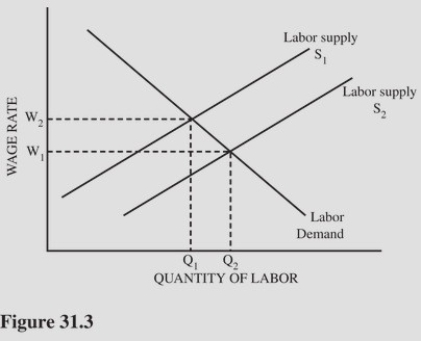 Refer to Figure 31.3 for a competitive labor market.A shift in labor supply from S1 to S2 could be caused by:
 (Multiple Choice)
4.8/5 (94)
(94) The quantities of labor employers are willing and able to hire at alternative wage rates in a given time period,ceteris paribus,is the definition of labor
(Multiple Choice)
4.7/5 (82)
(82) 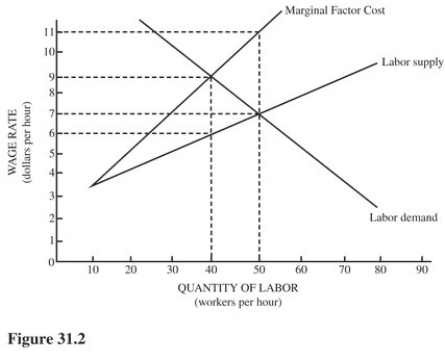 Refer to Figure 31.2.What is the competitive level of wages and employment?
 (Multiple Choice)
4.9/5 (75)
(75) Explain the concept of marginal factor cost.Why is the marginal factor cost higher than the wage rate?
(Essay)
4.8/5 (80)
(80) One World View table titled "Union Membership" shows the unionization rates for several countries including the United States.The decline in the U.S.unionization rate is the result of
(Multiple Choice)
5.0/5 (75)
(75) Compared with a competitive market,a monopsonist will pay a ________ wage and hire ________ workers.
(Multiple Choice)
4.7/5 (81)
(81) The unionized percentage of the labor force in the United States has been increasing steadily since the 1950s.
(True/False)
4.9/5 (85)
(85) Workers who demand a wage that is higher than the equilibrium wage
(Multiple Choice)
4.8/5 (84)
(84) As long as additional workers are attracted into the labor force by higher wages,the market labor supply curve is
(Multiple Choice)
4.8/5 (83)
(83) A profit-maximizing monopsonist will hire the quantity of labor where
(Multiple Choice)
4.8/5 (82)
(82) The marginal factor cost facing each employer in a competitive labor market is greater than the market wage rate.
(True/False)
4.8/5 (95)
(95) In the article "Walmart Shutters Quebec Store as Union Closes In," the company argued all of the following except
(Multiple Choice)
5.0/5 (77)
(77) 
Filters
- Essay(0)
- Multiple Choice(0)
- Short Answer(0)
- True False(0)
- Matching(0)