



 Chat with AI
Exam 31: Labor Unions

Exam 1: Economics: the Core Issues152 Questions
Exam 2: The Useconomy: a Global View146 Questions
Exam 3: Supply and Demand164 Questions
Exam 4: The Role of Government153 Questions
Exam 5: National Income Accounting152 Questions
Exam 6: Unemployment147 Questions
Exam 7: Inflation152 Questions
Exam 8: The Business Cycle153 Questions
Exam 9: Aggregate Demand149 Questions
Exam 10: Self-Adjustment or Instability140 Questions
Exam 11: Fiscal Policy151 Questions
Exam 12: Deficits and Debt151 Questions
Exam 13: Money and Banks146 Questions
Exam 14: The Federal Reserve System146 Questions
Exam 15: Monetary Policy149 Questions
Exam 16: Supply-Side Policy: Short-Run Options147 Questions
Exam 17: Growth and Productivity: Long-Run Possibilities143 Questions
Exam 18: Theory Versus Reality146 Questions
Exam 19: Consumer Choice136 Questions
Exam 20: Elasticity141 Questions
Exam 21: The Costs of Production151 Questions
Exam 22: The Competitive Firm148 Questions
Exam 23: Competitive Markets150 Questions
Exam 24: Monopoly147 Questions
Exam 25: Oligopoly145 Questions
Exam 26: Monopolistic Competition144 Questions
Exam 27: Natural Monopolies: Deregulation144 Questions
Exam 28: Environmental Protection144 Questions
Exam 29: The Farm Problem132 Questions
Exam 30: The Labor Market137 Questions
Exam 31: Labor Unions144 Questions
Exam 32: Financial Markets146 Questions
Exam 33: Taxes: Equity Versus Efficiency146 Questions
Exam 34: Transfer Payments: Welfare and Social Security146 Questions
Exam 35: International Trade149 Questions
Exam 36: International Finance142 Questions
Exam 37: Global Poverty141 Questions
Select questions type


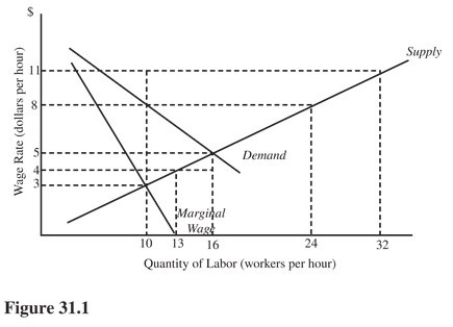 What are the optimal wage and employment level from the perspective of a union in Figure 31.1?
 (Multiple Choice)
4.8/5  (88)
(88) Union work rules may restrict productivity in all of the following ways except
(Multiple Choice)
4.9/5 (95)
(95) Unions do not need to worry about the effects of greater employment numbers on the wage rate.
(True/False)
4.9/5 (71)
(71) When only one buyer has access to a particular labor market,
(Multiple Choice)
4.7/5 (67)
(67) If a firm increases the number of workers from 32 to 33 and the total wages paid rise from $112,000 to $121,000,the marginal wage of the 33rd worker is
(Multiple Choice)
5.0/5 (78)
(78) Labor markets where power exists on both the demand side and the supply side are rare.
(True/False)
4.9/5 (82)
(82) If 10 workers will be hired by a firm at a wage rate of $15 per hour,but the 11th worker will be hired only if the wage rate falls to $14 per hour,then the marginal wage of the 11th worker is
(Multiple Choice)
4.7/5 (79)
(79) Because a union is a form of monopoly,it must be concerned about the ________ slope of the demand curve for labor.
(Multiple Choice)
4.9/5 (76)
(76) The relative decline in manufacturing in the United States has contributed to the decline in unionization.
(True/False)
5.0/5 (74)
(74) 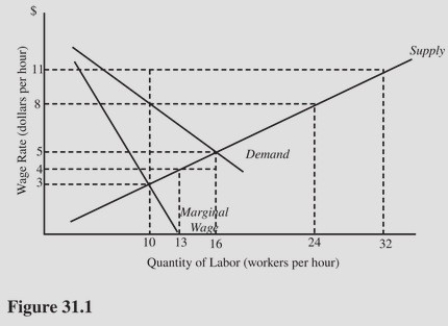 What is the difference between the competitive level of employment and the union optimum level of employment in Figure 31.1?
 (Multiple Choice)
4.8/5 (81)
(81) Increased global competition is one reason why unionization has become more popular.
(True/False)
5.0/5 (78)
(78) If a firm hires 10 workers at $6 per hour each and the 11th worker will be hired only if the wage rate falls to $5 per hour,the marginal wage rate must be
(Multiple Choice)
4.8/5 (73)
(73) A primary objective of unions is to raise the wages of union members.
(True/False)
4.8/5 (90)
(90) The distinguishing characteristic of labor market monopsonies is the fact that
(Multiple Choice)
4.9/5 (98)
(98) 
Filters
- Essay(0)
- Multiple Choice(0)
- Short Answer(0)
- True False(0)
- Matching(0)