



 Chat with AI
Exam 26: Monopolistic Competition

Exam 1: Economics: the Core Issues152 Questions
Exam 2: The Useconomy: a Global View146 Questions
Exam 3: Supply and Demand164 Questions
Exam 4: The Role of Government153 Questions
Exam 5: National Income Accounting152 Questions
Exam 6: Unemployment147 Questions
Exam 7: Inflation152 Questions
Exam 8: The Business Cycle153 Questions
Exam 9: Aggregate Demand149 Questions
Exam 10: Self-Adjustment or Instability140 Questions
Exam 11: Fiscal Policy151 Questions
Exam 12: Deficits and Debt151 Questions
Exam 13: Money and Banks146 Questions
Exam 14: The Federal Reserve System146 Questions
Exam 15: Monetary Policy149 Questions
Exam 16: Supply-Side Policy: Short-Run Options147 Questions
Exam 17: Growth and Productivity: Long-Run Possibilities143 Questions
Exam 18: Theory Versus Reality146 Questions
Exam 19: Consumer Choice136 Questions
Exam 20: Elasticity141 Questions
Exam 21: The Costs of Production151 Questions
Exam 22: The Competitive Firm148 Questions
Exam 23: Competitive Markets150 Questions
Exam 24: Monopoly147 Questions
Exam 25: Oligopoly145 Questions
Exam 26: Monopolistic Competition144 Questions
Exam 27: Natural Monopolies: Deregulation144 Questions
Exam 28: Environmental Protection144 Questions
Exam 29: The Farm Problem132 Questions
Exam 30: The Labor Market137 Questions
Exam 31: Labor Unions144 Questions
Exam 32: Financial Markets146 Questions
Exam 33: Taxes: Equity Versus Efficiency146 Questions
Exam 34: Transfer Payments: Welfare and Social Security146 Questions
Exam 35: International Trade149 Questions
Exam 36: International Finance142 Questions
Exam 37: Global Poverty141 Questions
Select questions type


Which of the following is not an example of nonprice competition in the airline market?

Free
(Multiple Choice)
4.8/5  (78)
(78) Correct Answer: Verified
A
If monopolistically competitive firms have some control over the prices they charge,why do they experience zero economic profits in the long run?
Free
(Essay)
4.9/5 (87)
(87) Correct Answer:Verified
VerifiedThe key is the relatively easy entry into monopolistically competitive markets.If a typical firm is experiencing economic profits in the short run,new firms will enter the market,reducing the demand and increasing the price elasticity for the typical firm's product.This process will continue as long as there are economic profits-that is,competition will force economic profits to zero in the long run.
Which of the following is not true about a monopolistic competitor?
Free
(Multiple Choice)
4.9/5 (67)
(67) Correct Answer:Verified
VerifiedD
The demand curve faced by a monopolistically competitive firm is
(Multiple Choice)
4.8/5 (86)
(86) A monopolistically competitive firm can raise its price somewhat without fear of great change in unit sales because
(Multiple Choice)
4.9/5 (75)
(75) In monopolistic competition,each firm competes with other firms offering identical substitutes.
(True/False)
4.8/5 (76)
(76) 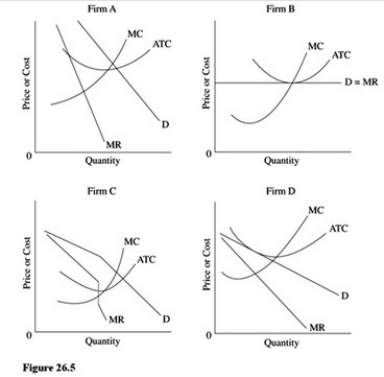 Refer to Figure 26.5.Which firm is least likely to engage in advertising?
 (Multiple Choice)
4.8/5 (78)
(78) The monopoly aspect of monopolistic competition is that there is only one seller.
(True/False)
4.9/5 (75)
(75) Advertising plays a role in reducing the cross-price elasticity of demand.
(True/False)
4.9/5 (79)
(79) Which of the following market structures will have lower prices in the long run than monopoly,ceteris paribus?
(Multiple Choice)
4.9/5 (74)
(74) When new firms enter a monopolistically competitive industry,the market
(Multiple Choice)
4.8/5 (81)
(81) If economic profits are earned in a monopolistically competitive market,
(Multiple Choice)
4.9/5 (81)
(81) For a monopolistically competitive firm,barriers to entry are high,which allows the firm to earn positive economic profits in the long run.
(True/False)
4.9/5 (86)
(86) Which of the following is similar for oligopoly and monopolistic competition?
(Multiple Choice)
4.7/5 (89)
(89) Which of the following characterizes monopolistic competition?
(Multiple Choice)
4.7/5 (90)
(90) Entry into a market characterized by monopolistic competition is generally
(Multiple Choice)
4.9/5 (88)
(88) 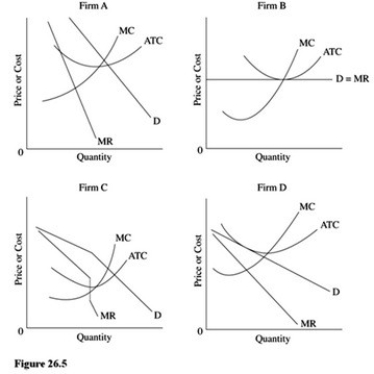 Which of the firms in Figure 26.5 is most likely a monopoly in the long run?
 (Multiple Choice)
4.8/5 (67)
(67) A monopolistically competitive firm that runs a successful advertising campaign creates enormous goodwill,but this goodwill does little to increase the value of the company.
(True/False)
4.8/5 (74)
(74) 
Filters
- Essay(0)
- Multiple Choice(0)
- Short Answer(0)
- True False(0)
- Matching(0)