



 Chat with AI
Exam 26: Monopolistic Competition

Exam 1: Economics: the Core Issues152 Questions
Exam 2: The Useconomy: a Global View146 Questions
Exam 3: Supply and Demand164 Questions
Exam 4: The Role of Government153 Questions
Exam 5: National Income Accounting152 Questions
Exam 6: Unemployment147 Questions
Exam 7: Inflation152 Questions
Exam 8: The Business Cycle153 Questions
Exam 9: Aggregate Demand149 Questions
Exam 10: Self-Adjustment or Instability140 Questions
Exam 11: Fiscal Policy151 Questions
Exam 12: Deficits and Debt151 Questions
Exam 13: Money and Banks146 Questions
Exam 14: The Federal Reserve System146 Questions
Exam 15: Monetary Policy149 Questions
Exam 16: Supply-Side Policy: Short-Run Options147 Questions
Exam 17: Growth and Productivity: Long-Run Possibilities143 Questions
Exam 18: Theory Versus Reality146 Questions
Exam 19: Consumer Choice136 Questions
Exam 20: Elasticity141 Questions
Exam 21: The Costs of Production151 Questions
Exam 22: The Competitive Firm148 Questions
Exam 23: Competitive Markets150 Questions
Exam 24: Monopoly147 Questions
Exam 25: Oligopoly145 Questions
Exam 26: Monopolistic Competition144 Questions
Exam 27: Natural Monopolies: Deregulation144 Questions
Exam 28: Environmental Protection144 Questions
Exam 29: The Farm Problem132 Questions
Exam 30: The Labor Market137 Questions
Exam 31: Labor Unions144 Questions
Exam 32: Financial Markets146 Questions
Exam 33: Taxes: Equity Versus Efficiency146 Questions
Exam 34: Transfer Payments: Welfare and Social Security146 Questions
Exam 35: International Trade149 Questions
Exam 36: International Finance142 Questions
Exam 37: Global Poverty141 Questions
Select questions type


All of the following are examples of nonprice competition except
(Multiple Choice)
4.8/5  (79)
(79) A major difference between oligopoly and monopolistic competition is that oligopolies do not
(Multiple Choice)
4.9/5 (88)
(88) Which of the following market structures will have only normal profit in the long run?
(Multiple Choice)
4.9/5 (72)
(72) A successful advertising campaign alters the demand curve and the supply curve facing the firm.
(True/False)
4.7/5 (87)
(87) Demand and Cost Data for Sylvie's Shampoo Company Table 26.2
A Monopolistically Competitive Firm
Price Demand Data Quartity Cost Data Output Total Cost \ 22 6 6 \ 96 \ 20 7 7 \ 104 \ 18 8 8 \ 114 \ 16 9 9 \ 126 \ 14 10 10 \ 140 Refer to Table 26.2.At the profit-maximizing output and price,Sylvie's Shampoo Company will earn a profit equal to
(Multiple Choice)
4.9/5 (80)
(80) Demand and Cost Data for Sylvie's Shampoo Company Table 26.2
A Monopolistically Competitive Firm
Demand Data Price Quantity Cost Data Output Total Cost \ 11 6 6 \ 48 \ 10 7 7 \ 52 \9 8 8 \5 7 \ 8 9 9 \6 3 \7 10 10 \7 0
Refer to Table 26.2.To maximize profit,Sylvie's Shampoo Company.should produce ________ bottles of shampoo and charge a price of ________ each.
(Multiple Choice)
4.7/5 (75)
(75) Demand and Cost Data for Will's Beach Ball Company Table 26.1
A Monopolistically Competitive Firm
Demand Data Price Quantity Cost Data Output Total Cost \ 11 6 6 \ 48 \ 10 7 7 \ 52 \9 8 8 \5 7 \ 8 9 9 \6 3 \7 10 10 \7 0
Refer to Table 26.1.At the profit-maximizing output and price,Will's Beach Ball Company will earn a ________ economic profit,and ________ the market will occur.
(Multiple Choice)
5.0/5 (74)
(74) For which of the following market structures will the firm's demand curve be tangent to the ATC curve in the long run?
(Multiple Choice)
4.7/5 (83)
(83) The combined market share for the top four firms in a monopolistically competitive industry will typically be in the range of 20 to 40 percent.
(True/False)
4.9/5 (93)
(93) In monopolistic competition there is allocative inefficiency because
(Multiple Choice)
4.8/5 (79)
(79) 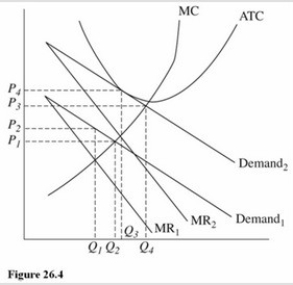 Refer to Figure 26.4 for a monopolistically competitive firm.If the firm currently faces Demand1 and MR1,then it will earn
 (Multiple Choice)
4.8/5 (78)
(78) An In the News article titled "Selling "Pure Water": A $Billion Scam?" refers to the use of advertising.When a firm successfully advertises its product,the firm
(Multiple Choice)
4.9/5 (92)
(92) An In the News article titled "Selling "Pure Water": A $Billion Scam?" refers to the use of advertising.When a firm successfully advertises its product,the price elasticity of demand becomes
(Multiple Choice)
4.8/5 (83)
(83) Firms in a monopolistically competitive market make independent production decisions.
(True/False)
5.0/5 (77)
(77) As new firms enter a monopolistically competitive industry,the demand curve for an individual firm shifts to the right.
(True/False)
4.8/5 (72)
(72) In monopolistically competitive markets,product differentiation is a significant barrier to entry.
(True/False)
4.7/5 (83)
(83) The kinked oligopoly demand curve does not describe the demand curve for monopolistic competition because in monopolistically competitive markets,
(Multiple Choice)
4.9/5 (76)
(76) 
Filters
- Essay(0)
- Multiple Choice(0)
- Short Answer(0)
- True False(0)
- Matching(0)