



 Chat with AI
Exam 34: Transfer Payments: Welfare and Social Security

Exam 1: Economics: the Core Issues152 Questions
Exam 2: The Useconomy: a Global View146 Questions
Exam 3: Supply and Demand164 Questions
Exam 4: The Role of Government153 Questions
Exam 5: National Income Accounting152 Questions
Exam 6: Unemployment147 Questions
Exam 7: Inflation152 Questions
Exam 8: The Business Cycle153 Questions
Exam 9: Aggregate Demand149 Questions
Exam 10: Self-Adjustment or Instability140 Questions
Exam 11: Fiscal Policy151 Questions
Exam 12: Deficits and Debt151 Questions
Exam 13: Money and Banks146 Questions
Exam 14: The Federal Reserve System146 Questions
Exam 15: Monetary Policy149 Questions
Exam 16: Supply-Side Policy: Short-Run Options147 Questions
Exam 17: Growth and Productivity: Long-Run Possibilities143 Questions
Exam 18: Theory Versus Reality146 Questions
Exam 19: Consumer Choice136 Questions
Exam 20: Elasticity141 Questions
Exam 21: The Costs of Production151 Questions
Exam 22: The Competitive Firm148 Questions
Exam 23: Competitive Markets150 Questions
Exam 24: Monopoly147 Questions
Exam 25: Oligopoly145 Questions
Exam 26: Monopolistic Competition144 Questions
Exam 27: Natural Monopolies: Deregulation144 Questions
Exam 28: Environmental Protection144 Questions
Exam 29: The Farm Problem132 Questions
Exam 30: The Labor Market137 Questions
Exam 31: Labor Unions144 Questions
Exam 32: Financial Markets146 Questions
Exam 33: Taxes: Equity Versus Efficiency146 Questions
Exam 34: Transfer Payments: Welfare and Social Security146 Questions
Exam 35: International Trade149 Questions
Exam 36: International Finance142 Questions
Exam 37: Global Poverty141 Questions
Select questions type


The largest amounts of dollars spent on income transfers are for

Free
(Multiple Choice)
4.9/5  (84)
(84) Correct Answer: Verified
A
A goal of income transfer programs is to do all of the following except
Free
(Multiple Choice)
4.9/5 (77)
(77) Correct Answer:Verified
VerifiedD
Use the following formula to answer the indicated question: Welfare benefit = Maximum benefit - 0.4 [Wages - (Work expenses + Child care costs)] Suppose Shanika works 2,000 hours per year at a wage of $6 per hour,has child care expenses of $3,000 per year,and has work expenses of $900.If the state maximum welfare benefit is $11,000 per year,based on the welfare formula given,Shanika's welfare benefit will be
(Multiple Choice)
4.9/5 (86)
(86) 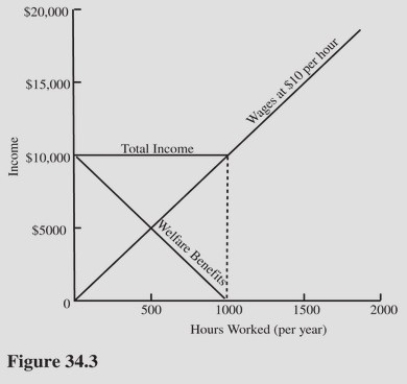 Refer to Figure 34.3.The disincentive to work caused by this welfare program
 (Multiple Choice)
4.7/5 (83)
(83) Which of the following statements concerning higher marginal tax rates is correct?
(Multiple Choice)
4.8/5 (96)
(96) Which of the following is not a determinant of eligibility for Social Security benefits?
(Multiple Choice)
5.0/5 (89)
(89) The Social Security payments received by retired persons are an in-kind transfer payment.
(True/False)
4.8/5 (79)
(79) The impact of a decrease in the marginal tax rate on labor supply depends on the tax elasticity of labor supply.
(True/False)
4.8/5 (69)
(69) Which of the following programs is the second-largest federal income transfer program?
(Multiple Choice)
4.8/5 (69)
(69) Suppose a poverty program has a basic benefit of $10,000,zero deductions,and a breakeven level of income of $25,000.The marginal tax rate is ________ percent.
(Multiple Choice)
4.9/5 (100)
(100) Higher basic benefits increase the breakeven level of income faced by welfare recipients.
(True/False)
4.9/5 (87)
(87) The shortfall between actual income and the poverty threshold is the
(Multiple Choice)
4.9/5 (79)
(79) 
Filters
- Essay(0)
- Multiple Choice(0)
- Short Answer(0)
- True False(0)
- Matching(0)