



 Chat with AI
Exam 1: Economics: the Core Issues

Exam 1: Economics: the Core Issues152 Questions
Exam 2: The Useconomy: a Global View146 Questions
Exam 3: Supply and Demand164 Questions
Exam 4: The Role of Government153 Questions
Exam 5: National Income Accounting152 Questions
Exam 6: Unemployment147 Questions
Exam 7: Inflation152 Questions
Exam 8: The Business Cycle153 Questions
Exam 9: Aggregate Demand149 Questions
Exam 10: Self-Adjustment or Instability140 Questions
Exam 11: Fiscal Policy151 Questions
Exam 12: Deficits and Debt151 Questions
Exam 13: Money and Banks146 Questions
Exam 14: The Federal Reserve System146 Questions
Exam 15: Monetary Policy149 Questions
Exam 16: Supply-Side Policy: Short-Run Options147 Questions
Exam 17: Growth and Productivity: Long-Run Possibilities143 Questions
Exam 18: Theory Versus Reality146 Questions
Exam 19: Consumer Choice136 Questions
Exam 20: Elasticity141 Questions
Exam 21: The Costs of Production151 Questions
Exam 22: The Competitive Firm148 Questions
Exam 23: Competitive Markets150 Questions
Exam 24: Monopoly147 Questions
Exam 25: Oligopoly145 Questions
Exam 26: Monopolistic Competition144 Questions
Exam 27: Natural Monopolies: Deregulation144 Questions
Exam 28: Environmental Protection144 Questions
Exam 29: The Farm Problem132 Questions
Exam 30: The Labor Market137 Questions
Exam 31: Labor Unions144 Questions
Exam 32: Financial Markets146 Questions
Exam 33: Taxes: Equity Versus Efficiency146 Questions
Exam 34: Transfer Payments: Welfare and Social Security146 Questions
Exam 35: International Trade149 Questions
Exam 36: International Finance142 Questions
Exam 37: Global Poverty141 Questions
Select questions type


If North Korea is currently producing at efficiency,and it proceeds to increase the size of its military,then,as long as nothing else changes,its

Free
(Multiple Choice)
4.8/5  (85)
(85) Correct Answer: Verified
D
The Latin phrase ceteris paribus means
Free
(Multiple Choice)
4.9/5 (79)
(79) Correct Answer:Verified
VerifiedC
Opportunity cost is a theoretical concept with no practical application.
Free
(True/False)
5.0/5 (77)
(77) Correct Answer:Verified
VerifiedFalse
Table 1.2 shows the hypothetical trade-off between different combinations of Stealth bombers and B-1 bombers that might be produced in a year with the limited U.S.capacity,ceteris paribus. Table 1.2
Production Possibilities for Bombers
Combination Number of B- 1 Bombers Opportunity cost(Foregone Stealth) Number of Stealth Bombers Opportunity cost (Foregone B-1) A 20 NA 195 B 35 180 C 45 150 D 50 100 NA On the basis of your calculations in Table 1.2,what is gained by producing at point B rather than point C?
(Multiple Choice)
4.8/5 (87)
(87) If an economy experiences increasing opportunity costs with respect to two goods,then the production possibilities curve between the two goods will be
(Multiple Choice)
4.9/5 (74)
(74) 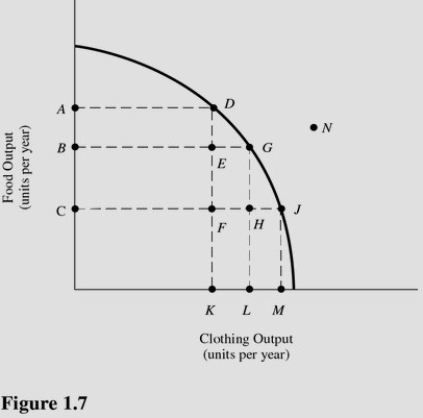 Refer to Figure 1.7.Which of the following points are considered to be inefficient?
 (Multiple Choice)
4.8/5 (69)
(69) 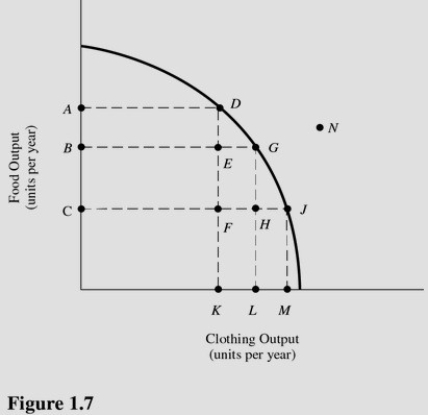 Refer to Figure 1.7.Which of the following points show unemployment of resources above the normal rate?
 (Multiple Choice)
4.7/5 (87)
(87) Table 1.3 shows the hypothetical trade-off between different combinations of brushes and combs that might be produced in a year with the limited capacity for Country X,ceteris paribus. Table 1.3
Production Possibilities for Brushes and Combs
Combination Number of Brushes Opportunity Cost of Brushes in Terms of Combs Number of Combs Opportunity Cost of Combs in Terms of Brushes 0 4 10 3 17 2 21 1 23 0
Table 1.3
Production Possibilities for Brushes and Combs
Combination Number of combs Opportunity Cost(Foregone brushes) Number of brushes Opportunity Cost (Foregone combs) 4 0 NA 3 10 2 17 1 21 0 NA 23 On the basis of Table 1.3,what is the opportunity cost of producing at point M rather than point N?
(Multiple Choice)
4.9/5 (79)
(79) 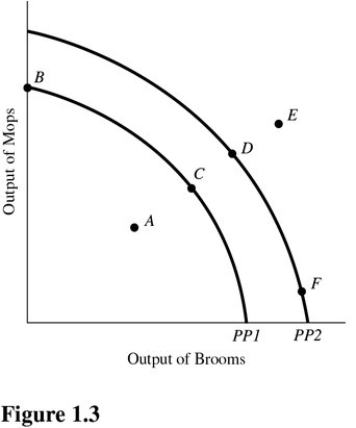 Using Figure 1.3 and PP1,at point A,
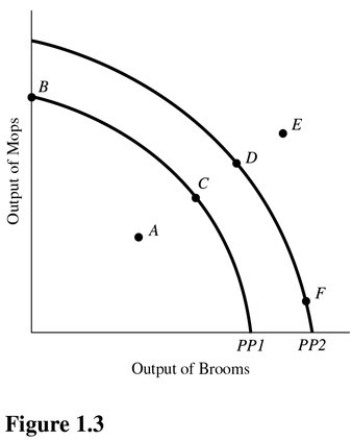 An increase in the proportion of the population that is unemployed above the normal rate is best represented in Figure 1.3 and using PP1 by a movement from point
 (Multiple Choice)
4.8/5 (67)
(67) 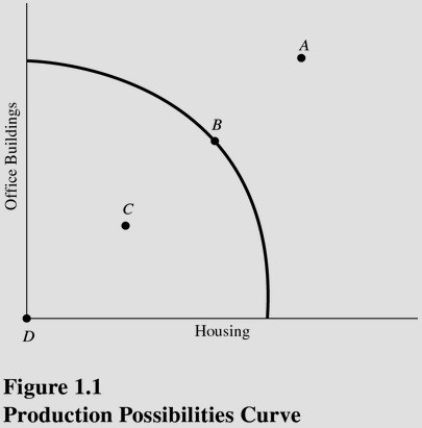 At which point is society employing some of its available technology but not all of it? (See Figure 1.1. )
 (Multiple Choice)
4.8/5 (82)
(82) If an economy experiences constant opportunity costs with respect to two goods,then the production possibilities curve between the two goods will be?
(Multiple Choice)
4.7/5 (69)
(69) 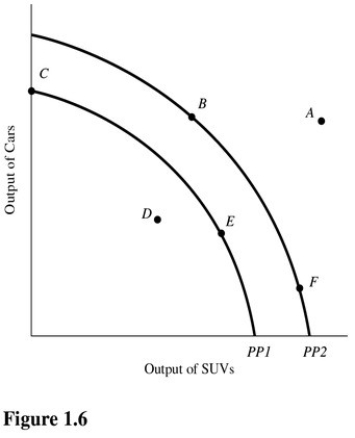 Using Figure 1.6,if an economy has the capacity to produce represented by PP1,then point E represents
 (Multiple Choice)
4.8/5 (83)
(83) Table 1.1 shows the hypothetical trade-off between different combinations of Stealth bombers and B-1 bombers that might be produced in a year with the limited U.S.capacity,ceteris paribus. Table 1.1
Production Possibilities for Bombers
Combination Number of B- 1 Bombers Opportunity cost(Foregone Stealth) Number of Stealth Bombers Opportunity cost (Foregone B-1) 0 NA 10 1 9 2 7 3 4 NA On the basis of Table 1.1,you may infer that the law of increasing opportunity costs applies to increasing production of
(Multiple Choice)
4.8/5 (89)
(89) The "guns versus butter" dilemma that all nations confront is that
(Multiple Choice)
4.9/5 (86)
(86) Scarcity results when available resources cannot satisfy all desired uses of those resources.
(True/False)
4.7/5 (81)
(81) 
Filters
- Essay(0)
- Multiple Choice(0)
- Short Answer(0)
- True False(0)
- Matching(0)