



 Chat with AI
Exam 1: Economics: the Core Issues

Exam 1: Economics: the Core Issues152 Questions
Exam 2: The Useconomy: a Global View146 Questions
Exam 3: Supply and Demand164 Questions
Exam 4: The Role of Government153 Questions
Exam 5: National Income Accounting152 Questions
Exam 6: Unemployment147 Questions
Exam 7: Inflation152 Questions
Exam 8: The Business Cycle153 Questions
Exam 9: Aggregate Demand149 Questions
Exam 10: Self-Adjustment or Instability140 Questions
Exam 11: Fiscal Policy151 Questions
Exam 12: Deficits and Debt151 Questions
Exam 13: Money and Banks146 Questions
Exam 14: The Federal Reserve System146 Questions
Exam 15: Monetary Policy149 Questions
Exam 16: Supply-Side Policy: Short-Run Options147 Questions
Exam 17: Growth and Productivity: Long-Run Possibilities143 Questions
Exam 18: Theory Versus Reality146 Questions
Exam 19: Consumer Choice136 Questions
Exam 20: Elasticity141 Questions
Exam 21: The Costs of Production151 Questions
Exam 22: The Competitive Firm148 Questions
Exam 23: Competitive Markets150 Questions
Exam 24: Monopoly147 Questions
Exam 25: Oligopoly145 Questions
Exam 26: Monopolistic Competition144 Questions
Exam 27: Natural Monopolies: Deregulation144 Questions
Exam 28: Environmental Protection144 Questions
Exam 29: The Farm Problem132 Questions
Exam 30: The Labor Market137 Questions
Exam 31: Labor Unions144 Questions
Exam 32: Financial Markets146 Questions
Exam 33: Taxes: Equity Versus Efficiency146 Questions
Exam 34: Transfer Payments: Welfare and Social Security146 Questions
Exam 35: International Trade149 Questions
Exam 36: International Finance142 Questions
Exam 37: Global Poverty141 Questions
Select questions type


If an economy is producing inside the production possibilities curve,then
(Multiple Choice)
4.9/5  (78)
(78) Which of the following events would allow the production possibilities curve to shift outward?
(Multiple Choice)
4.8/5 (79)
(79) Table 1.1 shows the hypothetical trade-off between different combinations of Stealth bombers and B-1 bombers that might be produced in a year with the limited U.S.capacity,ceteris paribus. Table 1.1
Production Possibilities for Bombers
Combination Number of B- 1 Bombers Opportunity cost (Foregone Stealth) Number of Stealth Bombers Opportunity cost (Foregone B-1) 0 NA 10 1 9 2 7 3 4 NA On the basis of Table 1.1,what is the opportunity cost of producing at point S rather than point T?
(Multiple Choice)
4.9/5 (82)
(82) 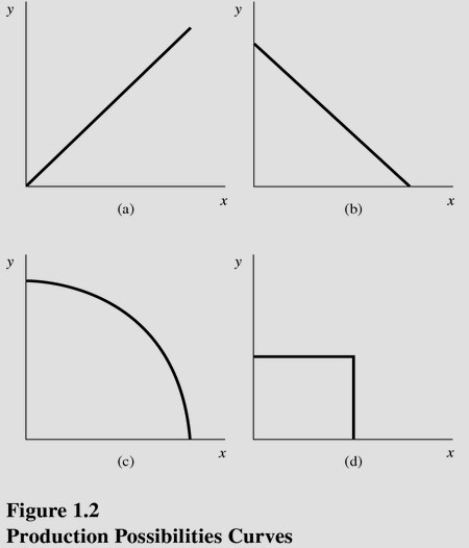 Choose the letter of the curve in Figure 1.2 that best represents a production possibilities curve for two goods that obey the law of increasing opportunity costs:
 (Multiple Choice)
4.7/5 (69)
(69) Table 1.1 shows the hypothetical trade-off between different combinations of Stealth bombers and B-1 bombers that might be produced in a year with the limited U.S.capacity,ceteris paribus. Table 1.1
Production Possibilities for Bombers
Combination Number of B- 1 Bombers Opportunity cost(Foregone Stealth) Number of Stealth Bombers Opportunity cost (Foregone B-1) 0 NA 10 1 9 2 7 3 4 NA The highest opportunity cost in Table 1.1 for B-1 bombers in terms of Stealth bombers is
(Multiple Choice)
5.0/5 (83)
(83) The fact that there are too few resources to satisfy all our wants is attributed to
(Multiple Choice)
4.9/5 (91)
(91) Critics of government regulation argue that government interference in the marketplace stifles the "animal spirits" of entrepreneurship.
(True/False)
4.9/5 (85)
(85) The Latin phrase ceteris paribus refers to holding other variables constant.
(True/False)
4.7/5 (88)
(88) Which of the following is not a basic decision that all nations must confront?
(Multiple Choice)
5.0/5 (84)
(84) Table 1.1 shows the hypothetical trade-off between different combinations of Stealth bombers and B-1 bombers that might be produced in a year with the limited U.S.capacity,ceteris paribus. Table 1.1
Production Possibilities for Bombers
Combination Number of B- 1 Bombers Opportunity cost (Foregone Stealth) Number of Stealth Bombers Opportunity cost (Foregone B-1) 0 NA 10 1 9 2 7 3 4 NA On the basis Table 1.1,what is the opportunity cost of producing at point V rather than point U?
(Multiple Choice)
4.8/5 (86)
(86) 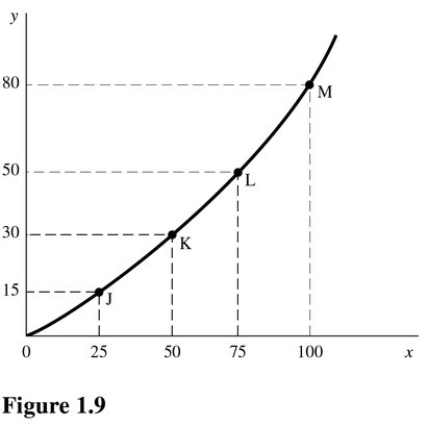 In Figure 1.9,as you move up the curve from point J toward point M,the slope
 (Multiple Choice)
4.9/5 (75)
(75) 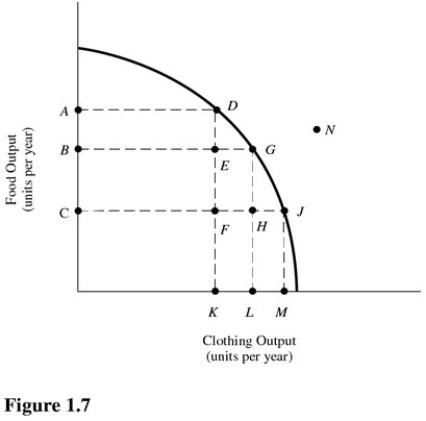 Refer to Figure 1.7.The benefit of producing at point G rather than point D is
 (Multiple Choice)
4.9/5 (72)
(72) Table 1.3 shows the hypothetical trade-off between different combinations of brushes and combs that might be produced in a year with the limited capacity for Country X,ceteris paribus. Table 1.3
Production Possibilities for Brushes and Combs
Combination Number of combs Opportunity Cost(Foregone brushes) Number of brushes Opportunity Cost (Foregone combs) 4 0 NA 3 10 2 17 1 21 0 NA 23 On the basis of Table 1.3,the law of increasing opportunity costs applies to
(Multiple Choice)
4.8/5 (76)
(76) Table 1.2 shows the hypothetical trade-off between different combinations of Stealth bombers and B-1 bombers that might be produced in a year with the limited U.S.capacity,ceteris paribus. Table 1.2
Production Possibilities for Bombers
Combination Number of B- 1 Bombers Opportunity cost(Foregone Stealth) Number of Stealth Bombers Opportunity cost (Foregone B-1) A 20 NA 195 B 35 180 C 45 150 D 50 100 NA The lowest opportunity cost in Table 1.2 for Stealth Bombers is
(Multiple Choice)
5.0/5 (71)
(71) If the economy is inside the production possibilities curve,then more output can be produced using existing resources.
(True/False)
4.9/5 (85)
(85) 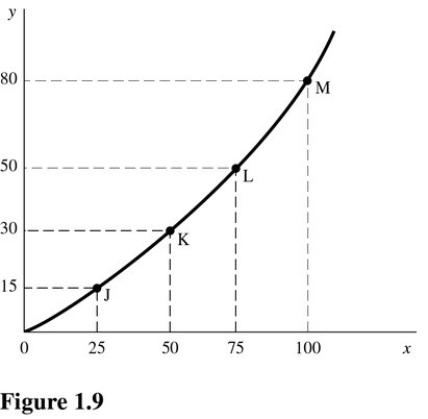 In Figure 1.9,the slope of the line between points K and L is
 (Multiple Choice)
4.8/5 (82)
(82) 
Filters
- Essay(0)
- Multiple Choice(0)
- Short Answer(0)
- True False(0)
- Matching(0)