



 Chat with AI
Exam 31: Labor Unions

Exam 1: Economics: the Core Issues152 Questions
Exam 2: The Useconomy: a Global View146 Questions
Exam 3: Supply and Demand164 Questions
Exam 4: The Role of Government153 Questions
Exam 5: National Income Accounting152 Questions
Exam 6: Unemployment147 Questions
Exam 7: Inflation152 Questions
Exam 8: The Business Cycle153 Questions
Exam 9: Aggregate Demand149 Questions
Exam 10: Self-Adjustment or Instability140 Questions
Exam 11: Fiscal Policy151 Questions
Exam 12: Deficits and Debt151 Questions
Exam 13: Money and Banks146 Questions
Exam 14: The Federal Reserve System146 Questions
Exam 15: Monetary Policy149 Questions
Exam 16: Supply-Side Policy: Short-Run Options147 Questions
Exam 17: Growth and Productivity: Long-Run Possibilities143 Questions
Exam 18: Theory Versus Reality146 Questions
Exam 19: Consumer Choice136 Questions
Exam 20: Elasticity141 Questions
Exam 21: The Costs of Production151 Questions
Exam 22: The Competitive Firm148 Questions
Exam 23: Competitive Markets150 Questions
Exam 24: Monopoly147 Questions
Exam 25: Oligopoly145 Questions
Exam 26: Monopolistic Competition144 Questions
Exam 27: Natural Monopolies: Deregulation144 Questions
Exam 28: Environmental Protection144 Questions
Exam 29: The Farm Problem132 Questions
Exam 30: The Labor Market137 Questions
Exam 31: Labor Unions144 Questions
Exam 32: Financial Markets146 Questions
Exam 33: Taxes: Equity Versus Efficiency146 Questions
Exam 34: Transfer Payments: Welfare and Social Security146 Questions
Exam 35: International Trade149 Questions
Exam 36: International Finance142 Questions
Exam 37: Global Poverty141 Questions
Select questions type


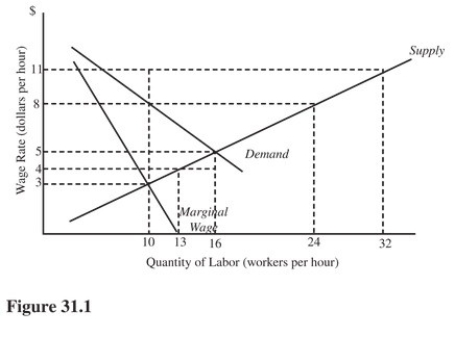 How many workers are willing and able to work at the optimal union wage rate in Figure 31.1?
 (Multiple Choice)
4.8/5  (66)
(66) The desired level of union employment occurs where the market wage curve intersects the labor supply curve.
(True/False)
4.8/5 (64)
(64) In a bilateral monopoly,wages and employment are determined by
(Multiple Choice)
4.9/5 (85)
(85) A workplace that requires workers to become union members within 30 days of being hired by a firm is
(Multiple Choice)
4.7/5 (76)
(76) If the total wages paid change from $200,000 to $250,000 when the quantity of labor employed increases from five to seven workers,the marginal wage is
(Multiple Choice)
4.8/5 (79)
(79) Monopsonists hire the amount of labor that will equate the marginal factor cost with the derived demand curve for labor.
(True/False)
4.8/5 (81)
(81) An In the News article titled "Caterpillar vs.the IAM" describes collective bargaining as
(Multiple Choice)
4.9/5 (76)
(76) In bilateral monopoly,price and output are determined by the intersection of demand and supply curves.
(True/False)
4.9/5 (84)
(84) Monopolists in the labor market equate the marginal wage with the marginal revenue product to find the desired level of employment for a union.
(True/False)
4.8/5 (85)
(85) The profit-maximizing level of labor,in a union-dominated labor market,occurs where
(Multiple Choice)
4.8/5 (83)
(83) A union will try to increase employment for its members as long as the marginal wage is positive.
(True/False)
4.9/5 (79)
(79) Table 31.1 Wage rate (dollars per hour) Labor demanded (workers) Total labor cost (dollars per hour) Marginal Wage (dollars per worker) \ 26 0 - 24 2 18 4 14 6 10 8 Table 31.1 shows the number of workers a firm is willing to hire per hour at different wage rates.Complete the table by computing the total wage bill (total labor cost)and the marginal wage.Assume the union collects dues of 1 percent of the total wage bill.How many workers would the union want hired in Table 31.1 if its goal was to maximize the amount of dues collected?
(Multiple Choice)
4.9/5 (63)
(63) Management's power in collective bargaining sessions rests on
(Multiple Choice)
4.9/5 (79)
(79) The collective bargaining process can result in a wage below the supply curve of labor.
(True/False)
4.9/5 (79)
(79) Both the unionization and concentration rates are measures of market power.
(True/False)
4.9/5 (84)
(84) 
Filters
- Essay(0)
- Multiple Choice(0)
- Short Answer(0)
- True False(0)
- Matching(0)