



 Chat with AI
Exam 31: Labor Unions

Exam 1: Economics: the Core Issues152 Questions
Exam 2: The Useconomy: a Global View146 Questions
Exam 3: Supply and Demand164 Questions
Exam 4: The Role of Government153 Questions
Exam 5: National Income Accounting152 Questions
Exam 6: Unemployment147 Questions
Exam 7: Inflation152 Questions
Exam 8: The Business Cycle153 Questions
Exam 9: Aggregate Demand149 Questions
Exam 10: Self-Adjustment or Instability140 Questions
Exam 11: Fiscal Policy151 Questions
Exam 12: Deficits and Debt151 Questions
Exam 13: Money and Banks146 Questions
Exam 14: The Federal Reserve System146 Questions
Exam 15: Monetary Policy149 Questions
Exam 16: Supply-Side Policy: Short-Run Options147 Questions
Exam 17: Growth and Productivity: Long-Run Possibilities143 Questions
Exam 18: Theory Versus Reality146 Questions
Exam 19: Consumer Choice136 Questions
Exam 20: Elasticity141 Questions
Exam 21: The Costs of Production151 Questions
Exam 22: The Competitive Firm148 Questions
Exam 23: Competitive Markets150 Questions
Exam 24: Monopoly147 Questions
Exam 25: Oligopoly145 Questions
Exam 26: Monopolistic Competition144 Questions
Exam 27: Natural Monopolies: Deregulation144 Questions
Exam 28: Environmental Protection144 Questions
Exam 29: The Farm Problem132 Questions
Exam 30: The Labor Market137 Questions
Exam 31: Labor Unions144 Questions
Exam 32: Financial Markets146 Questions
Exam 33: Taxes: Equity Versus Efficiency146 Questions
Exam 34: Transfer Payments: Welfare and Social Security146 Questions
Exam 35: International Trade149 Questions
Exam 36: International Finance142 Questions
Exam 37: Global Poverty141 Questions
Select questions type


Unions must worry about the marginal wage because it indicates the
(Multiple Choice)
4.8/5  (71)
(71) If the sellers of labor in a competitive market decided to unionize,ceteris paribus,then wages would
(Multiple Choice)
4.9/5 (78)
(78) Which of the following labor markets is classified as a monopsony?
(Multiple Choice)
4.8/5 (74)
(74) Because firms are willing to hire additional workers at lower wages,the market labor demand curve is
(Multiple Choice)
4.8/5 (89)
(89) The unionization rate grew most rapidly in the United States between
(Multiple Choice)
4.8/5 (81)
(81) 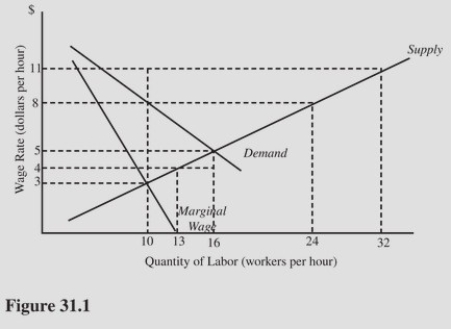 Which of the following indicates the number of workers who are willing to work but are unemployed at the optimal union wage rate in Figure 31.1?
 (Multiple Choice)
4.7/5 (76)
(76) Unions have had an impact on U.S.firms by supporting all of the following types of legislation except
(Multiple Choice)
4.9/5 (76)
(76) Which of the following is an example of an industrial union?
(Multiple Choice)
4.9/5 (82)
(82) Unlike most monopolies,unions do not attempt to use their market power to raise the equilibrium wage above its competitive level.
(True/False)
4.9/5 (94)
(94) 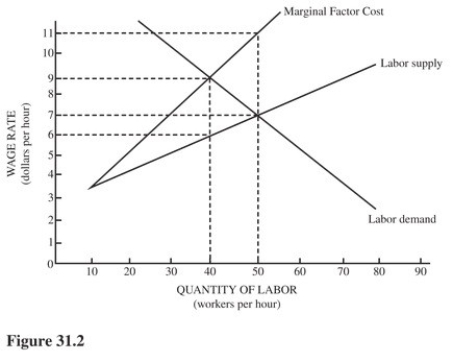 Refer to Figure 31.2 for a monopsonist employer.From the monopsonist's standpoint,the optimal wage and employment level would be
 (Multiple Choice)
4.9/5 (86)
(86) 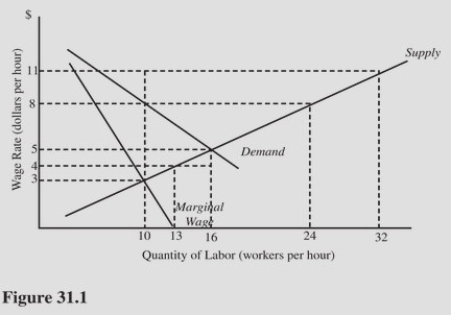 What are the competitive equilibrium wage and employment level in Figure 31.1?
 (Multiple Choice)
4.9/5 (87)
(87) Table 31.1 Wage rate (dollars per hour) Labor demanded (workers) Total labor cost (dollars per hour) Marginal Wage (dollars per worker) \ 26 0 - 24 2 18 4 14 6 10 8 Table 31.1 shows the number of workers a firm is willing to hire per hour at different wage rates.Complete the table by computing the total wage bill (total labor cost)and the marginal wage.Which of the following wages,in Table 31.1,would allow the most workers to be hired?
(Multiple Choice)
4.8/5 (89)
(89) The current private sector unionization rate in the United States is closest to
(Multiple Choice)
5.0/5 (81)
(81) Workers who organize themselves along industry lines are represented by
(Multiple Choice)
4.8/5 (78)
(78) In a monopoly labor market,the optimal union wage can be read off the marginal revenue product curve.
(True/False)
4.8/5 (76)
(76) 
Filters
- Essay(0)
- Multiple Choice(0)
- Short Answer(0)
- True False(0)
- Matching(0)