



 Chat with AI
Exam 11: The Blood

Exam 1: Introduction to Physiology and Homeostasis81 Questions
Exam 2: Cell Physiology135 Questions
Exam 3: The Plasma Membrane and Membrane Potential182 Questions
Exam 4: Principles of Neural and Hormonal Communication169 Questions
Exam 5: A--The Central Nervous System202 Questions
Exam 5: B--The Central Nervous System14 Questions
Exam 6: A--The Peripheral Nervous System: Afferent Division; Special Senses196 Questions
Exam 6: B--The Peripheral Nervous System: Afferent Division; Special Senses20 Questions
Exam 7: The Peripheral Nervous System: Efferent Division104 Questions
Exam 8: A--Muscle Physiology199 Questions
Exam 8: B--Muscle Physiology13 Questions
Exam 9: A--Cardiac Physiology159 Questions
Exam 9: B--Cardiac Physiology20 Questions
Exam 10: The Blood Vessels and Blood Pressure213 Questions
Exam 11: The Blood175 Questions
Exam 12: Body Defenses188 Questions
Exam 13: A--The Respiratory System198 Questions
Exam 13: B--The Respiratory System12 Questions
Exam 14: A--The Urinary System217 Questions
Exam 14: B--The Urinary System19 Questions
Exam 15: A--Fluid and Acid-Base Balance190 Questions
Exam 15: B--Fluid and Acid-Base Balance9 Questions
Exam 16: A--The Digestive System236 Questions
Exam 16: B--The Digestive System12 Questions
Exam 17: Energy Balance and Temperature Regulation139 Questions
Exam 18: A--Principles of Endocrinology: the Central Endocrine Glands204 Questions
Exam 18: B--Principles of Endocrinology: the Central Endocrine Glands6 Questions
Exam 19: A--The Peripheral Endocrine Glands196 Questions
Exam 19: B--The Peripheral Endocrine Glands6 Questions
Exam 20: A--The Reproductive System235 Questions
Exam 20: B--The Reproductive System5 Questions
Select questions type


Complete each of the following statments.
Pathogens are microorganisms that cause ____________________.
(Short Answer)
4.7/5  (81)
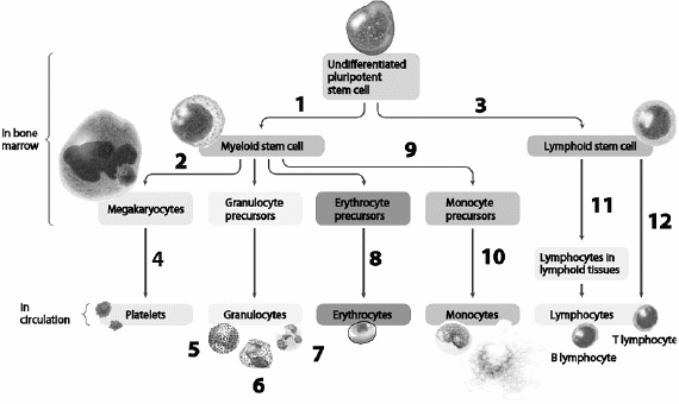
(81) Use this figure to answer the corresponding questions.
Which numbers identify the specific cell affected in mononucleosis?
(Short Answer)
4.8/5 (75)
(75) Complete each of the following statments.
By far, the most abundant cellular elements in the blood are the ____________________.
(Short Answer)
4.9/5 (87)
(87) Complete each of the following statments.
The three types of cellular elements in the blood are ____________________, ____________________, and ____________________.
(Essay)
4.9/5 (85)
(85) Which of the following statements concerning erythrocytes is incorrect?
(Multiple Choice)
5.0/5 (87)
(87) The deficiency of vitamin ____ can cause a bleeding tendency.
(Multiple Choice)
4.8/5 (82)
(82) Anemia results from a reduced O2-carrying capacity of the blood, which can be caused by a decrease in the number of
(Multiple Choice)
4.8/5 (83)
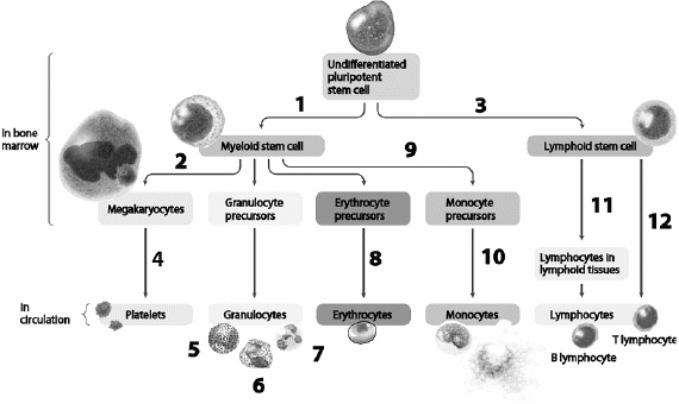
(83) Use this figure to answer the corresponding questions.
The two cells known primarily for their phagocytic activity are ____________________, which are identified as number ____________________, and the ____________________, which are identified as number ____________________.
(Short Answer)
4.8/5 (75)
(75) Complete each of the following statments.
____________________ are immature circulating erythrocytes that contain residual ribosomes and organelle remnants that have not yet been extruded.
(Short Answer)
4.7/5 (76)
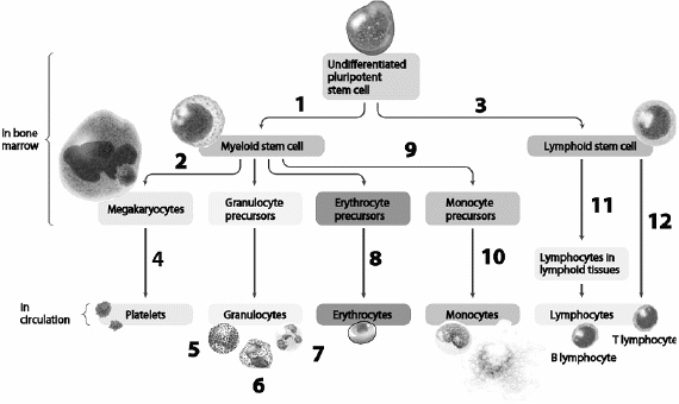
(76) Use this figure to answer the corresponding questions.
Which number identifies the specific cell most commonly associated with parasitic infections?
(Short Answer)
4.9/5 (78)
(78) The rate of erythropoiesis normally increases in a person adjusting to higher altitudes.
(True/False)
4.8/5 (79)
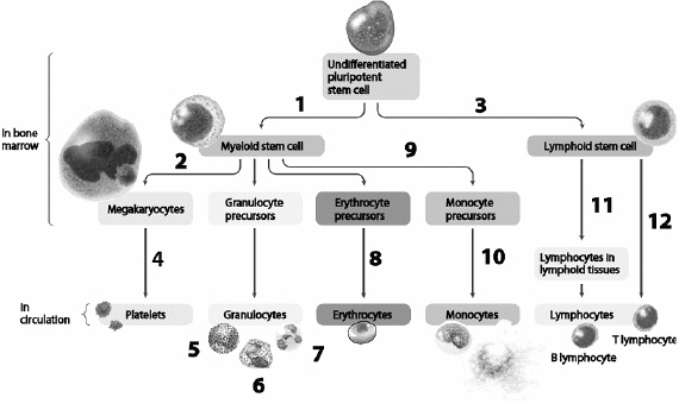
(79) Use this figure to answer the corresponding questions.
The cell marked 2 is a(n) ____________________ and it is derived from a(n) ____________________ cell (marked 1). The cell marked 2 gives rise to ____________________ (marked 4), which are important in blood ____________________.
(Essay)
4.9/5 (81)
(81) Why is the advantage of having biconcavity of the erythrocyte important?
(Multiple Choice)
4.8/5 (94)
(94) 
Filters
- Essay(0)
- Multiple Choice(0)
- Short Answer(0)
- True False(0)
- Matching(0)