



 Chat with AI
Exam 11: The Blood

Exam 1: Introduction to Physiology and Homeostasis81 Questions
Exam 2: Cell Physiology135 Questions
Exam 3: The Plasma Membrane and Membrane Potential182 Questions
Exam 4: Principles of Neural and Hormonal Communication169 Questions
Exam 5: A--The Central Nervous System202 Questions
Exam 5: B--The Central Nervous System14 Questions
Exam 6: A--The Peripheral Nervous System: Afferent Division; Special Senses196 Questions
Exam 6: B--The Peripheral Nervous System: Afferent Division; Special Senses20 Questions
Exam 7: The Peripheral Nervous System: Efferent Division104 Questions
Exam 8: A--Muscle Physiology199 Questions
Exam 8: B--Muscle Physiology13 Questions
Exam 9: A--Cardiac Physiology159 Questions
Exam 9: B--Cardiac Physiology20 Questions
Exam 10: The Blood Vessels and Blood Pressure213 Questions
Exam 11: The Blood175 Questions
Exam 12: Body Defenses188 Questions
Exam 13: A--The Respiratory System198 Questions
Exam 13: B--The Respiratory System12 Questions
Exam 14: A--The Urinary System217 Questions
Exam 14: B--The Urinary System19 Questions
Exam 15: A--Fluid and Acid-Base Balance190 Questions
Exam 15: B--Fluid and Acid-Base Balance9 Questions
Exam 16: A--The Digestive System236 Questions
Exam 16: B--The Digestive System12 Questions
Exam 17: Energy Balance and Temperature Regulation139 Questions
Exam 18: A--Principles of Endocrinology: the Central Endocrine Glands204 Questions
Exam 18: B--Principles of Endocrinology: the Central Endocrine Glands6 Questions
Exam 19: A--The Peripheral Endocrine Glands196 Questions
Exam 19: B--The Peripheral Endocrine Glands6 Questions
Exam 20: A--The Reproductive System235 Questions
Exam 20: B--The Reproductive System5 Questions
Select questions type


Describe the ABO blood types and the factors that determine the type of blood a person might receive in a transfusion.
(Essay)
4.8/5  (76)
(76) All of the constituents present in the plasma are freely diffusible across the capillary walls.
(True/False)
4.7/5 (71)
(71) People with type-A blood produce anti-B antibodies without ever being exposed to type-B blood, but Rh-negative individuals produce anti-Rh antibodies only if they are exposed to Rh-positive blood.
(True/False)
5.0/5 (78)
(78) Polycythemia can occur in association with chronic lung disease.
(True/False)
5.0/5 (74)
(74) When small blood vessels are damaged, loss of blood is prevented by
(Multiple Choice)
4.9/5 (81)
(81) The intrinsic clotting pathway stops blood in an injured vessel, whereas the extrinsic pathway clots blood that has escaped into the tissues.
(True/False)
4.8/5 (83)
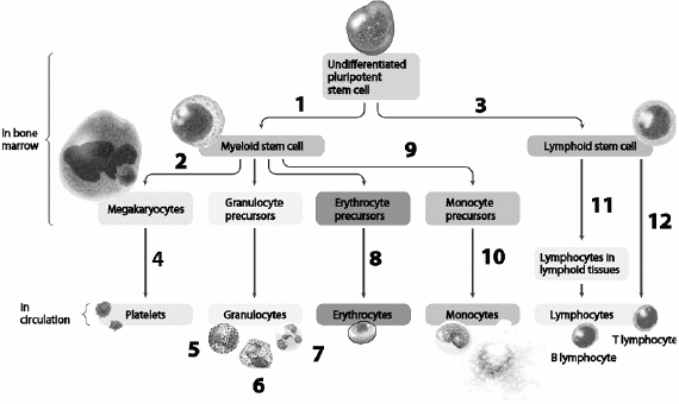
(83) Use this figure to answer the corresponding questions.
Of the cells identified with numbers 4-12, which type is the most abundant in the blood?
(Short Answer)
4.9/5 (82)
(82) Lymphocytes are the only granulocytes that make gamma globulins.
(True/False)
4.8/5 (79)
(79) A deficiency of vitamin B12 is responsible for aplastic anemia.
(Short Answer)
4.7/5 (80)
(80) Type AB blood has both A and B antigens and no anti-A or anti-B antibodies.
(True/False)
4.9/5 (91)
(91) 
Filters
- Essay(0)
- Multiple Choice(0)
- Short Answer(0)
- True False(0)
- Matching(0)