



 Chat with AI
Exam 34: Neurons, Sense Organs, and Nervous Systems

Exam 1: Introduction81 Questions
Exam 2: The Chemistry and Energy of Life87 Questions
Exam 3: Nucleic Acids, Proteins, and Enzymes118 Questions
Exam 4: Cells: the Working Units of Life115 Questions
Exam 5: Cell Membranes and Signaling95 Questions
Exam 6: Pathways That Harvest and Store Chemical Energy130 Questions
Exam 7: The Cell Cycle and Cell Division119 Questions
Exam 8: Inheritance, Genes, and Chromosomes80 Questions
Exam 9: DNA and Its Role in Heredity94 Questions
Exam 10: From Dna to Protein: Gene Expression80 Questions
Exam 11: Regulation of Gene Expression94 Questions
Exam 12: Genomes78 Questions
Exam 13: Biotechnology83 Questions
Exam 14: Genes, Development, and Evolution94 Questions
Exam 15: Processes of Evolution83 Questions
Exam 16: Reconstructing and Using Phylogenies76 Questions
Exam 17: Speciation80 Questions
Exam 18: The History of Life on Earth82 Questions
Exam 19: Bacteria, Archaea, and Viruses100 Questions
Exam 20: The Origin and Diversification of Eukaryotes96 Questions
Exam 21: The Evolution of Plants130 Questions
Exam 22: The Evolution and Diversity of Fungi103 Questions
Exam 23: Animal Origins and Diversity136 Questions
Exam 24: The Plant Body90 Questions
Exam 25: Plant Nutrition and Transport129 Questions
Exam 26: Plant Growth and Development85 Questions
Exam 27: Reproduction of Flowering Plants85 Questions
Exam 28: Plants in the Environment85 Questions
Exam 29: Fundamentals of Animal Function86 Questions
Exam 30: Nutrition and Digestion81 Questions
Exam 31: Breathing83 Questions
Exam 32: Circulation80 Questions
Exam 33: Muscle and Movement75 Questions
Exam 34: Neurons, Sense Organs, and Nervous Systems171 Questions
Exam 35: Nervous and Endocrine Control94 Questions
Exam 36: Water and Salts: Excretion85 Questions
Exam 37: Animal Reproduction84 Questions
Exam 38: Animal Development104 Questions
Exam 39: Immunology: Animal Defense Systems91 Questions
Exam 40: Animal Behavior83 Questions
Exam 41: The Distribution of Earths Ecological Systems82 Questions
Exam 42: Populations78 Questions
Exam 43: Ecological and Evolutionary Consequences of Interactions Within and Among Species114 Questions
Exam 44: Ecological Communities121 Questions
Exam 45: The Global Ecosystem127 Questions
Select questions type


The smell of bread baking triggers a sensory response comprising multiple steps.Which is the first step of this process?
(Multiple Choice)
4.9/5  (76)
(76) A certain cell is highly elongated and is able to conduct an action potential to a specific location.It is also able to integrate signals from many other cells into a single output.This type of cell is a(n)
(Multiple Choice)
4.7/5 (80)
(80) A person who suddenly smells an extremely strong,offensive odor is able to perceive it as strong because of the
(Multiple Choice)
4.8/5 (78)
(78) The function of combining and integrating incoming signals into a single output occurs in which part of the neuron?
(Multiple Choice)
4.9/5 (89)
(89) Refer to the diagram below showing the response of a muscle spindle to a stretch stimulus.What happens to the size and frequency of action potentials as the strength of the stretch stimulus increases? 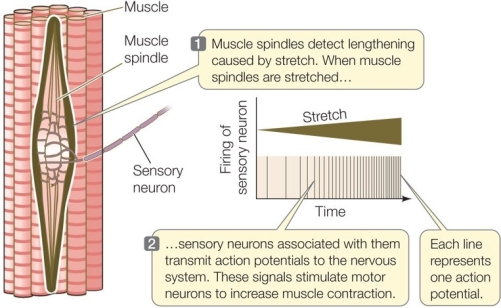
(Essay)
4.7/5 (62)
(62) In a situation that requires the most rapid possible response as an action potential crosses the synaptic cleft,_______ provide fast,invariant signal transmission.
(Multiple Choice)
4.9/5 (78)
(78) Whether a synapse is excitatory or inhibitory depends on the
(Multiple Choice)
4.9/5 (84)
(84) The difference between an IPSP and an EPSP is that an EPSP produces
(Multiple Choice)
4.8/5 (76)
(76) Define synaptic plasticity,and explain why it is important.Give an example.
(Essay)
4.8/5 (79)
(79) A neurotransmitter receptor is a ligand-gated ion channel,and neurotransmitter binding to this receptor results in a rapid but short-lived change in the postsynaptic membrane potential.This type of receptor is most likely
(Multiple Choice)
4.9/5 (69)
(69) How do graded changes in membrane potential give rise to all-or-none changes that generate action potentials?
(Multiple Choice)
4.7/5 (69)
(69) How do neurons in the nerve net of a jellyfish differ from those in vertebrate nervous systems?
(Multiple Choice)
4.8/5 (70)
(70) The four functional regions of a typical neuron include all of the following except the
(Multiple Choice)
4.8/5 (73)
(73) A sensory neuron from a muscle cell enters the spinal cord and synapses with a single interneuron.The interneuron synapses with a motor neuron,sending a response back to the muscle cell.This process is called a spinal _______.
(Essay)
4.9/5 (76)
(76) An animal's sensory processes enable it to detect and respond to
(Multiple Choice)
4.7/5 (79)
(79) Refer to the graphs below.In this experiment,researchers studied squid neuromuscular junctions.The graphs show membrane potential at the presynaptic (top)and postsynaptic (bottom)membrane for controls and two treatments.(BAPTA is a chemical that binds Ca2+ ions. )What do the graphs indicate about the role of calcium in transferring an action potential across a neuromuscular junction? 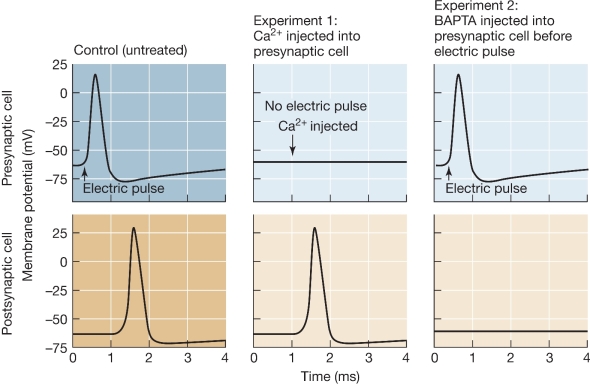
(Essay)
4.8/5 (73)
(73) Do autonomic functions,such as breathing,heart rate,and contraction of blood vessels and intestinal muscles,utilize sensory inputs?
(Multiple Choice)
4.9/5 (85)
(85) During vertebrate evolution,which part of the brain has shown the greatest increase in size?
(Multiple Choice)
4.7/5 (67)
(67) Which characteristic,found in the nervous systems of arthropods such as insects,is not shared by vertebrate nervous systems?
(Multiple Choice)
4.8/5 (81)
(81) 
Filters
- Essay(0)
- Multiple Choice(0)
- Short Answer(0)
- True False(0)
- Matching(0)