



 Chat with AI
Exam 34: Neurons, Sense Organs, and Nervous Systems

Exam 1: Introduction81 Questions
Exam 2: The Chemistry and Energy of Life87 Questions
Exam 3: Nucleic Acids, Proteins, and Enzymes118 Questions
Exam 4: Cells: the Working Units of Life115 Questions
Exam 5: Cell Membranes and Signaling95 Questions
Exam 6: Pathways That Harvest and Store Chemical Energy130 Questions
Exam 7: The Cell Cycle and Cell Division119 Questions
Exam 8: Inheritance, Genes, and Chromosomes80 Questions
Exam 9: DNA and Its Role in Heredity94 Questions
Exam 10: From Dna to Protein: Gene Expression80 Questions
Exam 11: Regulation of Gene Expression94 Questions
Exam 12: Genomes78 Questions
Exam 13: Biotechnology83 Questions
Exam 14: Genes, Development, and Evolution94 Questions
Exam 15: Processes of Evolution83 Questions
Exam 16: Reconstructing and Using Phylogenies76 Questions
Exam 17: Speciation80 Questions
Exam 18: The History of Life on Earth82 Questions
Exam 19: Bacteria, Archaea, and Viruses100 Questions
Exam 20: The Origin and Diversification of Eukaryotes96 Questions
Exam 21: The Evolution of Plants130 Questions
Exam 22: The Evolution and Diversity of Fungi103 Questions
Exam 23: Animal Origins and Diversity136 Questions
Exam 24: The Plant Body90 Questions
Exam 25: Plant Nutrition and Transport129 Questions
Exam 26: Plant Growth and Development85 Questions
Exam 27: Reproduction of Flowering Plants85 Questions
Exam 28: Plants in the Environment85 Questions
Exam 29: Fundamentals of Animal Function86 Questions
Exam 30: Nutrition and Digestion81 Questions
Exam 31: Breathing83 Questions
Exam 32: Circulation80 Questions
Exam 33: Muscle and Movement75 Questions
Exam 34: Neurons, Sense Organs, and Nervous Systems171 Questions
Exam 35: Nervous and Endocrine Control94 Questions
Exam 36: Water and Salts: Excretion85 Questions
Exam 37: Animal Reproduction84 Questions
Exam 38: Animal Development104 Questions
Exam 39: Immunology: Animal Defense Systems91 Questions
Exam 40: Animal Behavior83 Questions
Exam 41: The Distribution of Earths Ecological Systems82 Questions
Exam 42: Populations78 Questions
Exam 43: Ecological and Evolutionary Consequences of Interactions Within and Among Species114 Questions
Exam 44: Ecological Communities121 Questions
Exam 45: The Global Ecosystem127 Questions
Select questions type


One major difference between the stretch receptor cells of muscle fibers and the chemoreceptors found in the nasal cavity is that only stretch receptors contain
(Multiple Choice)
4.8/5  (75)
(75) After a test,Amanda relaxes,and her heart rate and breathing rate return to normal.This suggests that her _______ nervous system is activated and is releasing _______.
(Multiple Choice)
5.0/5 (83)
(83) Increase in which neural response is not likely to be due to short-term synaptic plasticity?
(Multiple Choice)
4.9/5 (79)
(79) Neurons and muscle cells have electrical polarity between the inside and outside of their cell membranes,enabling them to generate and transmit action potentials.This specialization means that both types of cells are _______ cells.
(Essay)
4.9/5 (85)
(85) How do the ommatidia of the compound eyes of arthropods differ from the image-forming eyes of vertebrates?
(Multiple Choice)
4.9/5 (88)
(88) Describe the steps of an experiment that could be designed to determine the part of the brain involved in mathematical learning.
(Essay)
4.9/5 (87)
(87) In simple organisms such as the sea anemone,the nervous system consists of a _______.
(Essay)
4.9/5 (85)
(85) In which organism are you likely to find myelinated axons?
(Multiple Choice)
5.0/5 (93)
(93) The preganglionic neurons of the sympathetic division synapse with their postganglionic neurons
(Multiple Choice)
4.8/5 (77)
(77) In the mammalian eye,1‒2 percent of ganglion cells are photosensitive.If these cells were not photosensitive,which function would mammals be unable to carry out?
(Multiple Choice)
4.9/5 (89)
(89) The type of neurons most prevalent in the central nervous system and that integrate information and make decisions about responses are called _______.
(Essay)
4.9/5 (74)
(74) Refer to the diagram below.This diagram illustrates the generating of an action potential by a process of 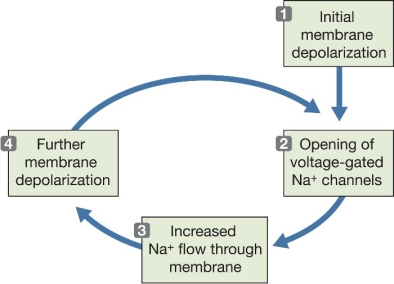
(Multiple Choice)
5.0/5 (73)
(73) A birdwatcher who is learning to identify a new bird notes the bird's color pattern,its call,and its name.Each time she sees the new bird,she becomes more efficient at identifying it.In regard to underlying synaptic plasticity,which action is likely occurring in the birdwatcher's brain?
(Multiple Choice)
4.8/5 (83)
(83) A male insect's body contains neurons that detect tiny concentrations of pheromones,or attractant molecules secreted by the female insect.The neurons change these chemical signals into electrical signals.Would these neurons be considered sensory receptor neurons?
(Multiple Choice)
4.8/5 (81)
(81) When an individual rod or cone cell is stimulated with light,
(Multiple Choice)
5.0/5 (71)
(71) The most rapid conduction of an action potential will occur in an axon of which type?
(Multiple Choice)
4.8/5 (95)
(95) If only the K+ ion channels in a cell membrane are open,the cell membrane will move toward a(n)
(Multiple Choice)
4.8/5 (74)
(74) Brain mapping shows that sensory and motor functions in the human cerebral cortex are arranged
(Multiple Choice)
4.8/5 (87)
(87) The Nernst equation calculates the membrane equilibrium potential to be approximately -80 mV,which is slightly different from the measured resting neuron potential of -60 to -70 mV.The difference most likely occurs because
(Multiple Choice)
4.9/5 (91)
(91) 
Filters
- Essay(0)
- Multiple Choice(0)
- Short Answer(0)
- True False(0)
- Matching(0)