



 Chat with AI
Exam 34: Neurons, Sense Organs, and Nervous Systems

Exam 1: Introduction81 Questions
Exam 2: The Chemistry and Energy of Life87 Questions
Exam 3: Nucleic Acids, Proteins, and Enzymes118 Questions
Exam 4: Cells: the Working Units of Life115 Questions
Exam 5: Cell Membranes and Signaling95 Questions
Exam 6: Pathways That Harvest and Store Chemical Energy130 Questions
Exam 7: The Cell Cycle and Cell Division119 Questions
Exam 8: Inheritance, Genes, and Chromosomes80 Questions
Exam 9: DNA and Its Role in Heredity94 Questions
Exam 10: From Dna to Protein: Gene Expression80 Questions
Exam 11: Regulation of Gene Expression94 Questions
Exam 12: Genomes78 Questions
Exam 13: Biotechnology83 Questions
Exam 14: Genes, Development, and Evolution94 Questions
Exam 15: Processes of Evolution83 Questions
Exam 16: Reconstructing and Using Phylogenies76 Questions
Exam 17: Speciation80 Questions
Exam 18: The History of Life on Earth82 Questions
Exam 19: Bacteria, Archaea, and Viruses100 Questions
Exam 20: The Origin and Diversification of Eukaryotes96 Questions
Exam 21: The Evolution of Plants130 Questions
Exam 22: The Evolution and Diversity of Fungi103 Questions
Exam 23: Animal Origins and Diversity136 Questions
Exam 24: The Plant Body90 Questions
Exam 25: Plant Nutrition and Transport129 Questions
Exam 26: Plant Growth and Development85 Questions
Exam 27: Reproduction of Flowering Plants85 Questions
Exam 28: Plants in the Environment85 Questions
Exam 29: Fundamentals of Animal Function86 Questions
Exam 30: Nutrition and Digestion81 Questions
Exam 31: Breathing83 Questions
Exam 32: Circulation80 Questions
Exam 33: Muscle and Movement75 Questions
Exam 34: Neurons, Sense Organs, and Nervous Systems171 Questions
Exam 35: Nervous and Endocrine Control94 Questions
Exam 36: Water and Salts: Excretion85 Questions
Exam 37: Animal Reproduction84 Questions
Exam 38: Animal Development104 Questions
Exam 39: Immunology: Animal Defense Systems91 Questions
Exam 40: Animal Behavior83 Questions
Exam 41: The Distribution of Earths Ecological Systems82 Questions
Exam 42: Populations78 Questions
Exam 43: Ecological and Evolutionary Consequences of Interactions Within and Among Species114 Questions
Exam 44: Ecological Communities121 Questions
Exam 45: The Global Ecosystem127 Questions
Select questions type


Suppose an ion channel opens and allows the influx of chloride (Cl-),a negative ion,into a cell.Which change would occur in the cell membrane?
(Multiple Choice)
4.7/5  (85)
(85) Neurons that transmit information from sensory cells to the central nervous system are part of the
(Multiple Choice)
4.8/5 (78)
(78) Which of these is not a characteristic of an action potential?
(Multiple Choice)
4.8/5 (75)
(75) The middle ear assists the processing of auditory information by converting _______ pressure waves into _______.
(Multiple Choice)
4.8/5 (87)
(87) Is a spinal reflex such as the knee-jerk response controlled by the autonomic nervous system or by the voluntary nervous system?
(Multiple Choice)
4.8/5 (61)
(61) If a star-nosed mole lost the use of its star-shaped sensory organ,it would be unable to find food by
(Multiple Choice)
4.9/5 (76)
(76) When you eat a very large meal,sensors in your stomach stretch and your body greatly increases its production of digestive enzymes.Which component of the nervous system is controlling this response?
(Multiple Choice)
4.9/5 (88)
(88) Refer to the diagram below.Name the process occurring and briefly describe how it is occurring. 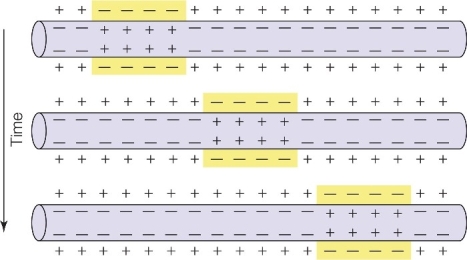
(Essay)
4.9/5 (90)
(90) The release of acetylcholine at a neuromuscular junction is dependent on the action of voltage-gated _______ channels.
(Essay)
4.9/5 (76)
(76) Brushing against a doorway as you enter a room will trigger which type of sensory response?
(Multiple Choice)
4.8/5 (83)
(83) A sea anemone has radial symmetry;its touch receptors and eye spots are located all around its circular body.A deer has large eyes and ears and a sensitive nose,all of which are clustered at the head end of its body.Which difference in these two organisms most likely accounts for this difference in the location of sensory organs?
(Multiple Choice)
4.8/5 (80)
(80) Refer to the diagrams below.What is one possible reason for the presence of ganglia in the insect's nervous system,but not in the dog's? 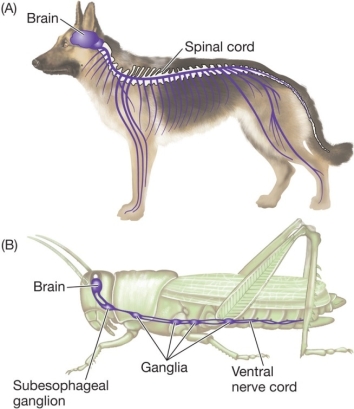
(Essay)
4.7/5 (81)
(81) For an action potential to be turned off after it passes to the next neuron,synapses must be cleared of _______ molecules.
(Essay)
4.8/5 (80)
(80) Stretch-gated Na+ ion channel receptors are of most use in which type of sensory receptor cell?
(Multiple Choice)
4.9/5 (95)
(95) Which of the following best represents the order of the flow of information from a muscle in a crayfish that will ultimately generate an action potential in the crayfish stretch receptor neuron?
(Multiple Choice)
4.9/5 (87)
(87) The resting potential of a membrane is maintained by a steady leakage of _______ ions through ion channels that always remain open.
(Essay)
4.7/5 (72)
(72) The fight-or-flight response is controlled by the _______ branch of the autonomic nervous system.
(Multiple Choice)
4.9/5 (81)
(81) The membrane potential,or electrical difference on the two sides of a membrane,is measured as a _______.
(Essay)
4.9/5 (77)
(77) Which response in vertebrates is controlled by the voluntary,rather than the involuntary (autonomic),nervous system?
(Multiple Choice)
4.9/5 (76)
(76) 
Filters
- Essay(0)
- Multiple Choice(0)
- Short Answer(0)
- True False(0)
- Matching(0)