



 Chat with AI
Exam 34: Neurons, Sense Organs, and Nervous Systems

Exam 1: Introduction81 Questions
Exam 2: The Chemistry and Energy of Life87 Questions
Exam 3: Nucleic Acids, Proteins, and Enzymes118 Questions
Exam 4: Cells: the Working Units of Life115 Questions
Exam 5: Cell Membranes and Signaling95 Questions
Exam 6: Pathways That Harvest and Store Chemical Energy130 Questions
Exam 7: The Cell Cycle and Cell Division119 Questions
Exam 8: Inheritance, Genes, and Chromosomes80 Questions
Exam 9: DNA and Its Role in Heredity94 Questions
Exam 10: From Dna to Protein: Gene Expression80 Questions
Exam 11: Regulation of Gene Expression94 Questions
Exam 12: Genomes78 Questions
Exam 13: Biotechnology83 Questions
Exam 14: Genes, Development, and Evolution94 Questions
Exam 15: Processes of Evolution83 Questions
Exam 16: Reconstructing and Using Phylogenies76 Questions
Exam 17: Speciation80 Questions
Exam 18: The History of Life on Earth82 Questions
Exam 19: Bacteria, Archaea, and Viruses100 Questions
Exam 20: The Origin and Diversification of Eukaryotes96 Questions
Exam 21: The Evolution of Plants130 Questions
Exam 22: The Evolution and Diversity of Fungi103 Questions
Exam 23: Animal Origins and Diversity136 Questions
Exam 24: The Plant Body90 Questions
Exam 25: Plant Nutrition and Transport129 Questions
Exam 26: Plant Growth and Development85 Questions
Exam 27: Reproduction of Flowering Plants85 Questions
Exam 28: Plants in the Environment85 Questions
Exam 29: Fundamentals of Animal Function86 Questions
Exam 30: Nutrition and Digestion81 Questions
Exam 31: Breathing83 Questions
Exam 32: Circulation80 Questions
Exam 33: Muscle and Movement75 Questions
Exam 34: Neurons, Sense Organs, and Nervous Systems171 Questions
Exam 35: Nervous and Endocrine Control94 Questions
Exam 36: Water and Salts: Excretion85 Questions
Exam 37: Animal Reproduction84 Questions
Exam 38: Animal Development104 Questions
Exam 39: Immunology: Animal Defense Systems91 Questions
Exam 40: Animal Behavior83 Questions
Exam 41: The Distribution of Earths Ecological Systems82 Questions
Exam 42: Populations78 Questions
Exam 43: Ecological and Evolutionary Consequences of Interactions Within and Among Species114 Questions
Exam 44: Ecological Communities121 Questions
Exam 45: The Global Ecosystem127 Questions
Select questions type


Which event is not one of the steps that make up a reflex action,such as the knee-jerk reflex?
(Multiple Choice)
4.8/5  (71)
(71) The vertebrate neuromuscular junction has often been used as a model for understanding the functioning of a synapse because it
(Multiple Choice)
4.8/5 (82)
(82) One factor that makes it possible for the odorant receptors on the antennae of moths to be extremely sensitive is that
(Multiple Choice)
4.9/5 (89)
(89) A young boy walks past an old,abandoned house every day on the way home from school.His parents have told him it's not haunted,but he disagrees.One day,some older kids hide in the house,and as he passes by,they rush out wearing costumes and making scary noises.The boy screams,his heart rate shoots up,and he runs away.Which of these reactions is controlled by his autonomic nervous system?
(Multiple Choice)
5.0/5 (67)
(67) A major difference between rods and cones in the human eye is that cones
(Multiple Choice)
4.7/5 (79)
(79) Synaptic plasticity is thought to underlie which brain function?
(Multiple Choice)
4.8/5 (96)
(96) An unusual feature of the brain's processing of language information is that
(Multiple Choice)
5.0/5 (83)
(83) If the resting potential of the neuronal cell membrane is between -60 and -70 mV,the cell
(Multiple Choice)
4.9/5 (90)
(90) Homeostasis of internal body systems is possible because the sympathetic and parasympathetic divisions of the autonomic nervous system have _______ functions.
(Essay)
4.8/5 (78)
(78) Which cell layer in the retina produces the action potentials that enter the brain?
(Multiple Choice)
4.8/5 (87)
(87) Which characteristic would best indicate that a particular synapse is a neuron-to-neuron synapse and not a neuromuscular junction?
(Multiple Choice)
4.8/5 (76)
(76) How do the sizes of synaptic potentials differ at a neuromuscular junction and a neuron-to-neuron synapse,and how does this difference affect the generation of action potentials at each synapse?
(Essay)
4.8/5 (97)
(97) When a neuron contacts another neuron,a muscle,or a gland,the nerve impulse (action potential)is carried to the next cell by means of a _______.
(Essay)
4.8/5 (83)
(83) Light,sound,pressure,and chemicals are all types of _______ information.
(Essay)
4.7/5 (73)
(73) In the myelinated axon of a vertebrate neuron,the action potential jumps along the axon from one _______ to the next.
(Essay)
4.7/5 (78)
(78) In a PET scan,the most active brain areas "light up" with radioactivity when certain activities are performed-for example,seeing,hearing,speaking,reading,or remembering.This suggests that action potentials are interpreted based on the
(Multiple Choice)
4.9/5 (85)
(85) Refer to the diagram below.In this experiment,how did the intensity of light affect the membrane potential? 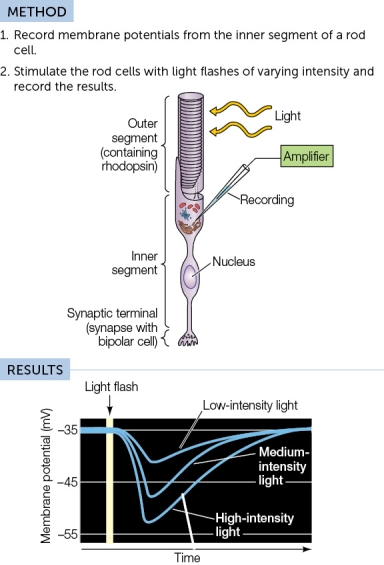
(Essay)
4.9/5 (93)
(93) A nerve cell body is able to depolarize within only one millisecond because,when the threshold potential is reached,
(Multiple Choice)
4.7/5 (86)
(86) The membrane protein sodium-potassium ATPase,also known as the _______,sets up concentration gradients of sodium and potassium ions across the membrane.
(Essay)
4.9/5 (86)
(86) 
Filters
- Essay(0)
- Multiple Choice(0)
- Short Answer(0)
- True False(0)
- Matching(0)