



 Chat with AI
Exam 5: Thermochemistry

Exam 1: Chemistry: the Central Science129 Questions
Exam 2: Atoms Molecules and Ions120 Questions
Exam 3: Stoichiometry Ratios of Combination131 Questions
Exam 4: Reactions in Aqueous Solutions144 Questions
Exam 5: Thermochemistry134 Questions
Exam 6: Quantum Theory and the Electronic Structure of Atoms107 Questions
Exam 7: Electron Configuration and the Periodic Table120 Questions
Exam 8: Chemical Bonding I Basic Concepts95 Questions
Exam 9: Chemical Bonding Ii Molecular Geometry and Bonding Theories137 Questions
Exam 10: Gases131 Questions
Exam 11: Intermolecular Forces and the Physical Properties of Liquids and Solids135 Questions
Exam 12: Modern Materials108 Questions
Exam 13: Physical Properties of Solutions147 Questions
Exam 14: Chemical Kinetics114 Questions
Exam 15: Chemical Equilibrium135 Questions
Exam 16: Acids and Bases133 Questions
Exam 17: Acid-Base Equilibria and Solubility Equilibria129 Questions
Exam 18: Entropy Free Energy and Equilibrium61 Questions
Exam 19: Electrochemistry122 Questions
Exam 20: Nuclear Chemistry125 Questions
Exam 21: Environmental Chemistry131 Questions
Exam 22: Coordination Chemistry128 Questions
Exam 23: Metallurgy and the Chemistry of Metals115 Questions
Exam 24: Nonmetallic Elements and Their Compounds119 Questions
Exam 25: Organic Chemistry148 Questions
Select questions type


The standard temperature is _____; the standard concentration of a solution is _______; and the standard pressure is _____.
(Essay)
4.9/5  (77)
(77) Suppose a sample of gas undergoes the following change of state. 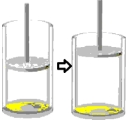 Which statement(s)is/are true concerning this change of state? i.w must be positive.
Ii)w must be negative.
Iii)q must be positive.
Iv)q must be negative.
Which statement(s)is/are true concerning this change of state? i.w must be positive.
Ii)w must be negative.
Iii)q must be positive.
Iv)q must be negative. (Multiple Choice)
4.8/5 (70)
(70) The statement,"Energy can neither be destroyed nor created," is the _____________.
(Short Answer)
4.7/5 (83)
(83) For a particular process,28 kJ of heat is absorbed and 15 kJ of work is done on the surroundings.What is ΔU?
(Multiple Choice)
4.8/5 (92)
(92) A system delivers 222 J of heat to the surroundings while delivering 645 J of work.What is the change in the internal energy,ΔU,of the system?
(Multiple Choice)
4.9/5 (69)
(69) What is ΔH°rxn for the following reaction? 2C8H18(l)+ 17O2(g)→ 16CO(g)+ 18H2O(l)
2C8H18(l)+ 25O2(g)→ 16CO2(g)+ 18H2O(l)
ΔH°rxn = -11020.kJ/mol
2CO(g)+ O2(g)→ 2CO2(g)
ΔH°rxn = -566.0 kJ/mol
(Multiple Choice)
4.8/5 (74)
(74) To which one of the following reactions,occurring at 25oC,does the symbol ΔHof [H2SO4(l)] refer?
(Multiple Choice)
4.8/5 (80)
(80) An ideal gas (the system)is contained in a flexible balloon at a pressure of 1 atm and is initially at a temperature of 20.°C.The surrounding air is at the same pressure,but its temperature is 25°C.When the system has equilibrated with its surroundings,both system and surroundings are at 25°C and 1 atm.In changing from the initial to the final state,which one of the following relationships regarding the system is correct?
(Multiple Choice)
4.9/5 (77)
(77) The sign of w when work is done by the system on the surroundings is _____________.
(Short Answer)
4.8/5 (75)
(75) What is the change in internal energy in joules for a system that releases 154 J of heat and does 125 J of work on its surroundings?
(Multiple Choice)
4.8/5 (78)
(78) Ozone (O3)in the atmosphere can be converted to oxygen gas by reaction with nitric oxide (NO).(Nitrogen dioxide is also produced in the reaction.)What is the enthalpy change when 8.50 L of ozone at a pressure of 1.00 atm and 25°C reacts with 12.00 L of nitric oxide at the same initial pressure and temperature (R = 0.0821 L atm/mol K)? [ΔH°f(NO)= 90.4 kJ/mol; ΔH°f(NO2)= 33.85 kJ/mol; ΔH°f(O3)= 142.2 kJ/mol]
(Multiple Choice)
4.8/5 (75)
(75) When heat is absorbed by the system and work is done by the system on the surroundings then
(Multiple Choice)
4.9/5 (86)
(86) Which type of system may transfer energy,but not mass,to the surroundings?
(Multiple Choice)
4.8/5 (80)
(80) 
Filters
- Essay(0)
- Multiple Choice(0)
- Short Answer(0)
- True False(0)
- Matching(0)