



 Chat with AI
Exam 5: Thermochemistry

Exam 1: Chemistry: the Central Science129 Questions
Exam 2: Atoms Molecules and Ions120 Questions
Exam 3: Stoichiometry Ratios of Combination131 Questions
Exam 4: Reactions in Aqueous Solutions144 Questions
Exam 5: Thermochemistry134 Questions
Exam 6: Quantum Theory and the Electronic Structure of Atoms107 Questions
Exam 7: Electron Configuration and the Periodic Table120 Questions
Exam 8: Chemical Bonding I Basic Concepts95 Questions
Exam 9: Chemical Bonding Ii Molecular Geometry and Bonding Theories137 Questions
Exam 10: Gases131 Questions
Exam 11: Intermolecular Forces and the Physical Properties of Liquids and Solids135 Questions
Exam 12: Modern Materials108 Questions
Exam 13: Physical Properties of Solutions147 Questions
Exam 14: Chemical Kinetics114 Questions
Exam 15: Chemical Equilibrium135 Questions
Exam 16: Acids and Bases133 Questions
Exam 17: Acid-Base Equilibria and Solubility Equilibria129 Questions
Exam 18: Entropy Free Energy and Equilibrium61 Questions
Exam 19: Electrochemistry122 Questions
Exam 20: Nuclear Chemistry125 Questions
Exam 21: Environmental Chemistry131 Questions
Exam 22: Coordination Chemistry128 Questions
Exam 23: Metallurgy and the Chemistry of Metals115 Questions
Exam 24: Nonmetallic Elements and Their Compounds119 Questions
Exam 25: Organic Chemistry148 Questions
Select questions type


A(n)___________ __________ is a process where heat is absorbed from the surroundings.

Free
(Short Answer)
5.0/5  (82)
(82) Correct Answer: Verified
endothermic process
Naphthalene combustion may be used to calibrate the heat capacity of a bomb calorimeter.The heat of combustion of naphthalene is -40.1 kJ/g.When 0.8210 g of naphthalene was burned in a bomb calorimeter containing 1.000 kg of water,a temperature rise of 4.21°C was observed.What is the heat capacity of the bomb calorimeter excluding the water?
Free
(Multiple Choice)
4.7/5 (85)
(85) Correct Answer:Verified
VerifiedC
The heat of solution of ammonium chloride is 15.2 kJ/mol.If a 6.134-g sample of NH4Cl is added to 65.0 mL of water in a calorimeter at 24.5°C,what is the final temperature of the solution? The specific heat of water is 4.18 J/g·°C and the heat capacity of the calorimeter is 365 J/°C.
Free
(Multiple Choice)
4.8/5 (87)
(87) Correct Answer:Verified
VerifiedD
Aluminum oxide can be reduced to aluminum metal using carbon,the other reaction product being carbon monoxide.What is the enthalpy change if 12.50 g of aluminum is produced by this method? Substance ΔH°f(kJ/mol)
CO(g)-110.5
Al2O3(s)-1669.8
(Multiple Choice)
4.9/5 (73)
(73) What is the change in temperature if a 25.0-g block of aluminum absorbs 10.0 kJ of heat? The specific heat of aluminum is 0.900 J/g·°C.
(Multiple Choice)
4.8/5 (78)
(78) The enthalpy of formation of a liquid is always larger than the enthalpy of formation of the gas of the same compound.
(True/False)
4.8/5 (78)
(78) If 75.4 J of energy is absorbed by 0.25 mol of CCl4 at constant pressure,what is the change in temperature? The specific heat of CCl4 is 0.861 J/g·°C.
(Multiple Choice)
4.8/5 (88)
(88) What is ΔH°rxn for the decomposition of calcium carbonate to calcium oxide and carbon dioxide? CaCO3(s)→ CaO(s)+ CO2(g)
Substance ΔH°f(kJ/mol)
CaCO3(s)-1206.9
CaO(s)-635.6
CO2(g)-393.5
(Multiple Choice)
4.8/5 (70)
(70) A 275-g sample of nickel at l00.0°C is placed in 100.0 g of water at 22.0°C.What is the final temperature of the water? Assume no heat transfer with the surroundings.The specific heat of nickel is 0.444 J/g·°C and the specific heat of water is 4.184 J/g·°C.
(Multiple Choice)
5.0/5 (85)
(85) Styrene,C8H8,is one of the substances used in the production of synthetic rubber.When styrene burns in oxygen to form carbon dioxide and liquid water under standard-state conditions at 25°C,42.15 kJ are released per gram of styrene.Find the standard enthalpy of formation of styrene at 25°C. ΔH°f(CO2(g))= -393.5 kJ/mol,ΔH°f(H2O(l))= -285.8 kJ/mol
(Multiple Choice)
4.9/5 (75)
(75) In which reaction would you expect ΔH to be substantially greater than ΔU (i.e.,ΔH > ΔU)?
(Multiple Choice)
4.9/5 (79)
(79) How much heat is required to raise the temperature of 22.8 g of copper from 20.0°C to 875.0°C? The specific heat of copper is 0.385 J/g·°C.
(Multiple Choice)
4.9/5 (85)
(85) A 307-g sample of an unknown mineral was heated to 98.7°C and placed into a calorimeter containing 72.4 g of water at 23.6°C.The heat capacity of the calorimeter was 15.7 J/°C.The final temperature in the calorimeter was 32.4°C.What is the specific heat capacity of the mineral?
(Multiple Choice)
4.9/5 (77)
(77) ___________ is the amount of heat required to raise the temperature of one gram of a substance by one degree Celsius.
pecific heat
(Short Answer)
4.8/5 (72)
(72) If 325 g of water at 4.2°C absorbs 12.28 kJ,what is the final temperature of the water? The specific heat of water is 4.184 J/g·°C.
(Multiple Choice)
4.8/5 (77)
(77) Atoms A and Z may form either single bonds or double bonds.Shown is an energy diagram for the formation of a single bond between A and Z from the individual atoms in the gas phase. 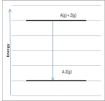 Which diagram below corresponds to the reaction A(g)+ Z(g)→ A=Z(g)?
 (Multiple Choice)
4.8/5 (87)
(87) A system receives 575 J of heat and delivers 424 J of work.What is the change in the internal energy,ΔU,of the system?
(Multiple Choice)
4.9/5 (72)
(72) What is the standard enthalpy change for the decomposition of one mole of SO3? 2SO2 + O2→ 2SO3 ΔH°rxn = -198 kJ/mol
(Multiple Choice)
4.9/5 (80)
(80) An important step in the synthesis of nitric acid is the conversion of ammonia to nitric oxide according to the following balanced chemical equation.What is ΔH°rxn for this reaction? 4NH3(g)+ 5O2(g)→ 4NO(g)+ 6H2O(g)
Substance ΔH°f(kJ/mol)
NH3(g)-46.3
NO(g)90.3
H2O(g)-241.8
(Multiple Choice)
4.9/5 (77)
(77) 
Filters
- Essay(0)
- Multiple Choice(0)
- Short Answer(0)
- True False(0)
- Matching(0)