



 Chat with AI
Exam 20: Nuclear Chemistry

Exam 1: Chemistry: the Central Science129 Questions
Exam 2: Atoms Molecules and Ions120 Questions
Exam 3: Stoichiometry Ratios of Combination131 Questions
Exam 4: Reactions in Aqueous Solutions144 Questions
Exam 5: Thermochemistry134 Questions
Exam 6: Quantum Theory and the Electronic Structure of Atoms107 Questions
Exam 7: Electron Configuration and the Periodic Table120 Questions
Exam 8: Chemical Bonding I Basic Concepts95 Questions
Exam 9: Chemical Bonding Ii Molecular Geometry and Bonding Theories137 Questions
Exam 10: Gases131 Questions
Exam 11: Intermolecular Forces and the Physical Properties of Liquids and Solids135 Questions
Exam 12: Modern Materials108 Questions
Exam 13: Physical Properties of Solutions147 Questions
Exam 14: Chemical Kinetics114 Questions
Exam 15: Chemical Equilibrium135 Questions
Exam 16: Acids and Bases133 Questions
Exam 17: Acid-Base Equilibria and Solubility Equilibria129 Questions
Exam 18: Entropy Free Energy and Equilibrium61 Questions
Exam 19: Electrochemistry122 Questions
Exam 20: Nuclear Chemistry125 Questions
Exam 21: Environmental Chemistry131 Questions
Exam 22: Coordination Chemistry128 Questions
Exam 23: Metallurgy and the Chemistry of Metals115 Questions
Exam 24: Nonmetallic Elements and Their Compounds119 Questions
Exam 25: Organic Chemistry148 Questions
Select questions type


The dose unit of ionizing radiation is called the rad.The rad is defined in terms of

Free
(Multiple Choice)
4.7/5  (93)
(93) Correct Answer: Verified
B
For stable atoms of elements having low atomic numbers (≤ 20),the neutron-to-proton ratio is close to zero.
Free
(True/False)
4.7/5 (81)
(81) Correct Answer:Verified
VerifiedFalse
Identify the missing species in the following nuclear transmutation. U-238 + ? → 1 neutron + Fm-249
Free
(Multiple Choice)
4.9/5 (82)
(82) Correct Answer:Verified
VerifiedD
Nuclei with an _____ number of protons and an _____ number of neutrons tend to be more stable than those with an _____ number of protons and/or an _____ number of neutrons.
(Multiple Choice)
4.9/5 (75)
(75) Which is an incorrect representation of the indicated particle or nucleus?
(Multiple Choice)
4.8/5 (84)
(84) What fraction of radioactive atoms remains in a sample after six half-lives?
(Multiple Choice)
4.9/5 (73)
(73) The ___________ _________ ___________ is a quantitative measure of the nuclear stability of a nucleus,which is the energy required to break up a nucleus into its component protons and neutrons.
(Short Answer)
4.7/5 (86)
(86) Identify the missing species in the following nuclear transmutation. 
(Multiple Choice)
4.9/5 (75)
(75) Which isotope,when bombarded with nitrogen-15,yields four neutrons and the artificial isotope dubnium-260?
(Multiple Choice)
4.9/5 (77)
(77) Uranium-235 decays by alpha emission.What isotope is also produced by this transformation?
(Multiple Choice)
4.8/5 (76)
(76) A 55-kg person exposed to thorium-234 receives 7.5 × 10⁴ β particles,each with an energy of 1.6 × 10⁻¹⁴ J.How many rads does the person receive?
(Multiple Choice)
4.7/5 (75)
(75) In the following diagrams,A represents a radioactive isotope that decays into a new isotope,X.Each circle represents 1 mmol of atoms. t = 0: 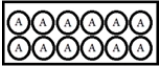 t = 25.0 s:
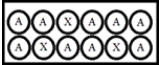 Over the first 25.0 s,what is the disintegration rate of A?
t = 25.0 s: Over the first 25.0 s,what is the disintegration rate of A? (Multiple Choice)
4.7/5 (86)
(86) A particle accelerator uses which of the following to increase the kinetic energy of charged species so that a reaction will occur?
(Multiple Choice)
4.8/5 (79)
(79) Select the nuclide that completes the following nuclear reaction  ?
? (Multiple Choice)
4.9/5 (86)
(86) Calculate the energy released in joules when one mole of polonium-214 decays according to the following equation.  Particle Mass (amu)
Pb-210
209)98284
Po-214
213)99519
He-4
4)00260
(1 kg = 6.022 × 1026 amu;
NA = 6.022 × 10²³ mol-1;
C = 2.99792458 × 10⁸ m/s)
Particle Mass (amu)
Pb-210
209)98284
Po-214
213)99519
He-4
4)00260
(1 kg = 6.022 × 1026 amu;
NA = 6.022 × 10²³ mol-1;
C = 2.99792458 × 10⁸ m/s) (Multiple Choice)
4.7/5 (85)
(85) In the following diagrams,A represents a radioactive isotope that decays into a new isotope,X.Each circle represents 1 mmol of atoms. t = 0: 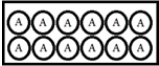 t = 25.0 s:
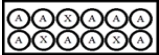 Which diagram best represents the sample at t = 50.0 s?
t = 25.0 s: Which diagram best represents the sample at t = 50.0 s? (Multiple Choice)
4.9/5 (90)
(90) 
Filters
- Essay(0)
- Multiple Choice(0)
- Short Answer(0)
- True False(0)
- Matching(0)