



 Chat with AI
Exam 20: Nuclear Chemistry

Exam 1: Chemistry: the Central Science129 Questions
Exam 2: Atoms Molecules and Ions120 Questions
Exam 3: Stoichiometry Ratios of Combination131 Questions
Exam 4: Reactions in Aqueous Solutions144 Questions
Exam 5: Thermochemistry134 Questions
Exam 6: Quantum Theory and the Electronic Structure of Atoms107 Questions
Exam 7: Electron Configuration and the Periodic Table120 Questions
Exam 8: Chemical Bonding I Basic Concepts95 Questions
Exam 9: Chemical Bonding Ii Molecular Geometry and Bonding Theories137 Questions
Exam 10: Gases131 Questions
Exam 11: Intermolecular Forces and the Physical Properties of Liquids and Solids135 Questions
Exam 12: Modern Materials108 Questions
Exam 13: Physical Properties of Solutions147 Questions
Exam 14: Chemical Kinetics114 Questions
Exam 15: Chemical Equilibrium135 Questions
Exam 16: Acids and Bases133 Questions
Exam 17: Acid-Base Equilibria and Solubility Equilibria129 Questions
Exam 18: Entropy Free Energy and Equilibrium61 Questions
Exam 19: Electrochemistry122 Questions
Exam 20: Nuclear Chemistry125 Questions
Exam 21: Environmental Chemistry131 Questions
Exam 22: Coordination Chemistry128 Questions
Exam 23: Metallurgy and the Chemistry of Metals115 Questions
Exam 24: Nonmetallic Elements and Their Compounds119 Questions
Exam 25: Organic Chemistry148 Questions
Select questions type


What other particle is emitted when a neutron is converted to a proton in a nucleus?
(Multiple Choice)
4.9/5  (81)
(81) The 14C activity of some ancient Peruvian corn was found to be 10 disintegrations per minute per gram of carbon.If present-day plant life shows 15 dpm/g,how old is the Peruvian corn? (The half-life of 14C is 5730 yr.)
(Multiple Choice)
4.9/5 (78)
(78) Naturally occurring uranium contains approximately 1% U-235 and 99% U-238.Of these,the isotope that undergoes fission in a nuclear reactor is U-238.
(True/False)
4.9/5 (85)
(85) In the following diagrams,A represents a radioactive isotope that decays into a new isotope,X.Each circle represents 1 mmol of atoms. t = 0: 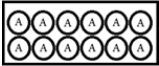 t = 25.0 s:
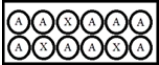 What is the half-life of A?
t = 25.0 s: What is the half-life of A? (Multiple Choice)
4.8/5 (88)
(88) What is the name for the minimum mass of fissionable material required to generate a self-sustaining nuclear chain reaction?
(Short Answer)
4.8/5 (70)
(70) In the equation below,what particle or type of radiation needs to be included to balance the equation? 234Th → ? + beta particle
(Multiple Choice)
4.9/5 (85)
(85) In a nuclear reaction elements are converted to other elements.
(True/False)
4.9/5 (80)
(80) What role does cadmium metal (Cd)play in a nuclear reactor?
(Multiple Choice)
4.9/5 (84)
(84) The difference between the mass of an atom and the sum of the masses of its protons,neutrons,and electrons is called the ___________ ___________.
(Short Answer)
4.7/5 (71)
(71) A patient's thyroid gland is to be exposed to an average of 5.5 μCi for 16 days as an ingested sample of iodine-131 decays.If the energy of the β radiation is 9.7 × 10⁻¹⁴ J and the mass of the thyroid is 32.0 g,what is the dose received by the patient? (1 rad = 1 × 10⁻⁵ J/g; 1 Ci = 3.7 × 10¹⁰ disintegrations/s)
(Multiple Choice)
4.8/5 (81)
(81) What is the nuclear process called where small nuclei are combined into larger ones?
(Multiple Choice)
4.7/5 (85)
(85) Rubidium-87 decays by beta decay with a half-life of 4.9 × 10¹⁰ yr.How many 87Rb atoms are in a moon rock sample that has a rubidium decay rate of 3500 disintegrations per hour?
(Multiple Choice)
4.8/5 (79)
(79) In order to investigate the age of a mineral sample believed to be millions of years old,which would be the best choice of radioactive isotope to measure?
(Multiple Choice)
4.9/5 (82)
(82) In the equation below,what particle or type of radiation needs to be included to balance the equation? 220Rn → ? + alpha particle
(Multiple Choice)
4.8/5 (73)
(73) Cobalt-60 is a beta emitter with a half-life of 5.3 years.Approximately what fraction of cobalt-60 atoms will remain in a particular sample after 26.5 years?
(Multiple Choice)
5.0/5 (89)
(89) 
Filters
- Essay(0)
- Multiple Choice(0)
- Short Answer(0)
- True False(0)
- Matching(0)