



 Chat with AI
Exam 19: Electrochemistry

Exam 1: Chemistry: the Central Science129 Questions
Exam 2: Atoms Molecules and Ions120 Questions
Exam 3: Stoichiometry Ratios of Combination131 Questions
Exam 4: Reactions in Aqueous Solutions144 Questions
Exam 5: Thermochemistry134 Questions
Exam 6: Quantum Theory and the Electronic Structure of Atoms107 Questions
Exam 7: Electron Configuration and the Periodic Table120 Questions
Exam 8: Chemical Bonding I Basic Concepts95 Questions
Exam 9: Chemical Bonding Ii Molecular Geometry and Bonding Theories137 Questions
Exam 10: Gases131 Questions
Exam 11: Intermolecular Forces and the Physical Properties of Liquids and Solids135 Questions
Exam 12: Modern Materials108 Questions
Exam 13: Physical Properties of Solutions147 Questions
Exam 14: Chemical Kinetics114 Questions
Exam 15: Chemical Equilibrium135 Questions
Exam 16: Acids and Bases133 Questions
Exam 17: Acid-Base Equilibria and Solubility Equilibria129 Questions
Exam 18: Entropy Free Energy and Equilibrium61 Questions
Exam 19: Electrochemistry122 Questions
Exam 20: Nuclear Chemistry125 Questions
Exam 21: Environmental Chemistry131 Questions
Exam 22: Coordination Chemistry128 Questions
Exam 23: Metallurgy and the Chemistry of Metals115 Questions
Exam 24: Nonmetallic Elements and Their Compounds119 Questions
Exam 25: Organic Chemistry148 Questions
Select questions type


What is the name given to the apparatus where reduction occurs in a cell where electricity flows?

Free
(Multiple Choice)
4.9/5  (79)
(79) Correct Answer: Verified
A
Based on the data presented below,which is the strongest reducing agent? PbI2(s)+ 2e-  Pb(s)+2I-(aq)E° = -0.365 V
Ca2+(aq)+ 2e-
 Ca(s)E° = -2.868 V
Pt2+(aq)+ 2e-
 Pt(s)E° = 1.18 V
Br2(l)+ 2e-
 2Br-(aq)E° = 1.066 V
Pb(s)+2I-(aq)E° = -0.365 V
Ca2+(aq)+ 2e- Ca(s)E° = -2.868 V
Pt2+(aq)+ 2e- Pt(s)E° = 1.18 V
Br2(l)+ 2e- 2Br-(aq)E° = 1.066 VFree
(Multiple Choice)
4.8/5 (74)
(74) Correct Answer:Verified
VerifiedB
What is E°cell for the following reaction? 2 Ag(s)+ Sn2+(aq)→ 2 Ag+(aq)+ Sn(s)
Ag+(aq)+ e- → Ag(s)E° = 0.80 V
Sn4+(aq)+ 2e? →Sn2+(aq)E° = 0.13 V
Sn2+(aq)+ 2e- → Sn(s)E° = -0.14 V
Free
(Multiple Choice)
4.9/5 (88)
(88) Correct Answer:Verified
VerifiedB
What is ΔG° at 298 K for the following reaction? (F = 96,500 C • mol-1) 2Cr3+(aq)+ 6Hg(l)→ 2Cr(s)+ 3Hg22+(aq)E°cell = 1.59V
(Multiple Choice)
4.8/5 (76)
(76) A voltaic cell consists of a Cd/Cd2+ electrode (E° = -0.40 V)and a Fe/Fe2+ electrode (E° = -0.44 V).If Ecell = 0 and the temperature is 25°C,what is the ratio [Fe2+]/[Cd2+]?
(Multiple Choice)
4.9/5 (94)
(94) Aluminum does not corrode in the same manner as iron does,because
(Multiple Choice)
4.8/5 (74)
(74) Based on the following electrochemical cell,what is the standard reduction potential of metal M at 298 K? (R = 8.314 J/K • mol,F = 96500 C/mol) 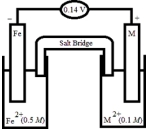 Half-Reaction E° (V) Fe2+(aq)+ 2e- → Fe(s)-0.44
 (Multiple Choice)
4.9/5 (95)
(95) If E° for X + e- → Y is larger than E° for A + 2e- → B,then in a spontaneous process under standard-state conditions,
(Multiple Choice)
4.8/5 (75)
(75) Which electrochemical cell pictured below corresponds to the following cell diagram? Cr(s)| Cr3+(aq,1.0 M)|| Sn2+(aq,1.0 M)| Sn(s)
(Multiple Choice)
4.9/5 (82)
(82) A metal object is to be gold-plated by an electrolytic procedure using aqueous AuCl3 electrolyte.How much gold may be deposited in 3.0 min by a constant current of 10.A?
(Multiple Choice)
4.9/5 (95)
(95) Given the following standard reduction potentials in acid solution
O2 + 4H+ + 4e- → 2H2O E° = +1.23V
Sn4+ + 2e- → Sn2+ E° = +0.13V
Zn2+ + 2e- → Zn(s)E° = -0.76V
write the formula of the strongest reducing agent.
(Short Answer)
4.8/5 (86)
(86) A voltaic cell consists of an Au/Au3+ electrode (E° = 1.50 V)and a Cu/ Cu2+ electrode (E° = 0.34 V).Calculate [Au3+] if [Cu2+] = 1.20 M and Ecell = 1.15 V at 25°C.
(Multiple Choice)
4.9/5 (77)
(77) What mass of copper can be deposited by the passage of 12.0 A for 25.0 min through a solution of copper(II)sulfate? [1 C = 1 A•s; F = 96,500 C]
(Multiple Choice)
4.9/5 (76)
(76) Which one of the following statements relating to the glass electrode is correct?
(Multiple Choice)
4.8/5 (63)
(63) Based on the data presented below,which is the strongest oxidizing agent? Half-Reaction E°(V)
Al3++ 3e- → Al(s)-1.66
AgBr(s)+ e- → Ag(s)+ Br- +0.07
Sn4++ 2e- → Sn2+ +0.14
Fe3++ e- → Fe2+ +0.77
(Multiple Choice)
4.9/5 (76)
(76) _______________ is a process used to coat iron in order to protect it from corrosion.
(Short Answer)
4.8/5 (80)
(80) A SHE has the acid concentration of 1 M and the H2 pressure is 1 atm.
(True/False)
4.7/5 (83)
(83) A current of 250.A flows for 24.0 hours at an anode where the reaction occurring is as follows: Mn2+(aq)+ 2H2O(l)→ MnO2(s)+ 4H+(aq)+ 2e-
What mass of MnO2 is deposited at this anode?
(Multiple Choice)
4.7/5 (67)
(67) 
Filters
- Essay(0)
- Multiple Choice(0)
- Short Answer(0)
- True False(0)
- Matching(0)