



 Chat with AI
Exam 19: Electrochemistry

Exam 1: Chemistry: the Central Science129 Questions
Exam 2: Atoms Molecules and Ions120 Questions
Exam 3: Stoichiometry Ratios of Combination131 Questions
Exam 4: Reactions in Aqueous Solutions144 Questions
Exam 5: Thermochemistry134 Questions
Exam 6: Quantum Theory and the Electronic Structure of Atoms107 Questions
Exam 7: Electron Configuration and the Periodic Table120 Questions
Exam 8: Chemical Bonding I Basic Concepts95 Questions
Exam 9: Chemical Bonding Ii Molecular Geometry and Bonding Theories137 Questions
Exam 10: Gases131 Questions
Exam 11: Intermolecular Forces and the Physical Properties of Liquids and Solids135 Questions
Exam 12: Modern Materials108 Questions
Exam 13: Physical Properties of Solutions147 Questions
Exam 14: Chemical Kinetics114 Questions
Exam 15: Chemical Equilibrium135 Questions
Exam 16: Acids and Bases133 Questions
Exam 17: Acid-Base Equilibria and Solubility Equilibria129 Questions
Exam 18: Entropy Free Energy and Equilibrium61 Questions
Exam 19: Electrochemistry122 Questions
Exam 20: Nuclear Chemistry125 Questions
Exam 21: Environmental Chemistry131 Questions
Exam 22: Coordination Chemistry128 Questions
Exam 23: Metallurgy and the Chemistry of Metals115 Questions
Exam 24: Nonmetallic Elements and Their Compounds119 Questions
Exam 25: Organic Chemistry148 Questions
Select questions type


When the following redox equation is balanced with the smallest whole number coefficients,the coefficient for the hydrogen sulfate ion will be ______. Al(s)+ HSO4-(aq)+ OH-(aq)→ Al2O3(s)+ S2-(aq)+ H2O(l)
(Multiple Choice)
4.9/5  (78)
(78) Iron objects such as storage tanks and underground pipelines can be protected from corrosion by connecting them through a wire to a piece of
(Multiple Choice)
4.7/5 (85)
(85) What is the oxidizing agent in the (unbalanced)reaction? Cu(s)+ H+(aq)+ NO3-(aq)→ NO(g)+ H2O(l)+ Cu2+(aq)
(Multiple Choice)
4.9/5 (97)
(97) The Faraday constant represents the charge of 1 mole of electrons.
(True/False)
4.8/5 (77)
(77) A voltaic cell consists of a Hg/Hg22+ electrode (E°= 0.85 V)and a Sn/Sn2+ electrode (E°= -0.14 V).Calculate [Sn2+] if [Hg22+] = 0.24 M and Ecell = 1.04 V at 25°C.
(Multiple Choice)
4.9/5 (77)
(77) The voltaic cell composed of Co(s),Co2+(aq),Cu(s),and Cu2+(aq)has E°cell = 0.62 V.If E° of the cathode half-cell is 0.34 V,what is E° of the anode half-cell? Cu2+(aq)+ Co(s)→ Cu(s)+ Co2+(aq)
(Multiple Choice)
4.9/5 (82)
(82) A salt bridge allows movement of cations and anions from one half-cell to the other.
(True/False)
4.9/5 (70)
(70) A cell can be prepared from copper and tin.What is the E°cell for the galvanic cell that forms from the following half-reactions? Cu2+(aq)+ 2e-  Cu(s)E° = 0.34V
Sn4+(aq)+ 2e-
 Sn2+(aq)E° = 0.13V
Cu(s)E° = 0.34V
Sn4+(aq)+ 2e- Sn2+(aq)E° = 0.13V (Multiple Choice)
4.9/5 (80)
(80) What is E°cell for a galvanic cell represented by the combination of the following half-reactions? ClO4-(aq)+ 8 H+(aq)+8e-
 Cl-(aq)+4H2O(l)E° = 1.389V
VO2+(aq)+ 2H+(aq)+e-
 VO+(aq)+H2O(l)E° = 0.991V
Cl-(aq)+4H2O(l)E° = 1.389V
VO2+(aq)+ 2H+(aq)+e-
VO+(aq)+H2O(l)E° = 0.991V (Multiple Choice)
4.7/5 (77)
(77) In the electrolyte of an electrochemical cell,current is carried by electrons moving from the anode to the cathode.
(True/False)
4.7/5 (87)
(87) What is the equilibrium constant at 25°C for the following reaction? (R = 8.314 J/K • mol,F = 96,500 C • mol-1)
Sn2+(aq)+ Fe(s)  Sn(s)+ Fe2+(aq)E°cell = 0.30V
 (Multiple Choice)
4.9/5 (86)
(86) Based on the data presented below,which is the strongest reducing agent? E°(V)
Al3+ + 3e- → Al(s)-1.66
AgBr(s)+ e- → Ag(s)+Br- +0.07
Sn4+ + 2e- → Sn2+ +0.14
Fe3+ + e- → Fe2+ +0.77
(Multiple Choice)
4.9/5 (93)
(93) What would you observe if you set up the following electrochemical cell: Ag|AgNO3(0.001 M)||AgNO3(1 M)|Ag?
(Multiple Choice)
4.9/5 (85)
(85) What is E°cell for the following reaction,and is it spontaneous or nonspontaneous under standard-state conditions? 2Fe3+(aq)+ 2H2O(l)→ H2O2(aq)+ 2H+(aq)+ 2Fe2+(aq)
Given:
H2O2(aq)+ 2H+(aq)+ 2e-
 2H2O(l)E° = 1.77V
Fe3+(aq)+ e-
 Fe2+(aq)E° = 0.77V
2H2O(l)E° = 1.77V
Fe3+(aq)+ e- Fe2+(aq)E° = 0.77V (Multiple Choice)
4.9/5 (74)
(74) Complete and balance the following redox equation.When properly balanced using the smallest whole-number coefficients,the coefficient of S is H2S + HNO3 → S + NO + H2O (acidic solution)
(Multiple Choice)
4.9/5 (86)
(86) Consider the following redox equation. Mn(OH)2(s)+ MnO4-(aq)→ MnO42-(aq) (basic solution)
When the equation is balanced with the smallest whole number coefficients,what is the coefficient for OH-(aq)and on which side of the equation is OH-(aq)present?
(Multiple Choice)
5.0/5 (72)
(72) Complete and balance the following redox equation using the set of smallest whole numbers coefficients.What is the sum of the coefficients? HI + HNO3 → I2 + NO (acidic solution)
(Multiple Choice)
4.8/5 (81)
(81) Based on the following electrochemical cell,what is the standard reduction potential of metal M at 298 K? 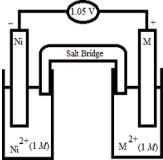 Half-Reaction E° (V) Ni2+(aq)+ 2e- →Ni(s)-0.25
 (Multiple Choice)
4.9/5 (84)
(84) What is the minimum voltage required for the electrolysis of 1.0 M NaCl in neutral solution? 2H2O + 2Cl- (1.0 M)→ H2(1 atm)+ Cl2(1 atm)+ 2OH-(1 × 10⁻⁷ M)
Note that
2H2O(l)+ 2e- → H2(g)+2OH-(aq),E° = -0.83 V,
2H2O(l)+ 2e- → H2(g)+2OH-(aq),E = -0.41 V([OH-] = 1 × 10⁻⁷M),
O2(g)+ 4H+(aq)+ 4e- →2H2O(l),E° = +1.23 V,
Cl2(g)+ 2e- → 2Cl-(aq)E° = +1.36 V,and
Na+(aq)+ e- → Na(s)E° = -2.71 V
(Multiple Choice)
4.8/5 (83)
(83) 
Filters
- Essay(0)
- Multiple Choice(0)
- Short Answer(0)
- True False(0)
- Matching(0)