



 Chat with AI
Exam 19: Electrochemistry

Exam 1: Chemistry: the Central Science129 Questions
Exam 2: Atoms Molecules and Ions120 Questions
Exam 3: Stoichiometry Ratios of Combination131 Questions
Exam 4: Reactions in Aqueous Solutions144 Questions
Exam 5: Thermochemistry134 Questions
Exam 6: Quantum Theory and the Electronic Structure of Atoms107 Questions
Exam 7: Electron Configuration and the Periodic Table120 Questions
Exam 8: Chemical Bonding I Basic Concepts95 Questions
Exam 9: Chemical Bonding Ii Molecular Geometry and Bonding Theories137 Questions
Exam 10: Gases131 Questions
Exam 11: Intermolecular Forces and the Physical Properties of Liquids and Solids135 Questions
Exam 12: Modern Materials108 Questions
Exam 13: Physical Properties of Solutions147 Questions
Exam 14: Chemical Kinetics114 Questions
Exam 15: Chemical Equilibrium135 Questions
Exam 16: Acids and Bases133 Questions
Exam 17: Acid-Base Equilibria and Solubility Equilibria129 Questions
Exam 18: Entropy Free Energy and Equilibrium61 Questions
Exam 19: Electrochemistry122 Questions
Exam 20: Nuclear Chemistry125 Questions
Exam 21: Environmental Chemistry131 Questions
Exam 22: Coordination Chemistry128 Questions
Exam 23: Metallurgy and the Chemistry of Metals115 Questions
Exam 24: Nonmetallic Elements and Their Compounds119 Questions
Exam 25: Organic Chemistry148 Questions
Select questions type


What is the standard free-energy change for the following reaction at 25°C? (F = 96,500 C • mol-1) 2Al(s)+ 3Sn4+(aq,1 M)→ 2Al3+(aq,1 M)+ 3Sn2+(aq,1 M)
Half-Reaction Eo (V)
Al3+(aq)+ 3e- → Al(s)-1.66
Sn4+(aq)+ 2e- →Sn2+(aq)+0.13
(Multiple Choice)
4.8/5  (66)
(66) Consider the following balanced redox reaction. 3CuO(s)+ 2NH3(aq)→ N2(g)+ 3H2O(l)+ 3Cu(s)
Which of the following statements is true?
(Multiple Choice)
4.8/5 (81)
(81) In a fuel cell,an external source of electrical power is used to drive a nonspontaneous reaction in which a fuel is produced.
(True/False)
4.9/5 (76)
(76) What product forms at the anode during the electrolysis of molten NaBr?
(Multiple Choice)
5.0/5 (66)
(66) When the following redox equation is balanced with the smallest whole number coefficients,what is the coefficient for nitrogen dioxide? I2(s)+ HNO3(aq)→ HIO3(aq)+ NO2(g)+ H2O(l)
(Multiple Choice)
4.9/5 (89)
(89) What is ΔG° at 200°C for the following reaction? (F = 96,500 C • mol-1) 2Na(l)+ FeCl2(s)  2NaCl(s)+ Fe(s)E°cell = 2.35 V
 (Multiple Choice)
4.9/5 (73)
(73) Which is the half-reaction at the cathode in a lead storage battery?
(Multiple Choice)
4.7/5 (92)
(92) What is E°cell for the following reaction? 2Fe2+(aq)+ Cd2+(aq)→ 2Fe3+(aq)+ Cd(s)
Fe3+(aq)+ e- →Fe2+ (aq)E° = 0.77 V
Cd2+(aq)+ 2e- → Cd(s)E° = -0.40 V
(Multiple Choice)
4.8/5 (89)
(89) If ΔG° of the following reaction is -110 kJ/mol,what is E°cell? (F = 96,500 C • mol-1) A3+(aq)+ 3B(s)→ A(s)+ 3B+(aq)
(Multiple Choice)
4.8/5 (66)
(66) Consider the reaction in the lead-acid cell Pb(s)+ PbO2(s)+ 2H2SO4(aq)→ 2PbSO4(aq)+ 2H2O(l)
For which E°cell = 2.04 V at 298 K.ΔG° for this reaction is
(Multiple Choice)
4.9/5 (77)
(77) What is ΔG° for the following reaction? (F = 96,500 C • mol-1) I2(s)+ 2Br-(aq)→ 2I-(aq)+ Br2(l)
Given:
I2(s) (aq)+ 2e- → 2I-(aq)E°= 0.53 V
Br2(l)+ 2e- → 2Br-(aq)E° = 1.07 V
(Multiple Choice)
4.9/5 (75)
(75) A voltaic cell consists of a Mn/Mn2+ electrode (E° = -1.18 V)and a Fe/Fe2+ electrode (E° = -0.44 V).Calculate [Fe2+] if [Mn2+] = 0.050 M and Ecell = 0.78 V at 25°C.
(Multiple Choice)
4.8/5 (80)
(80) ___________ - _________ fuel cells provide electrical power and drinking water for space flights.
(Short Answer)
4.9/5 (86)
(86) ______________ is the process that uses electrical energy to drive a nonspontaneous chemical reaction.
(Short Answer)
4.8/5 (81)
(81) If the following electrochemical cell is constructed,what voltage will be measured on the voltmeter? 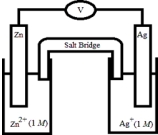 Half-Reaction E° (V) Zn2+(aq)+ 2e- →Zn(s)-0.76
Ag+(aq)+ e- → Ag(s)+0.80
Half-Reaction E° (V) Zn2+(aq)+ 2e- →Zn(s)-0.76
Ag+(aq)+ e- → Ag(s)+0.80 (Multiple Choice)
4.7/5 (76)
(76) Which of the following elements can be isolated by electrolysis of the aqueous salt shown?
(Multiple Choice)
4.9/5 (76)
(76) 
Filters
- Essay(0)
- Multiple Choice(0)
- Short Answer(0)
- True False(0)
- Matching(0)