



 Chat with AI
Exam 19: Electrochemistry

Exam 1: Chemistry: the Central Science129 Questions
Exam 2: Atoms Molecules and Ions120 Questions
Exam 3: Stoichiometry Ratios of Combination131 Questions
Exam 4: Reactions in Aqueous Solutions144 Questions
Exam 5: Thermochemistry134 Questions
Exam 6: Quantum Theory and the Electronic Structure of Atoms107 Questions
Exam 7: Electron Configuration and the Periodic Table120 Questions
Exam 8: Chemical Bonding I Basic Concepts95 Questions
Exam 9: Chemical Bonding Ii Molecular Geometry and Bonding Theories137 Questions
Exam 10: Gases131 Questions
Exam 11: Intermolecular Forces and the Physical Properties of Liquids and Solids135 Questions
Exam 12: Modern Materials108 Questions
Exam 13: Physical Properties of Solutions147 Questions
Exam 14: Chemical Kinetics114 Questions
Exam 15: Chemical Equilibrium135 Questions
Exam 16: Acids and Bases133 Questions
Exam 17: Acid-Base Equilibria and Solubility Equilibria129 Questions
Exam 18: Entropy Free Energy and Equilibrium61 Questions
Exam 19: Electrochemistry122 Questions
Exam 20: Nuclear Chemistry125 Questions
Exam 21: Environmental Chemistry131 Questions
Exam 22: Coordination Chemistry128 Questions
Exam 23: Metallurgy and the Chemistry of Metals115 Questions
Exam 24: Nonmetallic Elements and Their Compounds119 Questions
Exam 25: Organic Chemistry148 Questions
Select questions type


When the following redox equation is balanced with the smallest whole number coefficients,what is the coefficient of Sb3+(aq)? BrO3-(aq)+ Sb3+(aq)→ Br-(aq)+ Sb5+(aq) (acidic solution)
(Multiple Choice)
4.9/5  (72)
(72) What mass of Cu may be deposited from a Cu2+ solution during electrolysis by a current of 3.00 A for 10.0 hours?
(Multiple Choice)
4.7/5 (68)
(68) Consider the following balanced redox reaction. Mn2+(aq)+ S2O82-(aq)+ 2H2O(l)→ MnO2(s)+ 4H+(aq)+ 2SO42-(aq)
Which of the following statements is true?
(Multiple Choice)
4.8/5 (69)
(69) Which metal is not capable of acting as a sacrificial anode when used with iron pipe? 
(Multiple Choice)
5.0/5 (83)
(83) A voltaic cell is prepared using copper and silver.Its cell notation is shown below. Cu(s)| Cu2+(aq)|| Ag+(aq)| Ag(s)
Which reaction occurs at the cathode?
(Multiple Choice)
4.8/5 (85)
(85) Which is the correct cell notation for the following reaction? Au3+(aq)+ Al(s)→ Al3+(aq)+ Au(s)
(Multiple Choice)
5.0/5 (86)
(86) A galvanic cell is constructed using the two hypothetical half-reactions
A + e- → B E° = +1.50 V and
C + 2e- → D E° = -0.50 V
a.Calculate the standard potential of this cell,E°cell .
b.Calculate ΔG° for the cell reaction.(1 faraday = 96,500 C)
(Short Answer)
4.9/5 (72)
(72) Given Cu2+(aq)+ 2e- → Cu(s)E° = +0.34 V Al3+(aq)+ 3e- → Al(s)E° = -1.66 V
Na+(aq)+ e- → Na(s)E° = -2.71 V
Which of the following reactions will occur?
(Multiple Choice)
4.8/5 (84)
(84) Based on the data presented below,which is the strongest oxidizing agent? [PtCl4]2-(aq)+ 2e-
 Pt(s)+ 4Cl-(aq)E° = 0.755V
RuO4(s)+ 8H+(aq)+ 8e-
 Ru(s)+ 4H2O(l)E° = 1.038V
FeO42-(aq)+ 8H+(aq)+ 3e-
 Fe3+(aq)+4H2O(l)E° = 2.07 V
H4XeO6(aq)+ 2H+(aq)+ 2e-
 XeO3(aq)+3H2O(l)E° = 2.42 V
Pt(s)+ 4Cl-(aq)E° = 0.755V
RuO4(s)+ 8H+(aq)+ 8e- Ru(s)+ 4H2O(l)E° = 1.038V
FeO42-(aq)+ 8H+(aq)+ 3e- Fe3+(aq)+4H2O(l)E° = 2.07 V
H4XeO6(aq)+ 2H+(aq)+ 2e- XeO3(aq)+3H2O(l)E° = 2.42 V (Multiple Choice)
4.8/5 (81)
(81) Complete and balance the following redox equation.Now sum the coefficients of all species in the balanced equation.(Remember to add the coefficients that are equal to one,and to add the coefficients of any species added to the equation.)The sum of the smallest whole number coefficients is Bi(OH)3 + SnO22- → Bi + SnO32- (basic solution)
(Multiple Choice)
4.7/5 (77)
(77) Which is the correct cell diagram for the following electrochemical cell? 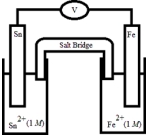 Half-Reaction E° (V) Sn2+(aq)+ 2e- →Sn(s)-0.14
Fe2+(aq)+ 2e- →Fe(s)-0.44
Half-Reaction E° (V) Sn2+(aq)+ 2e- →Sn(s)-0.14
Fe2+(aq)+ 2e- →Fe(s)-0.44 (Multiple Choice)
4.9/5 (80)
(80) What is the cell potential at 25°C for the following reaction if [Zn2+] = 1.0 × 10⁻⁴ M and [Sn2+] = 0.20 M ? (R = 8.314 J/K • mol,F = 96,500 C • mol-1) Zn2+(aq)+ Sn(s)→ Zn(s)+ Sn2+(aq)E°cell = -0.62 V
(Multiple Choice)
4.9/5 (84)
(84) What is E°cell for the following reaction? 2Au(s)+ 3Ca2+(aq)→ 2Au3+(aq)+ 3Ca(s)
Au3+(aq)+ 3e- → Au(s)E° = 1.50 V
Ca2+ (aq)+ 2e- → Ca(s)E° = -2.87 V
(Multiple Choice)
4.8/5 (79)
(79) Consider the reaction CuO(s)+ H2(g)→ Cu(s)+ H2O(l)
In this reaction,which substances are the oxidizing agent and reducing agent,
Respectively?
(Multiple Choice)
4.9/5 (69)
(69) The redox reaction of peroxydisulfate with iodide has been used for many years as part of the iodine clock reaction.If E°cell = 1.587 V and E° of the cathode half-cell is 0.536 V, what is E° of the anode half-cell?
S2O82-(aq)+ 2H+ + 2I-(aq)→ 2HSO4-(aq)+ I2(aq)
(Multiple Choice)
4.9/5 (91)
(91) Two cells are connected in series,so that the same current flows through two electrodes,where the following half-reactions occur: Cu2+(aq)+ 2e- → Cu(s)and Ag+(aq)+ e- → Ag(s)
For every 1.00 g of copper produced in the first process,how many grams of silver will be produced in the second one?
(Multiple Choice)
4.7/5 (84)
(84) What is the purpose of a salt bridge in an electrochemical cell?
(Multiple Choice)
4.8/5 (67)
(67) What is E°cell for the reaction of nickel(II)ions with cadmium metal at 25°C? (R = 8.314 J/K • mol,F = 96,500 C • mol-1)
Ni2+(aq)+ Cd(s)  Cd2+(aq)+ Ni(s)K = 1.17 × 10⁵
 (Multiple Choice)
4.7/5 (90)
(90) 
Filters
- Essay(0)
- Multiple Choice(0)
- Short Answer(0)
- True False(0)
- Matching(0)