



 Chat with AI
Exam 5: Thermochemistry

Exam 1: Chemistry: the Central Science129 Questions
Exam 2: Atoms Molecules and Ions120 Questions
Exam 3: Stoichiometry Ratios of Combination131 Questions
Exam 4: Reactions in Aqueous Solutions144 Questions
Exam 5: Thermochemistry134 Questions
Exam 6: Quantum Theory and the Electronic Structure of Atoms107 Questions
Exam 7: Electron Configuration and the Periodic Table120 Questions
Exam 8: Chemical Bonding I Basic Concepts95 Questions
Exam 9: Chemical Bonding Ii Molecular Geometry and Bonding Theories137 Questions
Exam 10: Gases131 Questions
Exam 11: Intermolecular Forces and the Physical Properties of Liquids and Solids135 Questions
Exam 12: Modern Materials108 Questions
Exam 13: Physical Properties of Solutions147 Questions
Exam 14: Chemical Kinetics114 Questions
Exam 15: Chemical Equilibrium135 Questions
Exam 16: Acids and Bases133 Questions
Exam 17: Acid-Base Equilibria and Solubility Equilibria129 Questions
Exam 18: Entropy Free Energy and Equilibrium61 Questions
Exam 19: Electrochemistry122 Questions
Exam 20: Nuclear Chemistry125 Questions
Exam 21: Environmental Chemistry131 Questions
Exam 22: Coordination Chemistry128 Questions
Exam 23: Metallurgy and the Chemistry of Metals115 Questions
Exam 24: Nonmetallic Elements and Their Compounds119 Questions
Exam 25: Organic Chemistry148 Questions
Select questions type


What is the standard enthalpy of formation of liquid methanol,CH3OH(l)? C(graphite)+ O2(g)→ CO2(g)
ΔH°rxn = -393.5 kJ/mol
H2(g)+ ½O2→ H2O(l)
ΔH°rxn = -285.8 kJ/mol
CH3OH(l)+ 3/2O2(g)→ CO2(g)+ 2H2O(l)
ΔH°rxn = -726.4 kJ/mol
(Multiple Choice)
4.7/5  (90)
(90) A system which does work on the surroundings with no heat change has
(Multiple Choice)
4.8/5 (81)
(81) A system that does no work but which transfers heat to the surroundings has
(Multiple Choice)
4.8/5 (95)
(95) The heat of solution of ammonium nitrate is 26.2 kJ/mol.If a 5.368 g sample of NH4NO3 is added to 40.0 mL of water in a calorimeter at 23.5°C,what is the final temperature of the solution? The specific heat of water is 4.18 J/g·°C and the heat capacity of the calorimeter is 0.650 kJ/°C.
(Multiple Choice)
4.8/5 (91)
(91) When Karl Kaveman adds chilled grog to his new granite mug,he removes 10.9 kJ of energy from the mug.If it has a mass of 625 g and was at 25°C,what is its new temperature? Specific heat capacity of granite = 0.79 J/g·°C.
(Multiple Choice)
4.8/5 (77)
(77) Suppose a 0.500-g sample of an organic compound is analyzed via bomb calorimetry.The temperature of the calorimeter is measured over time.At t = 5 min,the combustion reaction is initiated.Below is a plot of the data that are obtained. 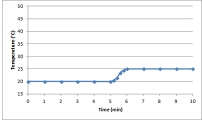 Suppose the experiment is repeated under identical conditions,but with a 1.000-g sample of the organic compound.What might a plot of the resulting data look like?
 (Multiple Choice)
4.8/5 (76)
(76) Which represents an enthalpy change at 25 °C and 1 atm that is equal to ΔHof for H2O(l)?
(Multiple Choice)
4.9/5 (72)
(72) A 1.00-g sample of octane (C8H18)is burned in a bomb calorimeter that has a heat capacity of 5.80 kJ/°C.The temperature of the calorimeter rises from 25.00°C to 33.20°C.What is ΔU per mole for the combustion of octane?
(Multiple Choice)
4.9/5 (78)
(78) How much heat is released if 35.0 g of ethanol (C2H5OH)burns in excess oxygen? C2H5OH(l)+ 3O2(g)→ 2 CO2(g)+ 3 H2O(l)ΔH°rxn = -1367 kJ/mol
(Multiple Choice)
4.9/5 (70)
(70) Ethanol,C2H5OH,is promoted as a clean fuel and is used as an additive in many gasoline mixtures.Calculate the ΔH°rxn for the combustion of ethanol. Substance ΔH°f(kJ/mol)
C2H5OH(l)-277.0
CO2(g)-393.5
H2O(g)-241.8
(Multiple Choice)
4.9/5 (85)
(85) A piece of copper metal is initially at 100.0°C.It is dropped into a coffee cup calorimeter containing 50.0 g of water at a temperature of 20.0°C.After stirring,the final temperature of both copper and water is 25.0°C.Assuming no heat losses,and that the specific heat (capacity)of water is 4.18 J/g·°C,what is the heat capacity of the copper in J/°C?
(Multiple Choice)
4.8/5 (76)
(76) A Snickers candy bar contains 280 Calories,of which the fat content accounts for 120 Calories.What is the energy of the fat content,in kJ? (1 cal = 4.184 J)
(Multiple Choice)
4.8/5 (68)
(68) Pentaborane B5H9(s)burns vigorously in O2 to give B2O3(s)and H2O(l).What is ΔH° for the combustion of 1 mol of B5H9(s)? Substance ΔH°f (kJ/mol)
B2O3(s) -1273.5
B5H9(s) +73.2
H2O(l) -285.8
(Multiple Choice)
4.8/5 (84)
(84) Given that CaO(s)+ H2O(l)→ Ca(OH)2(s),ΔH°rxn = -64.8 kJ/mol,how many grams of CaO must react in order to liberate 525 kJ of heat?
(Multiple Choice)
4.8/5 (70)
(70) A system contracts from an initial volume of 15.0 L to a final volume of 10.0 L under a constant external pressure of 0.80 atm.What is W? (1 L·atm = 101.3 J)
(Multiple Choice)
4.9/5 (77)
(77) Using Hess' law,what is ΔH°rxn at 25°C for the following reaction? ClF(g)+ F2(g)→ ClF3(g)2ClF(g)+ O2(g)→ Cl2O(g)+ OF2(g)ΔH°rxn = +167.4kJ/mol
2ClF3(g)+ 2O2(g)→ Cl2O(g)+3OF2(g)ΔH°rxn = +341.4kJ/mol
2F2(g)+ O2(g)→ 2OF2(g)ΔH°rxn = -43.4 kJ/mol
(Multiple Choice)
4.7/5 (72)
(72) Natural gas,or methane,is an important fuel.Combustion of one mole of methane releases 802.3 kJ of energy.How much energy does that represent in kcal? (1 cal = 4.184 J)
(Multiple Choice)
5.0/5 (79)
(79) 
Filters
- Essay(0)
- Multiple Choice(0)
- Short Answer(0)
- True False(0)
- Matching(0)