



 Chat with AI
Exam 15: Chemical Equilibrium

Exam 1: Chemistry: the Central Science129 Questions
Exam 2: Atoms Molecules and Ions120 Questions
Exam 3: Stoichiometry Ratios of Combination131 Questions
Exam 4: Reactions in Aqueous Solutions144 Questions
Exam 5: Thermochemistry134 Questions
Exam 6: Quantum Theory and the Electronic Structure of Atoms107 Questions
Exam 7: Electron Configuration and the Periodic Table120 Questions
Exam 8: Chemical Bonding I Basic Concepts95 Questions
Exam 9: Chemical Bonding Ii Molecular Geometry and Bonding Theories137 Questions
Exam 10: Gases131 Questions
Exam 11: Intermolecular Forces and the Physical Properties of Liquids and Solids135 Questions
Exam 12: Modern Materials108 Questions
Exam 13: Physical Properties of Solutions147 Questions
Exam 14: Chemical Kinetics114 Questions
Exam 15: Chemical Equilibrium135 Questions
Exam 16: Acids and Bases133 Questions
Exam 17: Acid-Base Equilibria and Solubility Equilibria129 Questions
Exam 18: Entropy Free Energy and Equilibrium61 Questions
Exam 19: Electrochemistry122 Questions
Exam 20: Nuclear Chemistry125 Questions
Exam 21: Environmental Chemistry131 Questions
Exam 22: Coordination Chemistry128 Questions
Exam 23: Metallurgy and the Chemistry of Metals115 Questions
Exam 24: Nonmetallic Elements and Their Compounds119 Questions
Exam 25: Organic Chemistry148 Questions
Select questions type


For the endothermic reaction A2(g)  2A(g),a snapshot of an equilibrium mixture of A(g)and A2(g)at low temperature may look as follows.(Each circle represents 1.0 mol of A atoms,and the volume of the box is 1.0 L.)
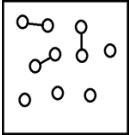 If the system pressure is lowered,what might the new equilibrium system look like?
2A(g),a snapshot of an equilibrium mixture of A(g)and A2(g)at low temperature may look as follows.(Each circle represents 1.0 mol of A atoms,and the volume of the box is 1.0 L.) If the system pressure is lowered,what might the new equilibrium system look like? (Multiple Choice)
4.8/5  (77)
(77) Consider the reversible reaction: 2NO2(g)  N2O4(g) If the concentrations of both NO2 and N2O4 are each 0.016 M,what is the value of Qc?
 (Multiple Choice)
4.8/5 (79)
(79) A container was charged with hydrogen,nitrogen,and ammonia gases at 120°C and the system was allowed to reach equilibrium.What will happen if the volume of the container is increased at constant temperature? 3H2(g)+ N2(g)  2NH3(g)
 (Multiple Choice)
4.8/5 (81)
(81) Which substances are included in the equilibrium constant expression,Kc?
(Multiple Choice)
4.9/5 (79)
(79) When the concentrations of both the reactants and products remain constant because the forward and reverse reactions are occurring at the same rate then the system is ________________.
(Short Answer)
4.8/5 (71)
(71) A mixture of 0.500 mole of carbon monoxide and 0.400 mole of bromine was placed into a rigid 1.00-L container and the system was allowed to come to equilibrium.The equilibrium concentration of COBr2 was 0.233 M.What is Kc for this reaction?
CO(g)+ Br2(g)  COBr2(g)
 (Multiple Choice)
4.8/5 (88)
(88) Hydrogen sulfide can be formed in the following reaction: H2(g)+ S2(g)  H2S(g); ΔH°rxn = -92 kJ/mol
The equilibrium constant,KP,is 106 at 1023 K.Estimate the value of KP at 1218 K.(R = 8.314 J/K • mol)
H2S(g); ΔH°rxn = -92 kJ/mol
The equilibrium constant,KP,is 106 at 1023 K.Estimate the value of KP at 1218 K.(R = 8.314 J/K • mol) (Multiple Choice)
5.0/5 (79)
(79) Which is the correct equilibrium constant expression for the following reaction? 2BrCl3(g)  Br2(g)+ 3Cl2(g)
 (Multiple Choice)
4.8/5 (77)
(77) At 250ºC,the equilibrium constant,KP,for the reaction PCl5(g)  PCl3(g)+ Cl2(g)is 1.80. Sufficient PCl5 is put into a reaction vessel to give an initial pressure of 2.74 atm at 250ºC.What is the partial pressure of PCl5 after the system has reached equilibrium.
 (Multiple Choice)
4.8/5 (88)
(88) If the system 3H2(g)+ N2(g)
 2NH3(g)is at equilibrium and more N2 is added,a net reaction that consumes some of the added N2 will occur until a new equilibrium is reached.
 (True/False)
4.7/5 (70)
(70) The equilibrium constant KP at 427°C for the reaction N2(g)+ 3H2(g)  2NH3(g)is 9.4 ×10⁻⁵.What is ΔG° for the reaction under these conditions? (R = 8.314 J/K • mol)
 (Multiple Choice)
5.0/5 (83)
(83) Nitric oxide and bromine were allowed to react in a sealed container.When equilibrium was reached,the following partial pressures of three gases were measured: NO: 0.526 atm; Br2 :1.59 atm; NOBr: 7.68 atm.Calculate KP for the reaction. 2NO(g)+ Br2(g)  2NOBr(g)
 (Multiple Choice)
4.9/5 (85)
(85) Consider the equilibrium reaction: N2O4(g)  2NO2(g) Which of the following correctly describes the relationship between Kc and KP for the reaction?
 (Multiple Choice)
4.8/5 (76)
(76) If,in a particular process,reactants are able to form products,and products are also able to form reactants,then this process may be described as
(Multiple Choice)
4.9/5 (76)
(76) Suppose 75.0 g of PCl5(g)is introduced into an evacuated 3.00-L vessel and allowed to reach equilibrium at 250ºC. PCl5(g)  PCl3(g)+ Cl2(g)
If KP = 1.80 for this reaction,what is the total pressure inside the vessel at equilibrium? (R =0.0821 atm • L/mol • K)
PCl3(g)+ Cl2(g)
If KP = 1.80 for this reaction,what is the total pressure inside the vessel at equilibrium? (R =0.0821 atm • L/mol • K) (Multiple Choice)
4.9/5 (85)
(85) A quantity of liquid methanol,CH3OH,is introduced into a rigid 3.00-L vessel,the vessel is sealed,and the temperature is raised to 500 K.At this temperature,the methanol vaporizes and decomposes according to the reaction CH3OH(g)  CO(g)+ 2H2(g),Kc = 6.90 ×10⁻²
If the concentration of H2 in the equilibrium mixture is 0.426 M,what mass of methanol was initially introduced into the vessel?
CO(g)+ 2H2(g),Kc = 6.90 ×10⁻²
If the concentration of H2 in the equilibrium mixture is 0.426 M,what mass of methanol was initially introduced into the vessel? (Multiple Choice)
4.9/5 (59)
(59) The equilibrium constant,KP,has a value of 6.5 × 10⁻⁴ at 308 K for the reaction of nitrogen monoxide with chlorine. 2NO(g)+ Cl2(g)  2NOCl(g)
What is the value of Kc? (R = 0.08206 L • atm/K • mol)
2NOCl(g)
What is the value of Kc? (R = 0.08206 L • atm/K • mol) (Multiple Choice)
4.8/5 (67)
(67) In the gas phase,formic acid forms a dimer,2HCOOH(g)  (HCOOH)2(g).For this reaction,ΔH° = -60.1 kJ/mol and ΔG° = -13.9 kJ/mol at 25°C.Find the equilibrium constant (KP)for this reaction at 75 °C.
 (Multiple Choice)
4.9/5 (66)
(66) Suppose 50.0 g of N2O4 is introduced into an evacuated 2.00-L vessel and allowed to come to equilibrium with its decomposition product,N2O4(g)  2NO2(g).For this reaction Kc = 0.133.Once the system has reached equilibrium,5.00 g of NO2 is injected into the vessel,and the system is allowed to equilibrate once again.What is the mass of NO2 in the final equilibrium mixture?
 (Multiple Choice)
4.9/5 (88)
(88) 
Filters
- Essay(0)
- Multiple Choice(0)
- Short Answer(0)
- True False(0)
- Matching(0)