



 Chat with AI
Exam 7: Mortgage Markets

Exam 1: Introduction50 Questions
Exam 2: Determinants of Interest Rates62 Questions
Exam 3: Interest Rates and Security Valuation72 Questions
Exam 4: The Federal Reserve System, monetary Policy, and Interest Rates60 Questions
Exam 5: Money Markets61 Questions
Exam 6: Bond Markets61 Questions
Exam 7: Mortgage Markets60 Questions
Exam 8: Stock Markets67 Questions
Exam 9: Foreign Exchange Markets60 Questions
Exam 10: Derivative Securities Markets61 Questions
Exam 11: Commercial Banks: Industry Overview48 Questions
Exam 12: Commercial Banks Financial Statements and Analysis59 Questions
Exam 13: Regulation of Commercial Banks60 Questions
Exam 14: Other Lending Institutions: Savings Institutions, credit Unions, and Finance Companies62 Questions
Exam 15: Insurance Companies62 Questions
Exam 16: Securities Firms and Investment Banks57 Questions
Exam 17: Investment Companies64 Questions
Exam 18: Pension Funds60 Questions
Exam 19: Types of Risks Incurred by Financial Institutions55 Questions
Exam 20: Managing Credit Risk on the Balance Sheet63 Questions
Exam 21: Managing Liquidity Risk on the Balance Sheet60 Questions
Exam 22: Managing Interest Rate Risk and Insolvency Risk on the Balance Sheet58 Questions
Exam 23: Managing Risk Off the Balance Sheet With Derivative Securities63 Questions
Exam 24: Managing Risk Off the Balance Sheet With Loan Sales and Securitization60 Questions
Select questions type


Construct an amortization schedule for the first three months and the final three months of payments for a 30-year,7 percent mortgage in the amount of $90,000. What percentage of the third payment is principal? What percentage of the final payment is principal? What do these differences imply? (Hint: The balance after the 357th payment is $1,775.56.)
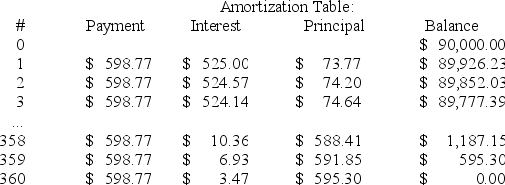
(Essay)
4.7/5  (87)
(87) 
Private mortgage insurance (and hence,that part of the homeowner's monthly payment)is automatically removed from a mortgage when the loan-to-value ratio on the mortgage falls below 80 percent.
(True/False)
4.8/5 (80)
(80) You bought your house five years ago and you believe you will be in the house only about five more years before it gets too small for your family. Your original home value when you bought it was $250,000,you paid 20 percent down,and you financed closing costs equal to 3 percent of the mortgage amount. The mortgage was a 30-year fixed-rate mortgage with a 6.5 percent annual interest rate. Rates on 30-year mortgages are now at 5 percent if you pay 2 points. Your refinancing costs will be 1.5 percent of the new mortgage amount (excluding points). You won't finance the points and closing costs this time. A new down payment is not required. Should you refinance? Ignore all taxes and show your work.
(Essay)
4.9/5 (79)
(79) A home buyer bought a house for $245,000. The buyer paid 20 percent down but decided to finance closing costs of 3 percent of the mortgage amount. If the borrower took out a 30-year fixed-rate mortgage at a 5 percent annual interest rate,how much interest will the borrower pay over the life of the mortgage?
(Multiple Choice)
4.9/5 (64)
(64) Mortgage fees paid by the homeowner at,or prior to,closing upon the purchase of a house typically include all but which one of the following?
(Multiple Choice)
4.9/5 (91)
(91) Why do mortgage lenders prefer ARMs while many borrowers prefer fixed-rate mortgages,ceteris paribus.
(Essay)
4.9/5 (74)
(74) Who are the major buyers of mortgages after they have been originated? What is the difference between selling with recourse or without recourse? Which is most common?
(Essay)
4.8/5 (85)
(85) If a borrower makes a 20 percent down payment on a conventional mortgage,she will be required to obtain
(Multiple Choice)
4.7/5 (71)
(71) You purchase a $255,000 house and you pay 20 percent down. You obtain a fixed-rate mortgage where the annual interest rate is 5.85 percent and there are 360 monthly payments. What is the monthly payment?
(Multiple Choice)
4.7/5 (88)
(88) On a fixed-rate mortgage the dollars of interest the homeowner pays falls each year the mortgage is outstanding.
(True/False)
4.8/5 (81)
(81) A homeowner can obtain a $250,000,30-year fixed-rate mortgage at a rate of 6.0 percent with zero points or at a rate of 5.5 percent with 2.25 points.
How long must the owner stay in the house to make it worthwhile to pay the points if the payment saving is invested monthly?
(Multiple Choice)
4.8/5 (84)
(84) Which of the following statements about mortgage markets is/are true?
I. Mortgage companies service more mortgages than they originate.
II. Servicing fees typically range from 2 percent to 4 percent.
III. Most mortgage sales are with recourse.
IV. The government is involved in the residential mortgage markets.
(Multiple Choice)
4.8/5 (81)
(81) Which one of the following types of mortgages is likely to become more popular as the average age of the U.S. population increases?
(Multiple Choice)
4.8/5 (72)
(72) A subprime mortgage is a mortgage made to a borrower who has a below normal credit rating.
(True/False)
4.8/5 (94)
(94) The process of packaging and/or selling mortgages that are then used to back publicly traded debt securities is called
(Multiple Choice)
4.8/5 (84)
(84) If the current interest environment is low,lenders tend to prefer ________ ; while borrowers tend to prefer ________.
(Multiple Choice)
4.8/5 (90)
(90) Rank the following types of mortgages by amount outstanding from largest to smallest.
I. Home mortgages
II. Multifamily mortgages
III. Farm mortgages
IV. Commercial mortgages
(Multiple Choice)
4.8/5 (69)
(69) 
Filters
- Essay(0)
- Multiple Choice(0)
- Short Answer(0)
- True False(0)
- Matching(0)