



 Chat with AI
Exam 21: Managing Liquidity Risk on the Balance Sheet

Exam 1: Introduction50 Questions
Exam 2: Determinants of Interest Rates62 Questions
Exam 3: Interest Rates and Security Valuation72 Questions
Exam 4: The Federal Reserve System, monetary Policy, and Interest Rates60 Questions
Exam 5: Money Markets61 Questions
Exam 6: Bond Markets61 Questions
Exam 7: Mortgage Markets60 Questions
Exam 8: Stock Markets67 Questions
Exam 9: Foreign Exchange Markets60 Questions
Exam 10: Derivative Securities Markets61 Questions
Exam 11: Commercial Banks: Industry Overview48 Questions
Exam 12: Commercial Banks Financial Statements and Analysis59 Questions
Exam 13: Regulation of Commercial Banks60 Questions
Exam 14: Other Lending Institutions: Savings Institutions, credit Unions, and Finance Companies62 Questions
Exam 15: Insurance Companies62 Questions
Exam 16: Securities Firms and Investment Banks57 Questions
Exam 17: Investment Companies64 Questions
Exam 18: Pension Funds60 Questions
Exam 19: Types of Risks Incurred by Financial Institutions55 Questions
Exam 20: Managing Credit Risk on the Balance Sheet63 Questions
Exam 21: Managing Liquidity Risk on the Balance Sheet60 Questions
Exam 22: Managing Interest Rate Risk and Insolvency Risk on the Balance Sheet58 Questions
Exam 23: Managing Risk Off the Balance Sheet With Derivative Securities63 Questions
Exam 24: Managing Risk Off the Balance Sheet With Loan Sales and Securitization60 Questions
Select questions type


A bank meets a deposit withdrawal with one of the following alternatives. Which one of the following is an example of using stored liquidity to meet a deposit withdrawal?
(Multiple Choice)
4.9/5  (67)
(67) Using stored liquidity to offset a deposit drain will reduce the size of the bank,but using purchased liquidity to offset the drain will not.
(True/False)
4.9/5 (78)
(78) A widely accepted method measuring liquidity risk exposure of a DI is core deposits over total assets ratio.
(True/False)
4.7/5 (75)
(75) A financial intermediary has two assets in its investment portfolio. It has 35 percent of its security portfolio invested in one-month Treasury bills and 65 percent in real estate loans. If it liquidated the bills today,the bank would receive $98 per hundred of face value. If the real estate loans were sold today,they would be worth $85 per 100 of face value. In one month,the real estate loans could be liquidated at $94 per 100 of face value. What is the intermediary's one-month liquidity index?
(Multiple Choice)
4.9/5 (78)
(78) BIS' Basel Committee on Banking Supervision provides regulatory standards for liquidity risk supervision. Which of the following are among the new ratios required to be maintained by large DIs?
I. Liquidity coverage ratio
II. Net stable funds ratio
III. Financing gap over total asset ratio
IV. Core deposits over financing gap ratio
(Multiple Choice)
4.8/5 (82)
(82) How does reliance on purchased liquidity rather than core deposits affect a bank?
I. Increases the risk of a liquidity crisis
II. Allows the bank to adjust to deposit drains without affecting bank size
III. Increases overall interest sensitivity of the bank's profits to interest rates
(Multiple Choice)
4.7/5 (76)
(76) The greater the discount required to sell assets quickly,the higher the value of the bank's liquidity index.
(True/False)
4.9/5 (80)
(80) The BIS guidelines for monitoring intraday liquidity risk at internationally active banks include which of the following:
I. Measure expected daily gross liquidity inflows and outflows,anticipate the intraday timing of these flows where possible,and forecast the range of potential net funding shortfalls that might arise at different points during the day.
II. Monitor intraday liquidity positions against expected activities and available resources.
III. Arrange to acquire sufficient intraday funding to meet intraday objectives.
IV. Have the ability to maintain a collateral-to-asset ratio above the minimum required by BIS.
(Multiple Choice)
4.9/5 (78)
(78) What are the major sources of liquidity risk for a bank? For a life insurer?
(Essay)
4.8/5 (87)
(87) You have the following data for a bank (million $):
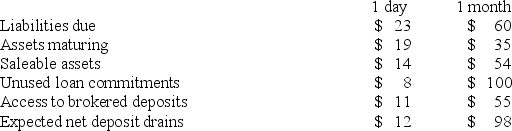 Calculate the net funding requirement for each period and the cumulative net funding requirement over the month. What does the plan reveal?
(Essay)
5.0/5 (97)
(97) Which one of the following situations creates the most liquidity risk?
(Multiple Choice)
4.9/5 (74)
(74) If a bank's brokered deposits increase $3 million and their savings accounts decrease $1 million,then core deposits decreased.
(True/False)
4.9/5 (70)
(70) When calculating the liquidity index,the larger the discount from fair value,the ________ the liquidity index; and the ________ the liquidity risk the FI faces.
(Multiple Choice)
4.9/5 (81)
(81) A corporation informs the bank that it will immediately draw down the maximum amount on its credit line. This is an example of liability side risk.
(True/False)
4.7/5 (67)
(67) Does a positive or a negative financing gap indicate greater liquidity risk? Explain.
(Essay)
4.8/5 (86)
(86) The amount that a policyholder receives when he or she cashes in an insurance policy is called the
(Multiple Choice)
4.8/5 (78)
(78) 
Filters
- Essay(0)
- Multiple Choice(0)
- Short Answer(0)
- True False(0)
- Matching(0)