



 Chat with AI
Exam 23: Managing Risk Off the Balance Sheet With Derivative Securities

Exam 1: Introduction50 Questions
Exam 2: Determinants of Interest Rates62 Questions
Exam 3: Interest Rates and Security Valuation72 Questions
Exam 4: The Federal Reserve System, monetary Policy, and Interest Rates60 Questions
Exam 5: Money Markets61 Questions
Exam 6: Bond Markets61 Questions
Exam 7: Mortgage Markets60 Questions
Exam 8: Stock Markets67 Questions
Exam 9: Foreign Exchange Markets60 Questions
Exam 10: Derivative Securities Markets61 Questions
Exam 11: Commercial Banks: Industry Overview48 Questions
Exam 12: Commercial Banks Financial Statements and Analysis59 Questions
Exam 13: Regulation of Commercial Banks60 Questions
Exam 14: Other Lending Institutions: Savings Institutions, credit Unions, and Finance Companies62 Questions
Exam 15: Insurance Companies62 Questions
Exam 16: Securities Firms and Investment Banks57 Questions
Exam 17: Investment Companies64 Questions
Exam 18: Pension Funds60 Questions
Exam 19: Types of Risks Incurred by Financial Institutions55 Questions
Exam 20: Managing Credit Risk on the Balance Sheet63 Questions
Exam 21: Managing Liquidity Risk on the Balance Sheet60 Questions
Exam 22: Managing Interest Rate Risk and Insolvency Risk on the Balance Sheet58 Questions
Exam 23: Managing Risk Off the Balance Sheet With Derivative Securities63 Questions
Exam 24: Managing Risk Off the Balance Sheet With Loan Sales and Securitization60 Questions
Select questions type


Your firm has sold long-term government bonds short on a when-issued basis; your firm must purchase the bonds and deliver them when they are issued in six months. To hedge this risk,you could
I. buy at-the-money put options on bonds.
II. sell bond futures contracts.
III. write at-the-money call options on bonds.
(Multiple Choice)
4.9/5  (82)
(82) Which of the following bond option positions increase in value when interest rates increase?
(Multiple Choice)
4.8/5 (76)
(76) A bondholder owns 15-year government bonds with a $5 million face value and a 6 percent coupon that is paid annually. The bonds are currently priced at $550,018.73 with a yield of 5.034 percent. The bonds have a duration of 10.53 years. If interest rates are projected to increase by 50 basis points,how much will the bondholder gain or lose?
(Multiple Choice)
4.7/5 (70)
(70) Draw a graph of the gains and losses from owning a bond and simultaneously buying a put on the bond.
(Essay)
4.8/5 (76)
(76) As interest rates fall,bond prices and call option potential profits increase.
(True/False)
4.8/5 (71)
(71) A ________ position in T-bond futures should be used to hedge falling interest rates and a ________ position in T-bond futures should be used to hedge falling bond prices.
(Multiple Choice)
4.7/5 (69)
(69) A U.S. corporation is bidding on a revenue-generating contract in England. If the corporation gets the bid,it will be paid in pounds. (A)If the managers are risk averse,can hedging increase the likelihood that the U.S. firm gets the bid? Explain. (B)In this situation,should the corporation hedge with options,futures,or forwards? Explain.
(Essay)
4.8/5 (76)
(76) A $995 million bank has a negative repricing gap equal to 6 percent of assets. The bank is currently paying 4.5 percent on its rate-sensitive liabilities. These rates will vary as interest rates move. The managers wish to reduce the effective repricing gap to zero with an interest rate cap or floor. A one-year cap is available with a 5 percent cap rate and a one-year floor is available at a floor rate of 4 percent.
(a)Suggest a position using either the cap or the floor (but not both)that will limit the bank's interest rate risk. Explain.
(b)Suppose that interest rates are volatile this year and the cap costs $275,000 and the floor costs $195,000. Suggest a collar that helps limit the bank's cost of hedging. How does the collar affect the bank's risk?
(Essay)
4.8/5 (75)
(75) A U.S. firm is earning British pounds from its foreign subsidiary. A UK firm is earning dollars from its U.S. subsidiary. Neither firm can borrow at a cost-effective rate outside of its home country/currency. What kind of swap could be used to limit the FX risk of both firms and explain the payment flows involved? (Be specific.)
(Essay)
4.8/5 (89)
(89) An FI with DA < kDL may choose to enter into a long-term swap in which it pays a fixed rate of interest and receives a variable rate in order to effectively reduce the duration gap.
(True/False)
4.8/5 (71)
(71) Swaps and forwards are subject to contingent risk; exchange-traded futures and options are not.
(True/False)
4.9/5 (78)
(78) A bank with a negative repricing gap could enter into a swap to pay a fixed rate of interest and receive a variable rate of interest to effectively reduce its repricing gap.
(True/False)
4.7/5 (77)
(77) A FI buys a $500 million cap of 7 percent at a premium of 0.75 percent of face value. In addition,it sells $500 million floor of 3 percent at a premium of 0.70 percent of face value.
If interest rates fall to 2.5% what is the net profit of the FI?
(Multiple Choice)
4.8/5 (88)
(88) Is it safer to hedge a contingent liability with options,futures,forwards,or swaps? Explain.
(Essay)
4.9/5 (92)
(92) The maximum gain (ignoring commissions and taxes)from buying an at-the-money bond put option is the bond price at time of option purchase less the put premium. The maximum loss is the put premium.
(True/False)
4.8/5 (82)
(82) In 2016,only about ________ of the largest banks actively used derivatives.
(Multiple Choice)
4.9/5 (91)
(91) A bank has a positive repricing gap and wishes to protect its profits from an unfavorable interest rate move. Purchasing a cap will help limit this bank's interest rate risk.
(True/False)
4.8/5 (73)
(73) After conducting a rate-sensitive analysis,a bank finds itself with the following amounts of rate-sensitive assets and liabilities (RSAs and RSL)and fixed-rate assets and liabilities (FRAs and FRLs); the rate of return and cost rates on the accounts are also given: 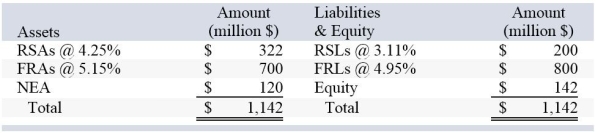 If the bank wishes to set up a swap to totally hedge the interest rate risk,the bank should
 (Multiple Choice)
4.9/5 (72)
(72) Swaps are usually the best hedging tool to use to hedge long-term risks of four or five years or more.
(True/False)
4.8/5 (82)
(82) What are the advantages and disadvantages of forwards versus futures contracts?
(Essay)
4.8/5 (90)
(90) 
Filters
- Essay(0)
- Multiple Choice(0)
- Short Answer(0)
- True False(0)
- Matching(0)