



 Chat with AI
Exam 28: Unemployment

Exam 1: Ten Principles of Economics439 Questions
Exam 2: Thinking Like an Economist617 Questions
Exam 3: Interdependence and the Gains From Trade527 Questions
Exam 4: The Market Forces of Supply and Demand697 Questions
Exam 5: Elasticity and Its Application594 Questions
Exam 6: Supply, Demand, and Government Policies645 Questions
Exam 7: Consumers, Producers, and the Efficiency of Markets549 Questions
Exam 8: Application: the Costs of Taxation513 Questions
Exam 9: Application: International Trade492 Questions
Exam 10: Externalities524 Questions
Exam 11: Public Goods and Common Resources433 Questions
Exam 12: The Design of the Tax System549 Questions
Exam 13: The Costs of Production420 Questions
Exam 14: Firms in Competitive Markets543 Questions
Exam 15: Monopoly637 Questions
Exam 16: Monopolistic Competition580 Questions
Exam 17: Oligopoly488 Questions
Exam 18: The Markets for the Factors of Production564 Questions
Exam 19: Earnings and Discrimination490 Questions
Exam 20: Income Inequality and Poverty455 Questions
Exam 21: The Theory of Consumer Choice431 Questions
Exam 22: Frontiers of Microeconomics440 Questions
Exam 23: Measuring a Nations Income520 Questions
Exam 24: Measuring the Cost of Living529 Questions
Exam 25: Production and Growth505 Questions
Exam 26: Saving, Investment, and the Financial System564 Questions
Exam 27: The Basic Tools of Finance500 Questions
Exam 28: Unemployment678 Questions
Exam 29: The Monetary System515 Questions
Exam 30: Money Growth and Inflation481 Questions
Exam 31: Open-Economy Macroeconomics: Basic Concepts522 Questions
Exam 32: A Macroeconomic Theory of the Open Economy475 Questions
Exam 33: Aggregate Demand and Aggregate Supply562 Questions
Exam 34: The Influence of Monetary and Fiscal Policy on Aggregate Demand508 Questions
Exam 35: The Short-Run Trade-Off Between Inflation and Unemployment491 Questions
Exam 36: Six Debates Over Macroeconomic Policy372 Questions
Select questions type


In 2009, based on concepts similar to those used to estimate U.S. employment figures, the Italian adult non- institutionalized population was 51.070 million, the labor force was 24.710 million, and the number of people employed was 22.765 million. According to these numbers, the Italian labor-force participation rate and unemployment rate were about
(Multiple Choice)
4.8/5  (80)
(80) Unemployment that results because it takes time for workers to search for the jobs that best suit their tastes and skills is called
(Multiple Choice)
4.9/5 (74)
(74) Table 28-4
2010 Labor Data for Adults (ages 16 and older) in Meditor  -Refer to Table 28-4. What is the adult female labor-force participation rate in Meditor?
 (Multiple Choice)
4.9/5 (92)
(92) The unemployment that results from the process of matching workers and jobs is called frictional unemployment.
(True/False)
4.8/5 (84)
(84) Table 28-11
2010 Labor Data for Tajnia  -Refer to Table 28-11. The labor-force participation rate of Tajnia in 2010 is about 40.8 percent.
 (True/False)
4.9/5 (72)
(72) The Bureau of Labor Statistics produces data on unemployment and other aspects of the labor market from a regular survey of about
(Multiple Choice)
4.9/5 (74)
(74) The Bureau of Labor Statistics is part of the U.S. Department of
(Multiple Choice)
4.9/5 (81)
(81) Michael decides to hire some additional workers for his roofing company. The equilibrium wage is $17 per hour. Efficiency wage theory suggests that it is reasonable for Michael to offer
(Multiple Choice)
4.7/5 (71)
(71) Suppose that the adult population in the town of Springfield is 225 million. If 40 million are unemployed and 100 million are employed, then the unemployment rate is approximately
(Multiple Choice)
4.8/5 (72)
(72) Almost nine-tenths of all spells of unemployment end when the unemployed person finds a job.
(True/False)
4.8/5 (84)
(84) It is only among the least skilled and least experienced members of the labor force that minimum-wage laws cause unemployment.
(True/False)
4.9/5 (86)
(86) Table 28-8
Below is data about the labor market in the state of Northwoods. 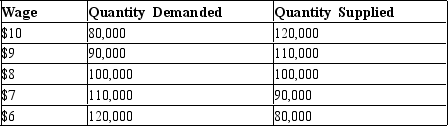 -Refer to Table 28-8. If the state government imposed a minimum wage of $9, how many people would be unemployed?
A) 0
-Refer to Table 28-8. If the state government imposed a minimum wage of $9, how many people would be unemployed?
A) 0 (Multiple Choice)
4.9/5 (87)
(87) List the main employment characteristics over which a labor union negotiates for its workers.
(Essay)
4.9/5 (83)
(83) When a minimum-wage law forces the wage to remain above the level that balances supply and demand, the quantity of labor supplied is lower and the quantity of labor demand is higher than at the equilibrium wage.
(True/False)
4.8/5 (83)
(83) Even though the difference in labor-force participation rates of U.S. males and females has narrowed, the labor- force participation rate of males remains higher than that of females.
(True/False)
4.7/5 (81)
(81) Minimum wages create unemployment in markets where they create a
(Multiple Choice)
4.8/5 (72)
(72) 
Filters
- Essay(0)
- Multiple Choice(0)
- Short Answer(0)
- True False(0)
- Matching(0)