



 Chat with AI
Exam 28: Unemployment

Exam 1: Ten Principles of Economics439 Questions
Exam 2: Thinking Like an Economist617 Questions
Exam 3: Interdependence and the Gains From Trade527 Questions
Exam 4: The Market Forces of Supply and Demand697 Questions
Exam 5: Elasticity and Its Application594 Questions
Exam 6: Supply, Demand, and Government Policies645 Questions
Exam 7: Consumers, Producers, and the Efficiency of Markets549 Questions
Exam 8: Application: the Costs of Taxation513 Questions
Exam 9: Application: International Trade492 Questions
Exam 10: Externalities524 Questions
Exam 11: Public Goods and Common Resources433 Questions
Exam 12: The Design of the Tax System549 Questions
Exam 13: The Costs of Production420 Questions
Exam 14: Firms in Competitive Markets543 Questions
Exam 15: Monopoly637 Questions
Exam 16: Monopolistic Competition580 Questions
Exam 17: Oligopoly488 Questions
Exam 18: The Markets for the Factors of Production564 Questions
Exam 19: Earnings and Discrimination490 Questions
Exam 20: Income Inequality and Poverty455 Questions
Exam 21: The Theory of Consumer Choice431 Questions
Exam 22: Frontiers of Microeconomics440 Questions
Exam 23: Measuring a Nations Income520 Questions
Exam 24: Measuring the Cost of Living529 Questions
Exam 25: Production and Growth505 Questions
Exam 26: Saving, Investment, and the Financial System564 Questions
Exam 27: The Basic Tools of Finance500 Questions
Exam 28: Unemployment678 Questions
Exam 29: The Monetary System515 Questions
Exam 30: Money Growth and Inflation481 Questions
Exam 31: Open-Economy Macroeconomics: Basic Concepts522 Questions
Exam 32: A Macroeconomic Theory of the Open Economy475 Questions
Exam 33: Aggregate Demand and Aggregate Supply562 Questions
Exam 34: The Influence of Monetary and Fiscal Policy on Aggregate Demand508 Questions
Exam 35: The Short-Run Trade-Off Between Inflation and Unemployment491 Questions
Exam 36: Six Debates Over Macroeconomic Policy372 Questions
Select questions type


Figure 28-5 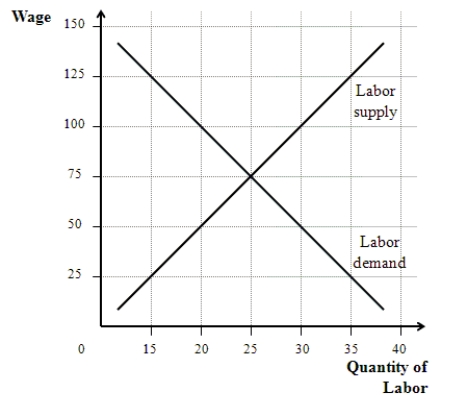 -Refer to Figure 28-5. If the minimum wage is set at $125, then
 (Multiple Choice)
4.8/5  (82)
(82) The Bureau of Labor Statistics reported in 2005 that there were 59.98 million people over age 25 whose highest level of education was a high school degree or equivalent, 36.40 million of whom were employed and 1.93 million of whom were unemployed. What were the labor-force participation rate and the unemployment rate for this group?
(Multiple Choice)
4.9/5 (70)
(70) When a union raises the wage above the equilibrium level, it reduces the quantity of labor supplied and raises the quantity of labor demanded, resulting in unemployment.
(True/False)
4.8/5 (75)
(75) The normal rate of unemployment around which the unemployment rate fluctuates is called cyclical unemployment.
(True/False)
4.7/5 (86)
(86) The Bureau of Labor Statistics divides the adult population into four categories: employed, underemployed, unemployed, and not in the labor force.
(True/False)
4.9/5 (83)
(83) Susan is a plant manager in charge of a factory in a relatively poor country. Even though market wages are low, she decides to raise the wages of her workers. Her decision
(Multiple Choice)
4.9/5 (93)
(93) Table 28-6  -Refer to Table 28-6. What is the U-5 measure of labor underutilization?
 (Multiple Choice)
5.0/5 (92)
(92) Sheamous loses his job and decides to sit on the beach rather than look for work during the next few months. Other things the same, the unemployment rate
(Multiple Choice)
4.8/5 (70)
(70) Minimum-wage laws and unions are similar to each other but different from efficiency wages in that minimum-wage law and unions
(Multiple Choice)
4.9/5 (88)
(88) Table 28-11
2010 Labor Data for Tajnia  -Refer to Table 28-11. The labor force of Tajnia in 2010 is 12,250.
 (True/False)
4.8/5 (73)
(73) According to the theory of efficiency wages, it may be profitable for firms to keep wages high even in the presence of a surplus of labor.
(True/False)
4.9/5 (79)
(79) Measuring unemployment is the job of the Bureau of Labor Statistics.
(True/False)
4.7/5 (73)
(73) The adult population must equal the sum of the employed, the unemployed, and those not in the labor force.
(True/False)
4.9/5 (80)
(80) When a union raises the wage above the equilibrium level, it
(Multiple Choice)
4.9/5 (94)
(94) Figure 28-6 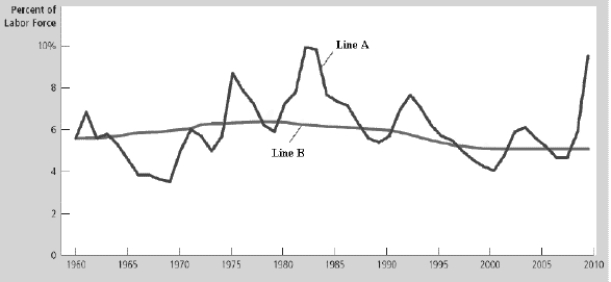 -Refer to Figure 28-6. What type of unemployment is measured by the differences between lines A and B?
 (Short Answer)
5.0/5 (86)
(86) Noah is an unpaid stay-at-home father who is not currently searching for paid work. Pete is a full-time student who is not looking for a job. Who is included in the labor force by the Bureau of Labor Statistics?
(Multiple Choice)
4.8/5 (80)
(80) 
Filters
- Essay(0)
- Multiple Choice(0)
- Short Answer(0)
- True False(0)
- Matching(0)