



 Chat with AI
Exam 28: Unemployment

Exam 1: Ten Principles of Economics439 Questions
Exam 2: Thinking Like an Economist617 Questions
Exam 3: Interdependence and the Gains From Trade527 Questions
Exam 4: The Market Forces of Supply and Demand697 Questions
Exam 5: Elasticity and Its Application594 Questions
Exam 6: Supply, Demand, and Government Policies645 Questions
Exam 7: Consumers, Producers, and the Efficiency of Markets549 Questions
Exam 8: Application: the Costs of Taxation513 Questions
Exam 9: Application: International Trade492 Questions
Exam 10: Externalities524 Questions
Exam 11: Public Goods and Common Resources433 Questions
Exam 12: The Design of the Tax System549 Questions
Exam 13: The Costs of Production420 Questions
Exam 14: Firms in Competitive Markets543 Questions
Exam 15: Monopoly637 Questions
Exam 16: Monopolistic Competition580 Questions
Exam 17: Oligopoly488 Questions
Exam 18: The Markets for the Factors of Production564 Questions
Exam 19: Earnings and Discrimination490 Questions
Exam 20: Income Inequality and Poverty455 Questions
Exam 21: The Theory of Consumer Choice431 Questions
Exam 22: Frontiers of Microeconomics440 Questions
Exam 23: Measuring a Nations Income520 Questions
Exam 24: Measuring the Cost of Living529 Questions
Exam 25: Production and Growth505 Questions
Exam 26: Saving, Investment, and the Financial System564 Questions
Exam 27: The Basic Tools of Finance500 Questions
Exam 28: Unemployment678 Questions
Exam 29: The Monetary System515 Questions
Exam 30: Money Growth and Inflation481 Questions
Exam 31: Open-Economy Macroeconomics: Basic Concepts522 Questions
Exam 32: A Macroeconomic Theory of the Open Economy475 Questions
Exam 33: Aggregate Demand and Aggregate Supply562 Questions
Exam 34: The Influence of Monetary and Fiscal Policy on Aggregate Demand508 Questions
Exam 35: The Short-Run Trade-Off Between Inflation and Unemployment491 Questions
Exam 36: Six Debates Over Macroeconomic Policy372 Questions
Select questions type


A survey showed that in each of the past 12 months there was one person who was unemployed who worked in all other months. There were also two people who were unemployed for all 12 months. What percentage of the unemployment spells during the year was short term, and what percentage of the unemployment in a given month was long term?
(Multiple Choice)
4.9/5  (78)
(78) Most spells of unemployment are short. About half of unemployment spells end with an exit from the labor force.
(True/False)
4.7/5 (69)
(69) Suppose that some people report themselves as unemployed when, in fact, they are working in the underground economy. If these persons were counted as employed, then
(Multiple Choice)
4.8/5 (78)
(78) Measuring the amount of unemployment in the economy is a straightforward task.
(True/False)
4.7/5 (80)
(80) The Bureau of Labor Statistics divides the adult population into three categories: employed, unemployed, and not in the labor force.
(True/False)
4.9/5 (93)
(93) Adults who were waiting to be recalled to a job from which they had been laid off are included in the Bureau of Labor Statistics' "employed" category.
(True/False)
4.8/5 (89)
(89) Job search is the process of matching workers with appropriate jobs.
(True/False)
4.9/5 (76)
(76) Most spells of unemployment are short, and most unemployment observed at any given time is long-term.
(True/False)
4.8/5 (95)
(95) Workers searching for jobs that best suit them is most closely associated with
(Multiple Choice)
4.8/5 (75)
(75) Duane owns his own real estate company. The Bureau of Labor Statistics counts Duane as
(Multiple Choice)
4.7/5 (91)
(91) Adults who are waiting to be recalled to a job from which they had been laid off are counted as "unemployed."
(True/False)
4.8/5 (82)
(82) The natural rate of unemployment is the desirable rate of unemployment for an economy.
(True/False)
4.9/5 (79)
(79) Almost half of all spells of unemployment end when the unemployed person leaves the labor force.
(True/False)
4.8/5 (71)
(71) Only paid workers are included in the Bureau of Labor Statistics' "employed" category.
(True/False)
4.8/5 (79)
(79) Economists have found that union workers earn what percent more than similar nonunion workers?
(Multiple Choice)
4.9/5 (88)
(88) Figure 28-1 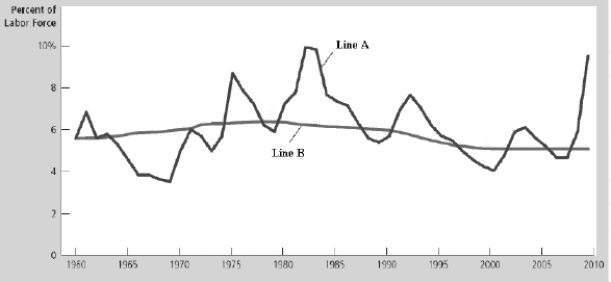 -Refer to Figure 28-1. Which of the following correctly identifies lines A and B?
 (Multiple Choice)
4.8/5 (82)
(82) Some of a firm's workers are made worse off by the introduction of a union.
(True/False)
4.7/5 (78)
(78) 
Filters
- Essay(0)
- Multiple Choice(0)
- Short Answer(0)
- True False(0)
- Matching(0)