



 Chat with AI
Exam 27: The Basic Tools of Finance

Exam 1: Ten Principles of Economics439 Questions
Exam 2: Thinking Like an Economist617 Questions
Exam 3: Interdependence and the Gains From Trade527 Questions
Exam 4: The Market Forces of Supply and Demand697 Questions
Exam 5: Elasticity and Its Application594 Questions
Exam 6: Supply, Demand, and Government Policies645 Questions
Exam 7: Consumers, Producers, and the Efficiency of Markets549 Questions
Exam 8: Application: the Costs of Taxation513 Questions
Exam 9: Application: International Trade492 Questions
Exam 10: Externalities524 Questions
Exam 11: Public Goods and Common Resources433 Questions
Exam 12: The Design of the Tax System549 Questions
Exam 13: The Costs of Production420 Questions
Exam 14: Firms in Competitive Markets543 Questions
Exam 15: Monopoly637 Questions
Exam 16: Monopolistic Competition580 Questions
Exam 17: Oligopoly488 Questions
Exam 18: The Markets for the Factors of Production564 Questions
Exam 19: Earnings and Discrimination490 Questions
Exam 20: Income Inequality and Poverty455 Questions
Exam 21: The Theory of Consumer Choice431 Questions
Exam 22: Frontiers of Microeconomics440 Questions
Exam 23: Measuring a Nations Income520 Questions
Exam 24: Measuring the Cost of Living529 Questions
Exam 25: Production and Growth505 Questions
Exam 26: Saving, Investment, and the Financial System564 Questions
Exam 27: The Basic Tools of Finance500 Questions
Exam 28: Unemployment678 Questions
Exam 29: The Monetary System515 Questions
Exam 30: Money Growth and Inflation481 Questions
Exam 31: Open-Economy Macroeconomics: Basic Concepts522 Questions
Exam 32: A Macroeconomic Theory of the Open Economy475 Questions
Exam 33: Aggregate Demand and Aggregate Supply562 Questions
Exam 34: The Influence of Monetary and Fiscal Policy on Aggregate Demand508 Questions
Exam 35: The Short-Run Trade-Off Between Inflation and Unemployment491 Questions
Exam 36: Six Debates Over Macroeconomic Policy372 Questions
Select questions type


Suppose Emilio offers you $500 today or $X in 10 years. If the interest rate is 6 percent, then at what value of X would you be indifferent between the two options?
(Multiple Choice)
4.7/5  (88)
(88) The present value of a future payment to be received in three years is $1,000. If the interest rate is 5%, what is the amount that will be paid in three years?
(Multiple Choice)
4.8/5 (81)
(81) A person who is risk averse might accept a 50% chance of losing $100 today in exchange for a 50% chance of winning $125 in two years if the interest rate was
(Multiple Choice)
4.9/5 (86)
(86) Suppose the interest rate is 5% and that you are to receive three annual payments of $10,000, with the first payment one year from now, the second payment two years from now, and the third payment three years from now. What is the present value of this stream of payments?
(Short Answer)
4.8/5 (71)
(71) Figure 27-3
The following figure shows the utility function for Paul. 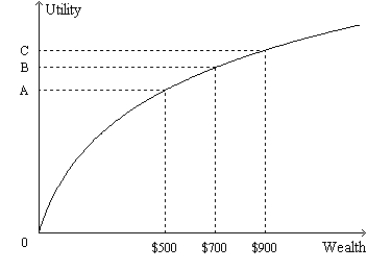 -Refer to Figure 27-3. Suppose the vertical distance between the points (0, A) and (0, B) is 10. If his wealth increased from $700 to $900, then
 (Multiple Choice)
4.8/5 (83)
(83) According to the efficient markets hypothesis, worse-than-expected news about a corporation will
(Multiple Choice)
4.8/5 (71)
(71) If the interest rate is 8 percent, then what is the present value of $5,000 to be received in ten years?
(Short Answer)
4.9/5 (63)
(63) Suppose you put $500 into a bank account today. Interest is paid annually and the annual interest rate is 8 percent. The future value of the $500 after 2 years is
(Multiple Choice)
4.7/5 (61)
(61) The market for insurance is one example of reducing risk by using diversification.
(True/False)
4.9/5 (70)
(70) Four years ago Ollie deposited some money into an account. He earned 5 percent interest on this account and now it has a balance of $303.88. About how much money did Ollie deposit into his account when he opened it?
(Multiple Choice)
4.8/5 (76)
(76) Suppose you win the lottery and one of your payment options is to receive $20,000 today, $20,000 one year from now, and $20,000 two years from now. If the interest rate is 5%, what is the present value of this option?
(Multiple Choice)
4.9/5 (78)
(78) Managed mutual funds usually outperform mutual funds that are supposed to follow some stock index.
(True/False)
5.0/5 (80)
(80) Writing in The Wall Street Journal in 2009, economist Jeremy Siegel pointed out that the efficient markets hypothesis
(Multiple Choice)
4.9/5 (94)
(94) When you were 10 years old, your grandparents put $500 into an account for you paying 7 percent interest. Now that you are 18 years old, your grandparents tell you that you can take the money out of the account. What is the balance to the nearest cent?
(Multiple Choice)
4.8/5 (80)
(80) Svetlana is risk averse. Which of the following is correct about Svetlana?
(Multiple Choice)
4.9/5 (87)
(87) Figure 27-4. The figure shows a utility function for Alex. 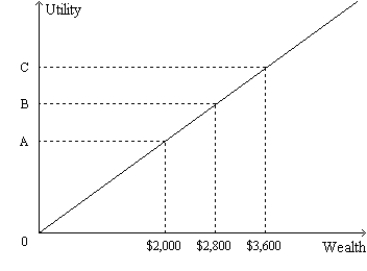 -Refer to Figure 27-4. From the appearance of Alex's utility function, we know that
 (Multiple Choice)
4.9/5 (77)
(77) What is the present value of a payment of $250 one year from today if the interest rate is 4 percent?
A) $240.38
(Multiple Choice)
4.8/5 (84)
(84) 
Filters
- Essay(0)
- Multiple Choice(0)
- Short Answer(0)
- True False(0)
- Matching(0)