



 Chat with AI
Exam 27: The Basic Tools of Finance

Exam 1: Ten Principles of Economics439 Questions
Exam 2: Thinking Like an Economist617 Questions
Exam 3: Interdependence and the Gains From Trade527 Questions
Exam 4: The Market Forces of Supply and Demand697 Questions
Exam 5: Elasticity and Its Application594 Questions
Exam 6: Supply, Demand, and Government Policies645 Questions
Exam 7: Consumers, Producers, and the Efficiency of Markets549 Questions
Exam 8: Application: the Costs of Taxation513 Questions
Exam 9: Application: International Trade492 Questions
Exam 10: Externalities524 Questions
Exam 11: Public Goods and Common Resources433 Questions
Exam 12: The Design of the Tax System549 Questions
Exam 13: The Costs of Production420 Questions
Exam 14: Firms in Competitive Markets543 Questions
Exam 15: Monopoly637 Questions
Exam 16: Monopolistic Competition580 Questions
Exam 17: Oligopoly488 Questions
Exam 18: The Markets for the Factors of Production564 Questions
Exam 19: Earnings and Discrimination490 Questions
Exam 20: Income Inequality and Poverty455 Questions
Exam 21: The Theory of Consumer Choice431 Questions
Exam 22: Frontiers of Microeconomics440 Questions
Exam 23: Measuring a Nations Income520 Questions
Exam 24: Measuring the Cost of Living529 Questions
Exam 25: Production and Growth505 Questions
Exam 26: Saving, Investment, and the Financial System564 Questions
Exam 27: The Basic Tools of Finance500 Questions
Exam 28: Unemployment678 Questions
Exam 29: The Monetary System515 Questions
Exam 30: Money Growth and Inflation481 Questions
Exam 31: Open-Economy Macroeconomics: Basic Concepts522 Questions
Exam 32: A Macroeconomic Theory of the Open Economy475 Questions
Exam 33: Aggregate Demand and Aggregate Supply562 Questions
Exam 34: The Influence of Monetary and Fiscal Policy on Aggregate Demand508 Questions
Exam 35: The Short-Run Trade-Off Between Inflation and Unemployment491 Questions
Exam 36: Six Debates Over Macroeconomic Policy372 Questions
Select questions type


Which, if any, of the present values below are correctly computed?
(Multiple Choice)
4.9/5  (80)
(80) When he was 18, Hussam put $100 into an account at an interest rate of 8 percent. He now has $158.69 in this account. For how many years did Hussam leave this money in his account?
(Multiple Choice)
4.8/5 (79)
(79) Suppose you put $500 into a bank account today. Interest is paid annually and the annual interest rate is 5.5 percent. The future value of the $500 is
(Multiple Choice)
4.7/5 (72)
(72) Cleo promises to pay Jacques $1,000 two years from today. If the interest rate is 4 percent, then how much is this future payment worth today?
(Multiple Choice)
5.0/5 (84)
(84) David's Utility Function 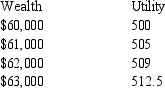 If David's current wealth is $61,000, then
 (Multiple Choice)
4.8/5 (89)
(89) Which of the following methods of picking stocks is not consistent with fundamental analysis?
(Multiple Choice)
4.9/5 (79)
(79) Suppose the interest rate is 5 percent. Which of the following payment options has the highest present value today?
(Multiple Choice)
4.9/5 (71)
(71) Figure 27-5. The figure shows a utility function for Dexter.  -Refer to Figure 27-5. Suppose the vertical distance between the points (0, A) and (0, B) is 12. If his wealth increased from $1,300 to $1,800, then
 (Multiple Choice)
4.9/5 (75)
(75) Figure 27-5. The figure shows a utility function for Dexter.
-Refer to Figure 27-5. From the appearance of the utility function, we know that
-Refer to Figure 27-5. From the appearance of the utility function, we know that (Multiple Choice)
4.8/5 (65)
(65) You are a financial advisor and a client tells you he is concerned about the amount of risk in his portfolio. Assuming your client hasn't already done them, what two things can you suggest to reduce your client's risk? What additional information about reducing risk should you provide?
(Essay)
4.8/5 (72)
(72) Which of the following actions best illustrates adverse selection?
(Multiple Choice)
4.9/5 (85)
(85) Jorge deposited $1,000 into an account three years ago. The first two years he earned 5 percent interest; the third year he earned 6 percent interest. How much money does Jorge have in his account today?
(Multiple Choice)
4.8/5 (81)
(81) If you put $300 into an account paying 2 percent interest, what will be the value of this account in 4 years?
(Multiple Choice)
4.8/5 (68)
(68) If the interest rate is 4.5 percent, what is the present value of a payment of $500 to be made one year from today?
A) $457.14
(Multiple Choice)
4.8/5 (76)
(76) You have a choice among three options. Option 1: receive $900 immediately. Option 2: receive $1,200 one year from now. Option 3: receive $2,000 five years from now. The interest rate is 15 percent. Rank these three options from highest present value to lowest present value.
(Multiple Choice)
4.9/5 (77)
(77) David increases the number of companies in which he holds stocks.
(Multiple Choice)
4.9/5 (76)
(76) If stock prices follow a random walk, then stock investors can make large profits by
(Multiple Choice)
4.9/5 (70)
(70) 
Filters
- Essay(0)
- Multiple Choice(0)
- Short Answer(0)
- True False(0)
- Matching(0)