



 Chat with AI
Exam 27: The Basic Tools of Finance

Exam 1: Ten Principles of Economics439 Questions
Exam 2: Thinking Like an Economist617 Questions
Exam 3: Interdependence and the Gains From Trade527 Questions
Exam 4: The Market Forces of Supply and Demand697 Questions
Exam 5: Elasticity and Its Application594 Questions
Exam 6: Supply, Demand, and Government Policies645 Questions
Exam 7: Consumers, Producers, and the Efficiency of Markets549 Questions
Exam 8: Application: the Costs of Taxation513 Questions
Exam 9: Application: International Trade492 Questions
Exam 10: Externalities524 Questions
Exam 11: Public Goods and Common Resources433 Questions
Exam 12: The Design of the Tax System549 Questions
Exam 13: The Costs of Production420 Questions
Exam 14: Firms in Competitive Markets543 Questions
Exam 15: Monopoly637 Questions
Exam 16: Monopolistic Competition580 Questions
Exam 17: Oligopoly488 Questions
Exam 18: The Markets for the Factors of Production564 Questions
Exam 19: Earnings and Discrimination490 Questions
Exam 20: Income Inequality and Poverty455 Questions
Exam 21: The Theory of Consumer Choice431 Questions
Exam 22: Frontiers of Microeconomics440 Questions
Exam 23: Measuring a Nations Income520 Questions
Exam 24: Measuring the Cost of Living529 Questions
Exam 25: Production and Growth505 Questions
Exam 26: Saving, Investment, and the Financial System564 Questions
Exam 27: The Basic Tools of Finance500 Questions
Exam 28: Unemployment678 Questions
Exam 29: The Monetary System515 Questions
Exam 30: Money Growth and Inflation481 Questions
Exam 31: Open-Economy Macroeconomics: Basic Concepts522 Questions
Exam 32: A Macroeconomic Theory of the Open Economy475 Questions
Exam 33: Aggregate Demand and Aggregate Supply562 Questions
Exam 34: The Influence of Monetary and Fiscal Policy on Aggregate Demand508 Questions
Exam 35: The Short-Run Trade-Off Between Inflation and Unemployment491 Questions
Exam 36: Six Debates Over Macroeconomic Policy372 Questions
Select questions type


As the number of stocks in a person's portfolio increases,
(Multiple Choice)
4.8/5  (79)
(79) Give an example of adverse selection and an example of moral hazard using homeowners insurance.
(Essay)
4.9/5 (83)
(83) Which of the following changes would decrease the present value of a future payment?
(Multiple Choice)
4.9/5 (81)
(81) At which interest rate is the present value of $360 three years from today equal to about $310 today?
(Multiple Choice)
4.9/5 (81)
(81) What is the present value of a payment of $100 to be made one year from today?
(Multiple Choice)
4.8/5 (79)
(79) If the interest rate is r percent, then the rule of 70 says that your savings will double about every
(Multiple Choice)
4.8/5 (64)
(64) If you deposit $1,000 into a savings account that pays you 5% interest per year, approximately how long will it take to double your money?
(Multiple Choice)
4.8/5 (78)
(78) Risk aversion simply means that people dislike bad things to happen.
(True/False)
4.8/5 (70)
(70) Susan put $375 into an account and one year later had $405. What interest rate was paid on Susan's deposit?
(Multiple Choice)
4.7/5 (81)
(81) Which of the following is correct concerning stock market irrationality?
(Multiple Choice)
5.0/5 (91)
(91) Which of the following is the correct way to compute the future value of $100 put into an account that earns 4 percent interest for 10 years?
(Multiple Choice)
4.9/5 (76)
(76) List three different ways that a risk-averse person can reduce financial risk.
(Essay)
4.8/5 (91)
(91) What is the future value of $500 one year from today if the interest rate is 6 percent?
(Multiple Choice)
4.8/5 (79)
(79) Historically the return on stocks has been higher than the return on bonds. In part this reflects the higher risk from holding stock.
(True/False)
4.8/5 (81)
(81) What is the future value of $800 one year from today if the interest rate is 7 percent?
(Multiple Choice)
4.8/5 (63)
(63) Of the following interest rates, which is the highest one at which you would prefer to have $170 ten years from today instead of $100 today?
(Multiple Choice)
4.9/5 (81)
(81) An increase in the number of corporations in a portfolio from 1 to 10 reduces
(Multiple Choice)
4.8/5 (75)
(75) Writing in the Wall Street Journal in 2009, economist Jeremy Siegel argued that, in the years leading up to the financial crisis of 2008-2009,
(Multiple Choice)
4.8/5 (86)
(86) Which of the following is the correct way to compute the future value of $1 put into an account that earns 5 percent interest for 16 years? 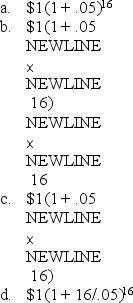
(Multiple Choice)
4.9/5 (80)
(80) 
Filters
- Essay(0)
- Multiple Choice(0)
- Short Answer(0)
- True False(0)
- Matching(0)