



 Chat with AI
Exam 27: The Basic Tools of Finance

Exam 1: Ten Principles of Economics439 Questions
Exam 2: Thinking Like an Economist617 Questions
Exam 3: Interdependence and the Gains From Trade527 Questions
Exam 4: The Market Forces of Supply and Demand697 Questions
Exam 5: Elasticity and Its Application594 Questions
Exam 6: Supply, Demand, and Government Policies645 Questions
Exam 7: Consumers, Producers, and the Efficiency of Markets549 Questions
Exam 8: Application: the Costs of Taxation513 Questions
Exam 9: Application: International Trade492 Questions
Exam 10: Externalities524 Questions
Exam 11: Public Goods and Common Resources433 Questions
Exam 12: The Design of the Tax System549 Questions
Exam 13: The Costs of Production420 Questions
Exam 14: Firms in Competitive Markets543 Questions
Exam 15: Monopoly637 Questions
Exam 16: Monopolistic Competition580 Questions
Exam 17: Oligopoly488 Questions
Exam 18: The Markets for the Factors of Production564 Questions
Exam 19: Earnings and Discrimination490 Questions
Exam 20: Income Inequality and Poverty455 Questions
Exam 21: The Theory of Consumer Choice431 Questions
Exam 22: Frontiers of Microeconomics440 Questions
Exam 23: Measuring a Nations Income520 Questions
Exam 24: Measuring the Cost of Living529 Questions
Exam 25: Production and Growth505 Questions
Exam 26: Saving, Investment, and the Financial System564 Questions
Exam 27: The Basic Tools of Finance500 Questions
Exam 28: Unemployment678 Questions
Exam 29: The Monetary System515 Questions
Exam 30: Money Growth and Inflation481 Questions
Exam 31: Open-Economy Macroeconomics: Basic Concepts522 Questions
Exam 32: A Macroeconomic Theory of the Open Economy475 Questions
Exam 33: Aggregate Demand and Aggregate Supply562 Questions
Exam 34: The Influence of Monetary and Fiscal Policy on Aggregate Demand508 Questions
Exam 35: The Short-Run Trade-Off Between Inflation and Unemployment491 Questions
Exam 36: Six Debates Over Macroeconomic Policy372 Questions
Select questions type


Some people argue that there are two advantages to holding mutual funds. The first is that mutual funds provide an inexpensive way to hold a diversified portfolio. The second is that because of their expertise mutual fund managers should be able to consistently beat the market. Which of the following does the evidence show?
(Multiple Choice)
4.8/5  (70)
(70) Greg's Tasty Ice Cream is considering building a new ice cream factory that costs $8.3 million. The company accountants believe that, not accounting for interest costs, building the factory will increase profits by $5 million the first year, $4 million the second year and have no value thereafter. Greg's Tasty Ice Cream should build the factory if the interest rate is
(Multiple Choice)
4.8/5 (85)
(85) In the 15 years ending June 2010, most active portfolio managers failed to beat the market.
(True/False)
4.7/5 (77)
(77) You could borrow $2,000 today from Bank A and repay the loan, with interest, by paying Bank A $2,125 one year from today. Or, you could borrow X dollars today from Bank B and repay the loan, with interest, by paying Bank B $2,200 two years from today. In order for the same interest rate to apply to the two loans, X =
(Multiple Choice)
4.8/5 (86)
(86) At which interest rate is the present value of $35.00 two years from today equal to about $30.00 today?
(Multiple Choice)
4.8/5 (64)
(64) Twenty years ago, Dr. Montgomery borrowed money from her parents to pay her tuition at graduate school. Now she wants to pay them back. She gives them double what they gave her. According to the rule of 70, what interest rate would have given her parents the same amount of money if they had put it in the bank rather than lending it to their daughter?
(Multiple Choice)
4.9/5 (74)
(74) People who are risk averse dislike bad outcomes more than they like comparable good outcomes.
(True/False)
4.9/5 (82)
(82) At which interest rate is the present value of $260.10 two years from today equal to $250 today?
(Multiple Choice)
4.8/5 (88)
(88) Black Oil Company considered building a service station in a new location. The owners and their accountants decided that this was the profitable thing to do. However, soon after they made this decision, both the interest rate and the cost of building the station changed. In which case do these changes both make it less likely that they will now build the station?
(Multiple Choice)
4.7/5 (90)
(90) Actively managed mutual funds usually fail to outperform index funds, and this fact provides evidence in favor of the efficient markets hypothesis.
(True/False)
4.8/5 (76)
(76) Figure 27-6. On the graph, x represents risk and y represents return. 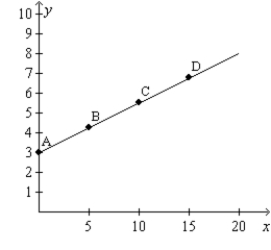 -Refer to Figure 27-6. Which of the following statements is correct?
 (Multiple Choice)
4.7/5 (69)
(69) At an annual interest rate of 10 percent, about how many years will it take $100 to double in value?
(Multiple Choice)
4.8/5 (84)
(84) The fact that we observe a trade-off between risk and return is puzzling to economists, because that observation conflicts with the notion that most people are risk averse.
(True/False)
5.0/5 (97)
(97) Assuming the interest rate is 6 percent, which of the following has the greatest present value?
(Multiple Choice)
4.9/5 (79)
(79) Suppose you place $500 into a savings account that will pay you 6% interest per year. What will be the future value of the savings account in 15 years?
(Short Answer)
4.8/5 (72)
(72) According to the efficient markets hypothesis, which of the following would decrease the price of stock in Veblen's Leisure Company?
(Multiple Choice)
4.8/5 (83)
(83) Historically, stocks have offered higher rates of return than bonds.
(True/False)
4.8/5 (76)
(76) According to the efficient markets hypothesis, stocks follow a random walk so that stocks that increase in price one year are more likely to increase than decrease in the next year.
(True/False)
4.8/5 (94)
(94) What is the present value of a payment of $2,000 to be received two years from today if the interest rate is 5%?
(Multiple Choice)
4.9/5 (79)
(79) Cash payments that companies make to shareholders are called
(Multiple Choice)
4.8/5 (74)
(74) 
Filters
- Essay(0)
- Multiple Choice(0)
- Short Answer(0)
- True False(0)
- Matching(0)