



 Chat with AI
Exam 12: The Design of the Tax System

Exam 1: Ten Principles of Economics439 Questions
Exam 2: Thinking Like an Economist617 Questions
Exam 3: Interdependence and the Gains From Trade527 Questions
Exam 4: The Market Forces of Supply and Demand697 Questions
Exam 5: Elasticity and Its Application594 Questions
Exam 6: Supply, Demand, and Government Policies645 Questions
Exam 7: Consumers, Producers, and the Efficiency of Markets549 Questions
Exam 8: Application: the Costs of Taxation513 Questions
Exam 9: Application: International Trade492 Questions
Exam 10: Externalities524 Questions
Exam 11: Public Goods and Common Resources433 Questions
Exam 12: The Design of the Tax System549 Questions
Exam 13: The Costs of Production420 Questions
Exam 14: Firms in Competitive Markets543 Questions
Exam 15: Monopoly637 Questions
Exam 16: Monopolistic Competition580 Questions
Exam 17: Oligopoly488 Questions
Exam 18: The Markets for the Factors of Production564 Questions
Exam 19: Earnings and Discrimination490 Questions
Exam 20: Income Inequality and Poverty455 Questions
Exam 21: The Theory of Consumer Choice431 Questions
Exam 22: Frontiers of Microeconomics440 Questions
Exam 23: Measuring a Nations Income520 Questions
Exam 24: Measuring the Cost of Living529 Questions
Exam 25: Production and Growth505 Questions
Exam 26: Saving, Investment, and the Financial System564 Questions
Exam 27: The Basic Tools of Finance500 Questions
Exam 28: Unemployment678 Questions
Exam 29: The Monetary System515 Questions
Exam 30: Money Growth and Inflation481 Questions
Exam 31: Open-Economy Macroeconomics: Basic Concepts522 Questions
Exam 32: A Macroeconomic Theory of the Open Economy475 Questions
Exam 33: Aggregate Demand and Aggregate Supply562 Questions
Exam 34: The Influence of Monetary and Fiscal Policy on Aggregate Demand508 Questions
Exam 35: The Short-Run Trade-Off Between Inflation and Unemployment491 Questions
Exam 36: Six Debates Over Macroeconomic Policy372 Questions
Select questions type


Scenario 12-3
Suppose Roger and Regina receive great satisfaction from their consumption of cheesecake. Regina would be willing to purchase only one slice and would pay up to $8 for it. Roger would be willing to pay $11 for his first slice,$9 for his second slice, and $5 for his third slice. The current market price is $5 per slice.
-Refer to Scenario 12-3. How much consumer surplus does Regina receive from consuming her slice of cheesecake?
(Multiple Choice)
4.8/5  (100)
(100) Scenario 12-1
Ken places a $20 value on a cigar, and Mark places a $17 value on it. The equilibrium price for this brand of cigar is $15.
-Refer to Scenario 12-1. How much total consumer surplus do Ken and Mark get when each purchases one cigar?
(Multiple Choice)
4.9/5 (83)
(83) Briefly describe the tradeoff between equity and efficiency of tax systems using a few examples.
(Essay)
4.9/5 (89)
(89) An advantage of a consumption tax over the present tax system is that a consumption tax
(Multiple Choice)
4.7/5 (80)
(80) Table 12-15 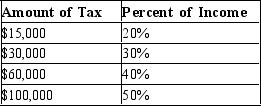 -Refer to Table 12-15. In this tax system which of the following is possible?
 (Multiple Choice)
4.8/5 (81)
(81) A tax levied on the total amount spent in retail stores is called
(Multiple Choice)
4.7/5 (87)
(87) Sue earns income of $80,000 per year. Her average tax rate is 50 percent. Sue paid $5,000 in taxes on the first $30,000 she earned. What was the marginal tax rate on the first $30,000 she earned, and what was the marginal tax rate on the remaining $50,000?
(Multiple Choice)
5.0/5 (80)
(80) The marginal tax rate for an unmarried taxpayer in the highest taxable income category for 2013 is approximately
(Multiple Choice)
4.8/5 (87)
(87) Table 12-5  -Refer to Table 12-5. What is the average tax rate for a person who makes $120,000?
 (Multiple Choice)
4.9/5 (87)
(87) The administrative burden of complying with tax laws is a cost to the government but not to taxpayers.
(True/False)
4.8/5 (77)
(77) Suppose the government taxes 25 percent of the first $60,000 of income and 40 percent of all income above $60,000. For a person earning $200,000, the marginal tax rate is
(Multiple Choice)
4.8/5 (71)
(71) The federal healthcare spending program that specifically targets the poor is called
(Multiple Choice)
4.8/5 (82)
(82) If your income is $40,000 and your income tax liability is $5,000, your
(Multiple Choice)
4.8/5 (86)
(86) Table 12-17
The following table shows the marginal tax rates for unmarried individuals for two years.
2009 2010  -Refer to Table 12-17. Which of the following best describes the tax schedule in 2009?
 (Multiple Choice)
4.9/5 (92)
(92) Suppose Max values a concert ticket at $45. Charles values the same concert ticket at $40. The pre-tax price of a concert ticket is $30. The government imposes a tax of $5 on each concert ticket, and the price rises to $35. The deadweight loss from the tax is
(Multiple Choice)
4.8/5 (67)
(67) Table 12-13
The table below provides information on the 4 households that make up a small economy and how much they would pay in taxes under 3 types of taxes.  -Refer to Table 12-13. In this economy Tax C exhibits
 (Multiple Choice)
4.8/5 (72)
(72) 
Filters
- Essay(0)
- Multiple Choice(0)
- Short Answer(0)
- True False(0)
- Matching(0)