



 Chat with AI
Exam 12: The Design of the Tax System

Exam 1: Ten Principles of Economics439 Questions
Exam 2: Thinking Like an Economist617 Questions
Exam 3: Interdependence and the Gains From Trade527 Questions
Exam 4: The Market Forces of Supply and Demand697 Questions
Exam 5: Elasticity and Its Application594 Questions
Exam 6: Supply, Demand, and Government Policies645 Questions
Exam 7: Consumers, Producers, and the Efficiency of Markets549 Questions
Exam 8: Application: the Costs of Taxation513 Questions
Exam 9: Application: International Trade492 Questions
Exam 10: Externalities524 Questions
Exam 11: Public Goods and Common Resources433 Questions
Exam 12: The Design of the Tax System549 Questions
Exam 13: The Costs of Production420 Questions
Exam 14: Firms in Competitive Markets543 Questions
Exam 15: Monopoly637 Questions
Exam 16: Monopolistic Competition580 Questions
Exam 17: Oligopoly488 Questions
Exam 18: The Markets for the Factors of Production564 Questions
Exam 19: Earnings and Discrimination490 Questions
Exam 20: Income Inequality and Poverty455 Questions
Exam 21: The Theory of Consumer Choice431 Questions
Exam 22: Frontiers of Microeconomics440 Questions
Exam 23: Measuring a Nations Income520 Questions
Exam 24: Measuring the Cost of Living529 Questions
Exam 25: Production and Growth505 Questions
Exam 26: Saving, Investment, and the Financial System564 Questions
Exam 27: The Basic Tools of Finance500 Questions
Exam 28: Unemployment678 Questions
Exam 29: The Monetary System515 Questions
Exam 30: Money Growth and Inflation481 Questions
Exam 31: Open-Economy Macroeconomics: Basic Concepts522 Questions
Exam 32: A Macroeconomic Theory of the Open Economy475 Questions
Exam 33: Aggregate Demand and Aggregate Supply562 Questions
Exam 34: The Influence of Monetary and Fiscal Policy on Aggregate Demand508 Questions
Exam 35: The Short-Run Trade-Off Between Inflation and Unemployment491 Questions
Exam 36: Six Debates Over Macroeconomic Policy372 Questions
Select questions type


Table 12-6
The table below shows the marginal tax rates for an unmarried taxpayer for various levels of taxable income.  -Refer to Table 12-6. For this tax schedule, what is the average tax rate for an individual with $49,000 in taxable income?
 (Multiple Choice)
4.9/5  (74)
(74) 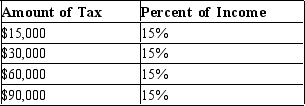 -Refer to Table 12-19. The tax system is
Country A's tax system is more efficient than Country B's tax system if
(Multiple Choice)
4.8/5 (75)
(75) Which of the following contributes to the projected rise in government spending on Social Security and Medicare as a percentage of GDP?
(Multiple Choice)
4.9/5 (73)
(73) Which of the following is not true about government spending on national defense?
(Multiple Choice)
4.9/5 (77)
(77) The principle that people should pay taxes based on the benefits they receive from government services is called the
(Multiple Choice)
4.7/5 (82)
(82) Most people agree that taxes should impose as small a cost on society as possible and that the burden of taxes should be distributed fairly.
(True/False)
4.9/5 (70)
(70) Which of the following is an important reason for the projected increase in government spending as a percentage of GDP over the next several decades?
(Multiple Choice)
4.9/5 (79)
(79) Suppose the government taxes 30 percent of the first $70,000 and 50 percent of all income above $70,000. For a person earning $100,000, the marginal tax rate is
(Multiple Choice)
4.9/5 (78)
(78) Table 12-5  -Refer to Table 12-5. What is the marginal tax rate for a person who makes $120,000?
 (Multiple Choice)
4.9/5 (74)
(74) If a tax takes a smaller fraction of income as income rises, it is
(Multiple Choice)
4.8/5 (76)
(76) Table 12-23
The dollar amounts in the last three columns are the taxes owed under the three different tax systems.  -Refer to Table 12-23. Which of the three tax systems exhibits vertical equity?
 (Multiple Choice)
4.8/5 (75)
(75) As a person's or family's income rises, the marginal federal income tax rate .
(Short Answer)
4.8/5 (90)
(90) From the time of Benjamin Franklin to the present, the percentage of the average American's income that goes to pay taxes has
(Multiple Choice)
4.8/5 (75)
(75) Suppose the government taxes 10 percent of the first $40,000 of income and 20 percent of all income over $40,000. Shahina paid $10,000 in taxes. What were her marginal and average tax rates?
(Multiple Choice)
4.8/5 (77)
(77) The U.S. federal government collects taxes in a number of ways. Rank the following sources of revenue from the largest to the smallest.
(Multiple Choice)
4.8/5 (86)
(86) 
Filters
- Essay(0)
- Multiple Choice(0)
- Short Answer(0)
- True False(0)
- Matching(0)