



 Chat with AI
Exam 12: The Design of the Tax System

Exam 1: Ten Principles of Economics439 Questions
Exam 2: Thinking Like an Economist617 Questions
Exam 3: Interdependence and the Gains From Trade527 Questions
Exam 4: The Market Forces of Supply and Demand697 Questions
Exam 5: Elasticity and Its Application594 Questions
Exam 6: Supply, Demand, and Government Policies645 Questions
Exam 7: Consumers, Producers, and the Efficiency of Markets549 Questions
Exam 8: Application: the Costs of Taxation513 Questions
Exam 9: Application: International Trade492 Questions
Exam 10: Externalities524 Questions
Exam 11: Public Goods and Common Resources433 Questions
Exam 12: The Design of the Tax System549 Questions
Exam 13: The Costs of Production420 Questions
Exam 14: Firms in Competitive Markets543 Questions
Exam 15: Monopoly637 Questions
Exam 16: Monopolistic Competition580 Questions
Exam 17: Oligopoly488 Questions
Exam 18: The Markets for the Factors of Production564 Questions
Exam 19: Earnings and Discrimination490 Questions
Exam 20: Income Inequality and Poverty455 Questions
Exam 21: The Theory of Consumer Choice431 Questions
Exam 22: Frontiers of Microeconomics440 Questions
Exam 23: Measuring a Nations Income520 Questions
Exam 24: Measuring the Cost of Living529 Questions
Exam 25: Production and Growth505 Questions
Exam 26: Saving, Investment, and the Financial System564 Questions
Exam 27: The Basic Tools of Finance500 Questions
Exam 28: Unemployment678 Questions
Exam 29: The Monetary System515 Questions
Exam 30: Money Growth and Inflation481 Questions
Exam 31: Open-Economy Macroeconomics: Basic Concepts522 Questions
Exam 32: A Macroeconomic Theory of the Open Economy475 Questions
Exam 33: Aggregate Demand and Aggregate Supply562 Questions
Exam 34: The Influence of Monetary and Fiscal Policy on Aggregate Demand508 Questions
Exam 35: The Short-Run Trade-Off Between Inflation and Unemployment491 Questions
Exam 36: Six Debates Over Macroeconomic Policy372 Questions
Select questions type


Suppose New York City passes a local "big gulp" tax that taxes carbonated beverages larger than 20 ounces if they contain sugar or high fructose corn syrup. If the revenue from the "big gulp" tax is earmarked for diabetes research, the "big gulp" tax may be justified
(Multiple Choice)
4.9/5  (84)
(84) Give an example of a tax system where the marginal tax rate would equal the average tax rate.
(Essay)
4.8/5 (76)
(76) 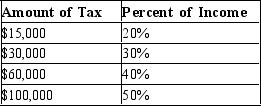 -Refer to Table 12-15. The tax system is
Table 12-10  -Refer to Table 12-10. If Jace has $33,000 in taxable income, his marginal tax rate is
 (Multiple Choice)
4.9/5 (82)
(82) Rank the following state and local government expenditure categories from smallest to largest.
(Multiple Choice)
4.8/5 (79)
(79) If a government sells debt to help meet its expenditures, then the government has a
(Multiple Choice)
4.8/5 (88)
(88) The ability-to-pay principle claims that a person should pay taxes according to
(Multiple Choice)
4.9/5 (77)
(77) Rank the following state and local government expenditure categories from largest to smallest.
(Multiple Choice)
4.8/5 (73)
(73) If we want to gauge how much the income tax system distorts incentives, we should use the
(Multiple Choice)
4.9/5 (74)
(74) Special tax treatment given to specific types of behavior are called
(Multiple Choice)
4.9/5 (71)
(71) Scenario 12-3
Suppose Roger and Regina receive great satisfaction from their consumption of cheesecake. Regina would be willing to purchase only one slice and would pay up to $8 for it. Roger would be willing to pay $11 for his first slice,$9 for his second slice, and $5 for his third slice. The current market price is $5 per slice.
-Refer to Scenario 12-3. Assume that the government places a $4 tax on each slice of cheesecake and that the new equilibrium price is $9. Which of the following statements is correct?
(Multiple Choice)
4.8/5 (83)
(83) According to the ability-to-pay principle, it is fair for people to pay taxes based on the amount of government services that they receive.
(True/False)
4.8/5 (82)
(82) Which tax system requires higher-income taxpayers to have lower tax rates, even though they pay a larger amount of tax when compared to lower-income taxpayers?
(Multiple Choice)
4.9/5 (87)
(87) Table 12-1  -Refer to Table 12-1. Assume that the price of a weekend ski pass is $45 and that the price reflects the actual unit cost of providing a weekend of skiing. Suppose the government imposes a tax of $12 on skiing, which raises the price of a weekend ski pass to $57. How much tax revenue is collected from these four skiers?
 (Multiple Choice)
4.8/5 (73)
(73) Which of the following programs is not included in the federal income security spending?
(Multiple Choice)
4.9/5 (78)
(78) Like spending on Social Security, the share of federal government spending on Medicare has risen substantially over time. This is most likely a result of
(Multiple Choice)
4.8/5 (77)
(77) Many people consider lump-sum taxes to be unfair to low-income taxpayers.
(True/False)
4.8/5 (82)
(82) 
Filters
- Essay(0)
- Multiple Choice(0)
- Short Answer(0)
- True False(0)
- Matching(0)