



 Chat with AI
Exam 7: Consumers, Producers, and the Efficiency of Markets

Exam 1: Ten Principles of Economics438 Questions
Exam 2: Thinking Like an Economist620 Questions
Exam 3: Interdependence and the Gains From Trade527 Questions
Exam 4: The Market Forces of Supply and Demand700 Questions
Exam 5: Elasticity and Its Application598 Questions
Exam 6: Supply, Demand, and Government Policies648 Questions
Exam 7: Consumers, Producers, and the Efficiency of Markets547 Questions
Exam 8: Application: the Costs of Taxation514 Questions
Exam 9: Application: International Trade496 Questions
Exam 10: Measuring a Nations Income522 Questions
Exam 11: Measuring the Cost of Living545 Questions
Exam 12: Production and Growth507 Questions
Exam 13: Saving, Investment, and the Financial System567 Questions
Exam 14: The Basic Tools of Finance513 Questions
Exam 15: Unemployment699 Questions
Exam 16: The Monetary System517 Questions
Exam 17: Money Growth and Inflation487 Questions
Exam 18: Open-Economy Macroeconomics: Basic Concepts522 Questions
Exam 19: A Macroeconomic Theory of the Open Economy484 Questions
Exam 20: Aggregate Demand and Aggregate Supply563 Questions
Exam 21: The Influence of Monetary and Fiscal Policy on Aggregate Demand511 Questions
Exam 22: The Short-Run Trade-Off Between Inflation and Unemployment516 Questions
Exam 23: Six Debates Over Macroeconomic Policy372 Questions
Select questions type


Refer to Table 7-12. If the sellers bid against each other for the right to sell the good to a consumer, then the producer surplus will be
(Multiple Choice)
4.7/5  (73)
(73) Figure 7-20  -Refer to Figure 7-20. For quantities greater than M, the value to the marginal buyer is
 (Multiple Choice)
4.7/5 (74)
(74) If John's willingness to pay for a good is $20 and the price of the good is $15, how much is John's consumer surplus
from purchasing the good?
(Essay)
4.8/5 (79)
(79) Refer to Figure 7-14. If the market price increases to $130 due to an increase in demand, then producer surplus is
(Multiple Choice)
4.9/5 (68)
(68) Figure 7-5 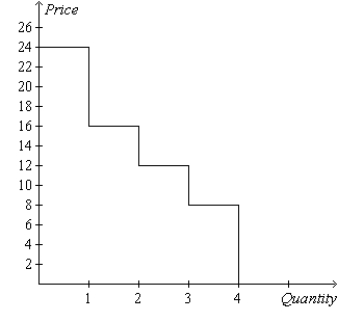 -Refer to Figure 7-5. If the price of the good is $6, then consumer surplus is
 (Multiple Choice)
5.0/5 (79)
(79) Table 7-5
For each of three potential buyers of oranges, the table displays the willingness to pay for the first three oranges of the day. Assume Allison, Bob, and Charisse are the only three buyers of oranges, and only three oranges can be supplied per day.
 -Refer to Table 7-5. Which of the following statements is correct?
 (Multiple Choice)
4.8/5 (80)
(80) Figure 7-8  -Refer to Figure 7-8. If the government imposes a price ceiling of $80 in this market, then, assuming those with the highest willingness to pay purchase the good, consumer surplus will be
 (Multiple Choice)
4.8/5 (80)
(80) A result of welfare economics is that the equilibrium price of a product is considered to be the best price because it
(Multiple Choice)
5.0/5 (76)
(76) Wendy is willing to pay $50 for a concert ticket and Bruce would like to receive $25. If the market price is $40 for this transaction, then the total surplus would be $15.
(True/False)
4.8/5 (80)
(80)  -Refer to Figure 7-15. Area A represents
Figure 7-21  -Refer to Figure 7-21. When the price is P1, area B represents
 (Multiple Choice)
5.0/5 (79)
(79) Table 7-17
 -Refer to Table 7-17. Both the demand curve and the supply curve are straight lines. If the price is $4 but only 6 units are bought and sold, consumer surplus will be
 (Multiple Choice)
4.7/5 (65)
(65) Suppose that the equilibrium price in the market for tomatoes is $3 per pound. If a law reduced the maximum legal price for tomatoes to $2 per pound,
(Multiple Choice)
4.8/5 (71)
(71) All else equal, an increase in supply will cause an increase in consumer surplus.
(True/False)
4.8/5 (76)
(76) Table 7-5
For each of three potential buyers of oranges, the table displays the willingness to pay for the first three oranges of the day. Assume Allison, Bob, and Charisse are the only three buyers of oranges, and only three oranges can be supplied per day.
-Refer to Table 7-5. If the market price of an orange is $0.40, then
-Refer to Table 7-5. If the market price of an orange is $0.40, then (Multiple Choice)
4.9/5 (76)
(76) Which of the following will cause an increase in producer surplus?
(Multiple Choice)
4.7/5 (75)
(75) 
Filters
- Essay(0)
- Multiple Choice(0)
- Short Answer(0)
- True False(0)
- Matching(0)