



 Chat with AI
Exam 7: Consumers, Producers, and the Efficiency of Markets

Exam 1: Ten Principles of Economics438 Questions
Exam 2: Thinking Like an Economist620 Questions
Exam 3: Interdependence and the Gains From Trade527 Questions
Exam 4: The Market Forces of Supply and Demand700 Questions
Exam 5: Elasticity and Its Application598 Questions
Exam 6: Supply, Demand, and Government Policies648 Questions
Exam 7: Consumers, Producers, and the Efficiency of Markets547 Questions
Exam 8: Application: the Costs of Taxation514 Questions
Exam 9: Application: International Trade496 Questions
Exam 10: Measuring a Nations Income522 Questions
Exam 11: Measuring the Cost of Living545 Questions
Exam 12: Production and Growth507 Questions
Exam 13: Saving, Investment, and the Financial System567 Questions
Exam 14: The Basic Tools of Finance513 Questions
Exam 15: Unemployment699 Questions
Exam 16: The Monetary System517 Questions
Exam 17: Money Growth and Inflation487 Questions
Exam 18: Open-Economy Macroeconomics: Basic Concepts522 Questions
Exam 19: A Macroeconomic Theory of the Open Economy484 Questions
Exam 20: Aggregate Demand and Aggregate Supply563 Questions
Exam 21: The Influence of Monetary and Fiscal Policy on Aggregate Demand511 Questions
Exam 22: The Short-Run Trade-Off Between Inflation and Unemployment516 Questions
Exam 23: Six Debates Over Macroeconomic Policy372 Questions
Select questions type


Table 7-7
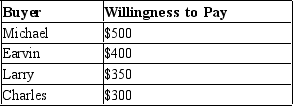 -Refer to Table 7-7. You have an extra ticket to the Midwest Regional Sweet 16 game in the men's NCAA basketball tournament. The table shows the willingness to pay of the four potential buyers in the market for a ticket to the game. You hold an auction to sell the ticket. Michael bids $410 for the ticket, and you sell him the ticket. What is his consumer surplus?
 (Multiple Choice)
4.8/5  (65)
(65) Table 7-7
-Refer to Table 7-7. You have four essentially identical extra tickets to the Midwest Regional Sweet 16 game in the men's NCAA basketball tournament. The table shows the willingness to pay of the four potential buyers in the market for a ticket to the game. You offer to sell the tickets for $325. How many tickets do you sell, and what is the total consumer surplus in the market?
-Refer to Table 7-7. You have four essentially identical extra tickets to the Midwest Regional Sweet 16 game in the men's NCAA basketball tournament. The table shows the willingness to pay of the four potential buyers in the market for a ticket to the game. You offer to sell the tickets for $325. How many tickets do you sell, and what is the total consumer surplus in the market? (Multiple Choice)
4.7/5 (91)
(91) In which of the following circumstances would a buyer be indifferent about buying a good?
(Multiple Choice)
4.8/5 (73)
(73) Many economists believe that restrictions against ticket scalping result in each of the following except
(Multiple Choice)
4.7/5 (80)
(80) Figure 7-34  -Refer to Figure 7-34. Suppose there is initially a price ceiling set at $4 in this market. How much is total producer surplus with the price ceiling in place?
 (Essay)
4.8/5 (65)
(65) The cost of production plus producer surplus is the price a seller is paid.
(True/False)
4.8/5 (84)
(84) Refer to Figure 7-12. If the equilibrium price rises from $200 to $350, what is the producer surplus to new producers
(Multiple Choice)
4.8/5 (85)
(85) Laissez-faire is a French expression which literally means
(Multiple Choice)
4.9/5 (89)
(89) A seller is willing to sell a product only if the seller receives a price that is at least as great as the
(Multiple Choice)
4.9/5 (83)
(83) If the price of oak lumber increases, what happens to consumer surplus in the market for oak cabinets?
(Multiple Choice)
4.8/5 (77)
(77) Figure 7-18  -Refer to Figure 7-18. Suppose the willingness to pay of the marginal buyer of the 3rd unit is $125. Then total surplus is maximized if
 (Multiple Choice)
4.7/5 (79)
(79) Figure 7-8  -Refer to Figure 7-8. If the government imposes a price floor of $100 in this market, then consumer surplus will decrease by
 (Multiple Choice)
4.9/5 (88)
(88) Table 7-6
For each of three potential buyers of apples, the table displays the willingness to pay for the first three apples of the day. Assume Xavier, Yadier, and Zavi are the only three buyers of apples, and only three apples can be supplied per day.
 -Refer to Table 7-6. If the market price of an apple increases from $1.40 to $1.60, then consumer surplus
 (Multiple Choice)
4.9/5 (77)
(77) At Nick's Bakery, the cost to make homemade chocolate cake is $4 per cake. As a result of selling five cakes, Nick experiences a producer surplus in the amount of $17.50. Nick must be selling his cakes for
(Multiple Choice)
4.9/5 (88)
(88) Chad is willing to pay $5.00 to get his first cup of morning latté. He buys a cup from a vendor selling latté for $3.75 per cup. Chad's consumer surplus is
(Multiple Choice)
4.8/5 (72)
(72) 
Filters
- Essay(0)
- Multiple Choice(0)
- Short Answer(0)
- True False(0)
- Matching(0)