



 Chat with AI
Exam 7: Consumers, Producers, and the Efficiency of Markets

Exam 1: Ten Principles of Economics438 Questions
Exam 2: Thinking Like an Economist620 Questions
Exam 3: Interdependence and the Gains From Trade527 Questions
Exam 4: The Market Forces of Supply and Demand700 Questions
Exam 5: Elasticity and Its Application598 Questions
Exam 6: Supply, Demand, and Government Policies648 Questions
Exam 7: Consumers, Producers, and the Efficiency of Markets547 Questions
Exam 8: Application: the Costs of Taxation514 Questions
Exam 9: Application: International Trade496 Questions
Exam 10: Measuring a Nations Income522 Questions
Exam 11: Measuring the Cost of Living545 Questions
Exam 12: Production and Growth507 Questions
Exam 13: Saving, Investment, and the Financial System567 Questions
Exam 14: The Basic Tools of Finance513 Questions
Exam 15: Unemployment699 Questions
Exam 16: The Monetary System517 Questions
Exam 17: Money Growth and Inflation487 Questions
Exam 18: Open-Economy Macroeconomics: Basic Concepts522 Questions
Exam 19: A Macroeconomic Theory of the Open Economy484 Questions
Exam 20: Aggregate Demand and Aggregate Supply563 Questions
Exam 21: The Influence of Monetary and Fiscal Policy on Aggregate Demand511 Questions
Exam 22: The Short-Run Trade-Off Between Inflation and Unemployment516 Questions
Exam 23: Six Debates Over Macroeconomic Policy372 Questions
Select questions type


Table 7-7
 -Refer to Table 7-7. You are selling extra tickets to the Midwest Regional Sweet 16 game in the men's NCAA basketball tournament. The table shows the willingness to pay of the four potential buyers in the market for a ticket to the game. Which of the following graphs represents the market demand curve?
 (Multiple Choice)
4.9/5  (86)
(86) Figure 7-13  -Refer to Figure 7-13. If the equilibrium price is $60, what is the producer surplus?
 (Multiple Choice)
4.9/5 (77)
(77) Producing a soccer ball costs Jake $5. He sells it to Darby for $35. Darby values the soccer ball at $50. For this transaction, the total surplus in the market is $40.
(True/False)
4.8/5 (96)
(96) Given the following two equations:
1) Total Surplus = Consumer Surplus + Producer Surplus
2) Total Surplus = Value to Buyers - Cost to Sellers
Show how equation 1) can be used to derive equation 2).
(Essay)
4.9/5 (74)
(74) Efficiency refers to whether a market outcome is fair, while equality refers to whether the maximum amount of output was produced from a given number of inputs.
(True/False)
4.9/5 (69)
(69) Figure 7-16  -Refer to Figure 7-16. If the price of the good is $300, then producer surplus amounts to
 (Multiple Choice)
4.7/5 (76)
(76) Chad is willing to pay $5.00 to get his first cup of morning latté; he is willing to pay $4.50 for a second cup. He buys his first cup from a vendor selling latté for $3.75 per cup. He returns to that vendor later in the morning to find that the vendor has increased her price to $3.90 per cup. Chad buys a second cup. Which of the following statements is correct?
(Multiple Choice)
4.7/5 (79)
(79) The equilibrium of supply and demand in a market maximizes the total benefits to buyers and sellers of participating in that market.
(True/False)
5.0/5 (80)
(80) Economists say that a market where goods are not consumed by those valuing the goods most highly is
(Multiple Choice)
4.9/5 (92)
(92) Scenario 7-2
Suppose market demand and market supply are given by the equations:  -Refer to Scenario 7-2. How much is total producer surplus at the equilibrium price in this market?
 (Essay)
4.8/5 (78)
(78) Table 7-11
The following table represents the costs of five possible sellers.
-Refer to Table 7-11. If the market price is $1,400, the combined total cost of all participating sellers is
(Multiple Choice)
4.8/5 (83)
(83) You are offered a free ticket to see the Chicago Cubs play the Chicago White Sox at Wrigley Field. Assume the ticket has no resale value. Willie Nelson is performing on the same night, and his concert is your next-best alternative activity. Tickets to see Willie Nelson cost $40. On any given day, you would be willing to pay up to $50 to see and hear Willie Nelson perform. Assume there are no other costs of seeing either event. Based on this information, at a minimum, how much would you have to value seeing the Cubs play the White Sox to accept the ticket and go to the game?
(Multiple Choice)
5.0/5 (89)
(89) Figure 7-34  -Refer to Figure 7-34. Suppose there is initially a price floor set at $10 in this market. If the government removed the price floor, by how much would total producer surplus change, assuming the producers with the lowest cost were the ones supplying the market when the price floor was in place?
 (Essay)
4.9/5 (87)
(87) The current policy on kidney donation effectively sets a price ceiling of zero.
(True/False)
4.8/5 (72)
(72) Figure 7-10  -Refer to Figure 7-10. When the price rises from P1 to P2, which area represents the increase in producer surplus to existing producers?
 (Multiple Choice)
4.9/5 (83)
(83) One of the basic principles of economics is that markets are usually a good way to organize economic activity. This principle is explained by the study of
(Multiple Choice)
5.0/5 (78)
(78) Another way to think of the marginal seller is the seller who
(Multiple Choice)
4.8/5 (81)
(81) Figure 7-25 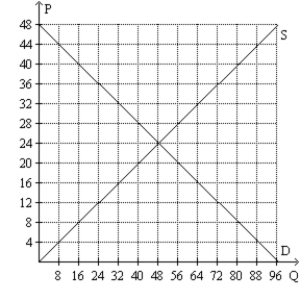 -Refer to Figure 7-25. Suppose the government imposes a price ceiling of $16 in this market. If the buyers with the highest willingness to pay purchase the good, then total surplus will be
 (Multiple Choice)
4.8/5 (83)
(83) 
Filters
- Essay(0)
- Multiple Choice(0)
- Short Answer(0)
- True False(0)
- Matching(0)