



 Chat with AI
Exam 7: Consumers, Producers, and the Efficiency of Markets

Exam 1: Ten Principles of Economics438 Questions
Exam 2: Thinking Like an Economist620 Questions
Exam 3: Interdependence and the Gains From Trade527 Questions
Exam 4: The Market Forces of Supply and Demand700 Questions
Exam 5: Elasticity and Its Application598 Questions
Exam 6: Supply, Demand, and Government Policies648 Questions
Exam 7: Consumers, Producers, and the Efficiency of Markets547 Questions
Exam 8: Application: the Costs of Taxation514 Questions
Exam 9: Application: International Trade496 Questions
Exam 10: Measuring a Nations Income522 Questions
Exam 11: Measuring the Cost of Living545 Questions
Exam 12: Production and Growth507 Questions
Exam 13: Saving, Investment, and the Financial System567 Questions
Exam 14: The Basic Tools of Finance513 Questions
Exam 15: Unemployment699 Questions
Exam 16: The Monetary System517 Questions
Exam 17: Money Growth and Inflation487 Questions
Exam 18: Open-Economy Macroeconomics: Basic Concepts522 Questions
Exam 19: A Macroeconomic Theory of the Open Economy484 Questions
Exam 20: Aggregate Demand and Aggregate Supply563 Questions
Exam 21: The Influence of Monetary and Fiscal Policy on Aggregate Demand511 Questions
Exam 22: The Short-Run Trade-Off Between Inflation and Unemployment516 Questions
Exam 23: Six Debates Over Macroeconomic Policy372 Questions
Select questions type


Suppose there is an early freeze in California that reduces the size of the lemon crop. What happens to consumer surplus in the market for lemons?
(Multiple Choice)
4.8/5  (75)
(75) Table 7-18
The following table shows the willingness to pay for a good for the only four consumers in a market.
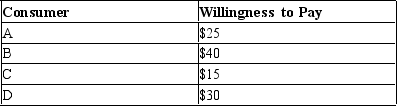 -Refer to Table 7-18. If the price of the good is $20, how much is the total consumer surplus?
 (Essay)
4.9/5 (83)
(83) Which of the Ten Principles of Economics does welfare economics explain more fully?
(Multiple Choice)
4.8/5 (86)
(86) When a buyer's willingness to pay for a good is equal to the price of the good, the
(Multiple Choice)
4.9/5 (70)
(70) Scenario 7-2
Suppose market demand and market supply are given by the equations:  -Refer to Scenario 7-2. Suppose a reduction in input prices shifts the market supply curve to
 By how much does total consumer surplus increase as a result of this supply shift?
-Refer to Scenario 7-2. Suppose a reduction in input prices shifts the market supply curve to By how much does total consumer surplus increase as a result of this supply shift? (Essay)
4.8/5 (81)
(81) The area below the price and above the supply curve measures the producer surplus in a market.
(True/False)
4.9/5 (78)
(78) Figure 7-15  -Refer to Figure 7-15. Suppose producer surplus is larger than C but smaller than A+B+C. The price of the good must be
 (Multiple Choice)
4.9/5 (80)
(80) Figure 7-26  -Refer to Figure 7-26. At the equilibrium price, consumer surplus is
 (Multiple Choice)
4.7/5 (82)
(82) Figure 7-10  -Refer to Figure 7-10. Which area represents producer surplus when the price is P2?
 (Multiple Choice)
4.9/5 (83)
(83) Refer to Figure 7-11. If the supply curve is S and the demand curve shifts from D to D', what is the increase in producer surplus due to new producers
(Multiple Choice)
4.9/5 (69)
(69) The distinction between efficiency and equality can be described as follows:
(Multiple Choice)
4.9/5 (93)
(93) Welfare economics explains which of the following in the market for televisions?
(Multiple Choice)
4.9/5 (79)
(79) Market power and externalities are examples of market failures.
(True/False)
5.0/5 (89)
(89) Figure 7-6 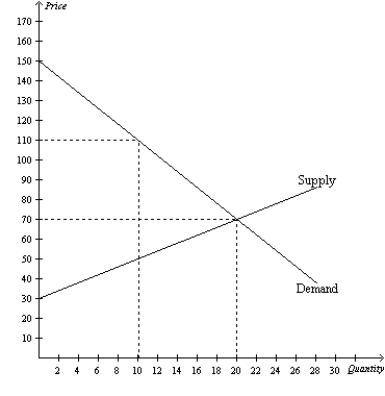 -Refer to Figure 7-6. If the government imposes a price floor of $110 in this market, then consumer surplus will decrease by
 (Multiple Choice)
4.9/5 (95)
(95) Figure 7-6
-Refer to Figure 7-6. At the equilibrium price, consumer surplus is
-Refer to Figure 7-6. At the equilibrium price, consumer surplus is (Multiple Choice)
4.9/5 (69)
(69) 
Filters
- Essay(0)
- Multiple Choice(0)
- Short Answer(0)
- True False(0)
- Matching(0)