



 Chat with AI
Exam 7: Consumers, Producers, and the Efficiency of Markets

Exam 1: Ten Principles of Economics438 Questions
Exam 2: Thinking Like an Economist620 Questions
Exam 3: Interdependence and the Gains From Trade527 Questions
Exam 4: The Market Forces of Supply and Demand700 Questions
Exam 5: Elasticity and Its Application598 Questions
Exam 6: Supply, Demand, and Government Policies648 Questions
Exam 7: Consumers, Producers, and the Efficiency of Markets547 Questions
Exam 8: Application: the Costs of Taxation514 Questions
Exam 9: Application: International Trade496 Questions
Exam 10: Measuring a Nations Income522 Questions
Exam 11: Measuring the Cost of Living545 Questions
Exam 12: Production and Growth507 Questions
Exam 13: Saving, Investment, and the Financial System567 Questions
Exam 14: The Basic Tools of Finance513 Questions
Exam 15: Unemployment699 Questions
Exam 16: The Monetary System517 Questions
Exam 17: Money Growth and Inflation487 Questions
Exam 18: Open-Economy Macroeconomics: Basic Concepts522 Questions
Exam 19: A Macroeconomic Theory of the Open Economy484 Questions
Exam 20: Aggregate Demand and Aggregate Supply563 Questions
Exam 21: The Influence of Monetary and Fiscal Policy on Aggregate Demand511 Questions
Exam 22: The Short-Run Trade-Off Between Inflation and Unemployment516 Questions
Exam 23: Six Debates Over Macroeconomic Policy372 Questions
Select questions type


Refer to Table 7-14. If the sellers bid against each other for the right to sell the good to a single consumer, then the producer surplus will be
(Multiple Choice)
4.8/5  (78)
(78) Table 7-17
 -Refer to Table 7-17. Both the demand curve and the supply curve are straight lines. If the price is $4 but only 6 units are bought and sold, total surplus will be
 (Multiple Choice)
4.9/5 (74)
(74) Suppose Lauren, Leslie and Lydia all purchase bulletin boards for their rooms for $15 each. Lauren's willingness to pay was $35, Leslie's willingness to pay was $25, and Lydia's willingness to pay was $30. Total consumer surplus for these three would be
(Multiple Choice)
4.7/5 (78)
(78) Figure 7-20  -Refer to Figure 7-20. For quantities less than M, the value to the marginal buyer is
 (Multiple Choice)
4.8/5 (94)
(94) George produces cupcakes. His production cost is $10 per dozen. He sells the cupcakes for $16 per dozen. His producer surplus per dozen cupcakes is
(Multiple Choice)
4.9/5 (63)
(63) Suppose that the equilibrium price in the market for widgets is $5. If a law increased the minimum legal price for widgets to $6,
(Multiple Choice)
4.9/5 (77)
(77) If the government imposes a binding price floor in a market, then the consumer surplus in that market will decrease.
(True/False)
4.8/5 (76)
(76) In a competitive market, sales go to those producers who are willing to supply the product at the lowest price.
(True/False)
4.9/5 (76)
(76) Table 7-4
The numbers in Table 7-1 reveal the maximum willingness to pay for a ticket to a Chicago Cubs vs. St. Louis Cardinal's baseball game at Wrigley Field.
 -Refer to Table 7-4. If you have a ticket that you sell to the group in an auction, what will be the selling price?
 (Multiple Choice)
4.8/5 (89)
(89) Table 7-16
The following table represents the costs of five possible sellers.
Seller Cost $)
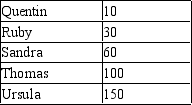 -Refer to Table 7-16. If each producer has one unit available for sale, and if the market equilibrium price is $70, how much is the combined total cost of all participating sellers in the market?
 (Multiple Choice)
4.8/5 (74)
(74) Figure 7-34  -Refer to Figure 7-34. Suppose the government imposes a price floor at $10 per unit in this market. With the price floor, how much is total producer surplus assuming those producers with the lowest cost are the ones who supply the market?
 (Essay)
4.8/5 (72)
(72) Figure 7-15  -Refer to Figure 7-15. When the price rises from P1 to P2, which area represents the increase in producer surplus due to new producers entering the market?
 (Multiple Choice)
4.9/5 (82)
(82) Table 7-10
The only four consumers in a market have the following willingness to pay for a good:
Buyer Willingness to Pay
 -Refer to Table 7-10. If there is only one unit of the good available for purchase, and if the buyers bid against each other for the right to purchase it, then the good will sell for
 (Multiple Choice)
4.9/5 (70)
(70) Abraham drinks Mountain Dew. He can buy as many cans of Mountain Dew as he wishes at a price of $0.55 per can. On a particular day, he is willing to pay $0.95 for the first can, $0.80 for the second can, $0.60 for the third can, and $0.40 for the fourth can. Assume Abraham is rational in deciding how many cans to buy. His consumer surplus is
(Multiple Choice)
4.8/5 (78)
(78) Which of the following will cause a decrease in producer surplus?
(Multiple Choice)
4.9/5 (72)
(72)  -Refer to Figure 7-22. The efficient price is
Figure 7-3  -Refer to Figure 7-3. When the price rises from P1 to P2, consumer surplus
 (Multiple Choice)
4.7/5 (79)
(79) Janine would be willing to pay $50 to see Les Misérables, but she buys a ticket for only $30. Janine values the performance at
(Multiple Choice)
4.8/5 (76)
(76) 
Filters
- Essay(0)
- Multiple Choice(0)
- Short Answer(0)
- True False(0)
- Matching(0)