



 Chat with AI
Exam 6: Supply, Demand, and Government Policies

Exam 1: Ten Principles of Economics438 Questions
Exam 2: Thinking Like an Economist620 Questions
Exam 3: Interdependence and the Gains From Trade527 Questions
Exam 4: The Market Forces of Supply and Demand700 Questions
Exam 5: Elasticity and Its Application598 Questions
Exam 6: Supply, Demand, and Government Policies648 Questions
Exam 7: Consumers, Producers, and the Efficiency of Markets547 Questions
Exam 8: Application: the Costs of Taxation514 Questions
Exam 9: Application: International Trade496 Questions
Exam 10: Measuring a Nations Income522 Questions
Exam 11: Measuring the Cost of Living545 Questions
Exam 12: Production and Growth507 Questions
Exam 13: Saving, Investment, and the Financial System567 Questions
Exam 14: The Basic Tools of Finance513 Questions
Exam 15: Unemployment699 Questions
Exam 16: The Monetary System517 Questions
Exam 17: Money Growth and Inflation487 Questions
Exam 18: Open-Economy Macroeconomics: Basic Concepts522 Questions
Exam 19: A Macroeconomic Theory of the Open Economy484 Questions
Exam 20: Aggregate Demand and Aggregate Supply563 Questions
Exam 21: The Influence of Monetary and Fiscal Policy on Aggregate Demand511 Questions
Exam 22: The Short-Run Trade-Off Between Inflation and Unemployment516 Questions
Exam 23: Six Debates Over Macroeconomic Policy372 Questions
Select questions type


Figure 6-15  -Refer to Figure 6-15. For a price ceiling to be binding in this market, it would have to be set at
 (Multiple Choice)
4.8/5  (82)
(82) Table 6-4
The following table contains the demand schedule and supply schedule for a market for a particular good. Suppose sellers of the good successfully lobby Congress to impose a price floor $3 above the equilibrium price in this market.
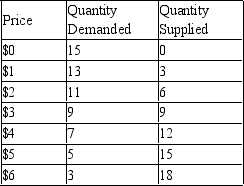 -Refer to Table 6-4. Following the imposition of a price floor $3 above the equilibrium price, irate buyers convince Congress to repeal the price floor and to impose a price ceiling $1 below the former price floor. The resulting shortage is
 (Multiple Choice)
4.8/5 (82)
(82) Figure 6-25  -Refer to Figure 6-25. As the figure is drawn, who sends the tax payment to the government?
 (Multiple Choice)
4.9/5 (92)
(92) Figure 6-14 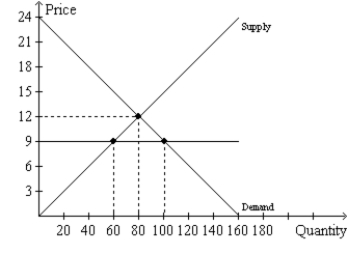 -Refer to Figure 6-14. If the horizontal line on the graph represents a price floor, then the price floor is
 (Multiple Choice)
4.9/5 (77)
(77) The demand for salt is inelastic, and the supply of salt is elastic. The demand for caviar is elastic, and the supply of caviar is inelastic. Suppose that a tax of $1 per pound is levied on the sellers of salt, and a tax of $1 per pound is levied on the buyers of caviar. We would expect that most of the burden of these taxes will fall on
(Multiple Choice)
4.9/5 (84)
(84) Figure 6-36  -Refer to Figure 6-36. If the government places a $2 tax in the market, the seller receives $6.
 (True/False)
4.9/5 (91)
(91) Which of the following is the most likely explanation for the imposition of a price ceiling on the market for milk?
(Multiple Choice)
4.7/5 (72)
(72) The mayor of Workerville proposes a local payroll tax to fund a new water park for the city. The mayor proposes to collect half the tax from workers and half the tax from firms. Workers will bear
(Multiple Choice)
4.7/5 (84)
(84) A tax on sellers usually causes buyers to pay more for the good and sellers to receive less for the good than they did before the tax was levied.
(True/False)
5.0/5 (79)
(79) Figure 6-15
-Refer to Figure 6-15. Suppose a price floor of $4 is imposed on this market. As a result,
-Refer to Figure 6-15. Suppose a price floor of $4 is imposed on this market. As a result, (Multiple Choice)
4.8/5 (80)
(80) Suppose that the demand for light bulbs is inelastic, and the supply of light bulbs is elastic. A tax of $2 per bulb levied on light bulbs will increase the price paid by buyers of light bulbs by
(Multiple Choice)
4.9/5 (72)
(72) Does a binding price ceiling result in a shortage or a surplus in the market?
(Essay)
4.9/5 (91)
(91) To say that a price ceiling is nonbinding is to say that the price ceiling
(Multiple Choice)
4.9/5 (77)
(77) Scenario 6-1
Suppose that demand in the market for good X is given by the equation  and that supply in the market for good X is given by the equation
 -Refer to Scenario 6-1. If the government set a price ceiling at $8, would there be a shortage or surplus, and how large would be the shortage/surplus?
and that supply in the market for good X is given by the equation
-Refer to Scenario 6-1. If the government set a price ceiling at $8, would there be a shortage or surplus, and how large would be the shortage/surplus? (Essay)
4.8/5 (88)
(88) Table 6-5
 -Refer to Table 6-5. Which of the following price floors would be binding in this market?
 (Multiple Choice)
4.9/5 (76)
(76) Figure 6-32  -Refer to Figure 6-32. If the government set a price floor at $55, would there be a shortage or surplus, and how large would be the shortage/surplus?
 (Essay)
4.9/5 (77)
(77)  -Refer to Figure 6-9. A price floor set at
If the government levies a $500 tax per car on sellers of cars, then the price received by sellers of cars would
(Multiple Choice)
4.8/5 (84)
(84) 
Filters
- Essay(0)
- Multiple Choice(0)
- Short Answer(0)
- True False(0)
- Matching(0)