



 Chat with AI
Exam 6: Supply, Demand, and Government Policies

Exam 1: Ten Principles of Economics438 Questions
Exam 2: Thinking Like an Economist620 Questions
Exam 3: Interdependence and the Gains From Trade527 Questions
Exam 4: The Market Forces of Supply and Demand700 Questions
Exam 5: Elasticity and Its Application598 Questions
Exam 6: Supply, Demand, and Government Policies648 Questions
Exam 7: Consumers, Producers, and the Efficiency of Markets547 Questions
Exam 8: Application: the Costs of Taxation514 Questions
Exam 9: Application: International Trade496 Questions
Exam 10: Measuring a Nations Income522 Questions
Exam 11: Measuring the Cost of Living545 Questions
Exam 12: Production and Growth507 Questions
Exam 13: Saving, Investment, and the Financial System567 Questions
Exam 14: The Basic Tools of Finance513 Questions
Exam 15: Unemployment699 Questions
Exam 16: The Monetary System517 Questions
Exam 17: Money Growth and Inflation487 Questions
Exam 18: Open-Economy Macroeconomics: Basic Concepts522 Questions
Exam 19: A Macroeconomic Theory of the Open Economy484 Questions
Exam 20: Aggregate Demand and Aggregate Supply563 Questions
Exam 21: The Influence of Monetary and Fiscal Policy on Aggregate Demand511 Questions
Exam 22: The Short-Run Trade-Off Between Inflation and Unemployment516 Questions
Exam 23: Six Debates Over Macroeconomic Policy372 Questions
Select questions type


A legal maximum on the price at which a good can be sold is called a price
(Multiple Choice)
4.8/5  (83)
(83) You receive a paycheck from your employer, and your pay stub indicates that $400 was deducted to pay the FICA Social Security/Medicare) tax. Which of the following statements is correct?
(Multiple Choice)
4.9/5 (86)
(86) When a tax is imposed on a good, the result is always a shortage of the good.
(True/False)
4.8/5 (71)
(71) Figure 6-26  -Refer to Figure 6-26. The price paid by buyers after the tax is imposed is
 (Multiple Choice)
4.8/5 (80)
(80) A binding minimum wage causes the quantity of labor demanded to exceed the quantity of labor supplied.
(True/False)
4.8/5 (76)
(76) When a tax is imposed on the sellers of a good, the supply curve shifts
(Multiple Choice)
4.9/5 (86)
(86) When OPEC raised the price of crude oil in the 1970s, it caused the United States'
(Multiple Choice)
4.8/5 (71)
(71) Suppose that the demand for picture frames is highly inelastic, and the supply of picture frames is highly elastic. A tax of $1 per frame levied on picture frames will increase the price paid by buyers of picture frames by
(Multiple Choice)
4.8/5 (87)
(87) Figure 6-34  -Refer to Figure 6-34. If the government imposes a tax of $6 per unit in this market, what price will buyers pay per unit after the tax is imposed?
 (Essay)
4.9/5 (73)
(73) Suppose sellers of liquor are required to send $5.00 to the government for every bottle of liquor they sell. Further, suppose this tax causes the price paid by buyers of liquor to rise by $3.00 per bottle. Which of the following statements is correct?
(Multiple Choice)
4.9/5 (72)
(72) States in the U.S. may mandate minimum wages above the federal level.
(True/False)
4.8/5 (85)
(85) Figure 6-12 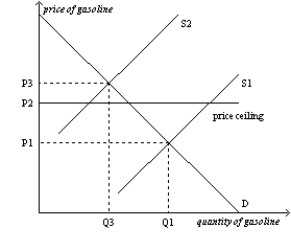 -Refer to Figure 6-12. When the price ceiling applies in this market, and the supply curve for gasoline shifts from S1 to S2, the resulting quantity of gasoline that is bought and sold is
 (Multiple Choice)
4.9/5 (87)
(87) Workers, rather than firms, bear most of the burden of the payroll tax.
(True/False)
4.8/5 (71)
(71) The burden of a luxury tax most likely falls more heavily on sellers because demand is more elastic and supply is more inelastic.
(True/False)
4.9/5 (77)
(77) 
Filters
- Essay(0)
- Multiple Choice(0)
- Short Answer(0)
- True False(0)
- Matching(0)