



 Chat with AI
Exam 6: Supply, Demand, and Government Policies

Exam 1: Ten Principles of Economics438 Questions
Exam 2: Thinking Like an Economist620 Questions
Exam 3: Interdependence and the Gains From Trade527 Questions
Exam 4: The Market Forces of Supply and Demand700 Questions
Exam 5: Elasticity and Its Application598 Questions
Exam 6: Supply, Demand, and Government Policies648 Questions
Exam 7: Consumers, Producers, and the Efficiency of Markets547 Questions
Exam 8: Application: the Costs of Taxation514 Questions
Exam 9: Application: International Trade496 Questions
Exam 10: Measuring a Nations Income522 Questions
Exam 11: Measuring the Cost of Living545 Questions
Exam 12: Production and Growth507 Questions
Exam 13: Saving, Investment, and the Financial System567 Questions
Exam 14: The Basic Tools of Finance513 Questions
Exam 15: Unemployment699 Questions
Exam 16: The Monetary System517 Questions
Exam 17: Money Growth and Inflation487 Questions
Exam 18: Open-Economy Macroeconomics: Basic Concepts522 Questions
Exam 19: A Macroeconomic Theory of the Open Economy484 Questions
Exam 20: Aggregate Demand and Aggregate Supply563 Questions
Exam 21: The Influence of Monetary and Fiscal Policy on Aggregate Demand511 Questions
Exam 22: The Short-Run Trade-Off Between Inflation and Unemployment516 Questions
Exam 23: Six Debates Over Macroeconomic Policy372 Questions
Select questions type


Rent subsidies and wage subsidies are better than price controls at helping the poor because they have no costs associated with them.
(True/False)
4.8/5  (68)
(68) Table 6-6
 -Refer to Table 6-6. If the government set a price ceiling at $2, would there be a shortage or surplus, and how large would be the shortage/surplus?
 (Essay)
4.7/5 (74)
(74) Table 6-3
The following table contains the demand schedule and supply schedule for a market for a particular good. Suppose sellers of the good successfully lobby Congress to impose a price floor $2 above the equilibrium price in this market.
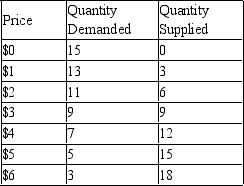 -Refer to Table 6-3. How many units of the good are sold after the imposition of the price floor?
 (Multiple Choice)
4.9/5 (82)
(82) Figure 6-31  -Refer to Figure 6-31. If the government set a price ceiling at $15, would there be a shortage or surplus, and how large would be the shortage/surplus?
 (Essay)
4.9/5 (72)
(72) If the equilibrium wage is $4 per hour and the minimum wage is $5.15 per hour, then a shortage of labor will exist.
(True/False)
4.9/5 (81)
(81) Figure 6-21  -Refer to Figure 6-21. What is the amount of the tax per unit?
 (Multiple Choice)
4.8/5 (66)
(66) When a price floor is binding, is the price floor set above or below the market equilibrium price?
(Essay)
4.8/5 (83)
(83) Figure 6-36  -Refer to Figure 6-36. If the government places a $2 tax in the market, the seller receives $4.
 (True/False)
5.0/5 (85)
(85) Suppose the government imposes a $40 tax on the buyers of refrigerators. The tax would
(Multiple Choice)
4.8/5 (82)
(82) Figure 6-3
Panel a) Panel b)

 -Refer to Figure 6-3. In panel a), there will be
 (Multiple Choice)
4.7/5 (68)
(68) The following table shows the demand and supply schedules in a particular market.
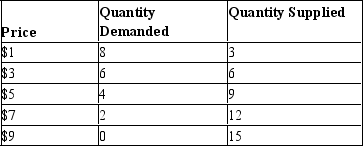 If the government sets a price floor $2 above the equilibrium price, how many units will be sold in this market?
 (Essay)
4.8/5 (82)
(82) A price ceiling is a legal minimum on the price at which a good or service can be sold.
(True/False)
4.8/5 (86)
(86) Figure 6-21
-Refer to Figure 6-21. In the after-tax equilibrium, how much revenue does the government collect from the tax on this good?
-Refer to Figure 6-21. In the after-tax equilibrium, how much revenue does the government collect from the tax on this good? (Multiple Choice)
4.8/5 (89)
(89) Figure 6-11 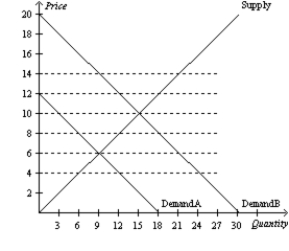 -Refer to Figure 6-11. If the government imposes a price ceiling at $6, it would be
 (Multiple Choice)
4.8/5 (78)
(78) Figure 6-22  -Refer to Figure 6-22. Suppose the same supply and demand curves apply, and a tax of the same amount per unit as shown here is imposed. Now, however, the buyers of the good, rather than the sellers, are required to pay the tax to the government. After the buyers pay the tax, relative to the case depicted in the figure, the burden on buyers will be
 (Multiple Choice)
4.8/5 (80)
(80) Figure 6-21
-Refer to Figure 6-21. The price that buyers pay after the tax is imposed is
-Refer to Figure 6-21. The price that buyers pay after the tax is imposed is (Multiple Choice)
4.7/5 (84)
(84) The term tax incidence refers to how the burden of a tax is distributed among the various people who make up the economy.
(True/False)
5.0/5 (78)
(78) The quantity sold in a market will decrease if the government
(Multiple Choice)
4.8/5 (95)
(95) 
Filters
- Essay(0)
- Multiple Choice(0)
- Short Answer(0)
- True False(0)
- Matching(0)